Bureaucracy's Rate Limiter Was Paperwork. 84 Cases Say It's Gone.
TL;DR
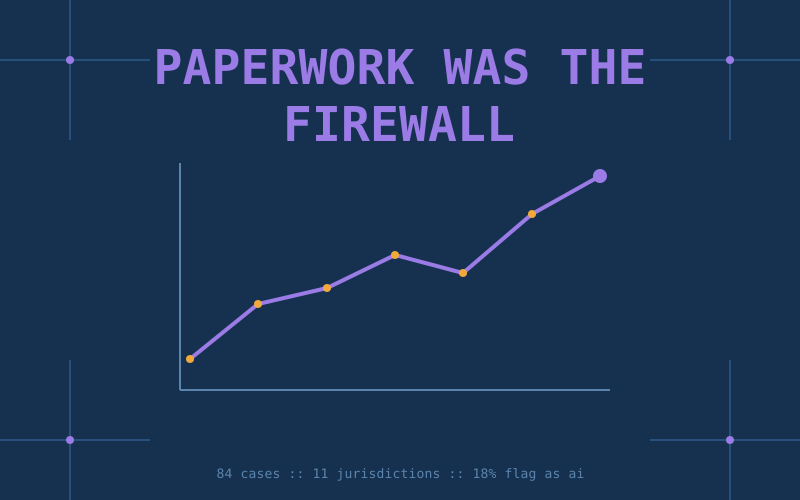
A paper headed for the 9th AAAI Conference on AI, Ethics, and Society, Characterizing Agentic Flooding of Government Services, documents 84 cases across 11 jurisdictions and 13 service domains where a surge in submissions to a government service was attributed to AI by the affected agency or a reputable outlet. In 87% of them the mechanism is the least futuristic thing imaginable: an LLM writes legally competent text, and a human still clicks submit. Independent US federal court data puts hard numbers on the same effect, with self-represented civil filings jumping from a 17-year average of 23,210 per year to 41,490 in FY2025. The part that matters if you build agents is the response: the fastest government countermeasure is friction, and friction is what will break your integration.
What the paper actually counted
The authors are Chris Schmitz (Centre for Digital Governance, Hertie School), Lewis Hammond (Cooperative AI Foundation) and Alan Chan (GovAI). Their definition of flooding is narrow on purpose: a surge in the volume or complexity of requests that both strains capacity and traces back to agents lowering the cost of submitting. It is scheduled for AIES 2026 in October.
Inclusion is strict. Every case needs a plausible mechanism, evidence of a change in demand, and an external attribution of that change to AI by either the government body itself or a credible secondary source. Of 2,288 candidate services scanned during discovery, roughly 190 per country, fewer than one in twenty survived. Attribution was the binding constraint.
What made it through: 84 cases, 11 jurisdictions, 13 domains. Justice and legal services lead at 23% (N=19), regulatory complaints at 12% (N=10), benefits and social protection at 11% (N=9). Government officials assert AI involvement in 58 cases (69%); only third parties do in the other 26.
The mechanism is boring, which is why it works
There is almost no evidence of the thing the word "agentic" makes you picture. No browser-driving swarms, no autonomous form-fillers. In 87% of cases the capability doing the damage is text generation into a free-text field that never had a length limit because nobody previously had the stamina to abuse one.
The paper is honest that this may be a sampling artifact. Cases enter the dataset because a human noticed something anomalous, and LLM prose announces itself. A structured form submitted by a script looks identical to a human's. Those submissions could already be there, invisible, showing up only as a volume number that officials are slower to blame on AI.
The typology splits into quantitative flooding (more requests) and qualitative flooding (each request is bigger). They code 60% quantitative, 90% qualitative, 50% both. Germany's social courts are the case that clarifies why the second kind hurts. At the eight social courts in North Rhine-Westphalia, provisional legal protection proceedings rose more than 55% to 7,615 in 2025, and LSG NRW president Jens Blüggel told his annual press conference the filings were arriving 20-plus pages long, verbose, and stuffed with hallucinated or irrelevant citations. His diagnosis was not that citizens are gaming the system. It is that there are too few social-law attorneys willing to take the work, so people help themselves with an LLM.
Think of a service whose only rate limiter was how hard the form was to fill out. It was a bar with no bouncer that stayed quiet because the door was down an unlit alley. AI just put it on the map with directions.
The hard numbers the paper deliberately does not claim
The flooding paper refuses causal or quantitative claims: it is diagnostic, not econometric. For actual measurement, the strongest evidence is one of its own citations. Access to Justice in the Age of AI by Anand V. Shah (MIT) and Joshua Y. Levy (USC), dated March 2026, works from administrative records on more than 4.5 million non-prisoner federal civil cases across FY2005 to FY2026, matched to 46 million PACER docket entries.
Pro se filings averaged 23,210 per year from FY2005 through FY2022, a number two decades of recessions and litigation waves failed to move. Then: 27,370 in FY2023, 31,478 in FY2024, 41,490 in FY2025. The pro se share of filings went 11.6%, 11.4%, 14.5%, 16.8% over FY2022 to FY2025.
Total civil filings rose about 31,170 cases above the pre-AI mean by FY2025, a 14.4% increase. Pro se accounted for 18,280 of them, which is 59% of all the growth, from a category an order of magnitude smaller than represented cases. Docket entries generated per court by pro se cases in their first 180 days are up 158% against pre-AI means.
The direct validation
Shah and Levy did not stop at correlation. They pulled a random sample of 1,600 complaints spanning 2019 to 2026 from CourtListener/RECAP, stripped the PDF metadata, and ran the bodies through Pangram Labs, the AI-text detector that came out best in an independent 2025 four-detector evaluation. The hit rate climbs monotonically: 1.0% in 2023, 3.5% in 2024, 10.5% in 2025, 18.0% in early 2026. The pre-2023 baseline is essentially zero, which doubles as the false-positive calibration.
The response that ships fastest is the one that breaks your agent
Governments responded in some form in 56% of the 84 cases, though the paper notes most responses are non-binding, like publishing AI-use guidance. In 14 cases (17%) they added real friction. That is the category worth watching, because friction needs no new infrastructure and can be deployed mid-surge.
The menu the paper maps, with precedent for each: reintroduce fees wherever a payment rail already exists, require digital identity verification, impose per-claimant rate caps, block bots or entire IP ranges. Australia has considered bringing back FOI fees. Japanese authorities blocked submissions to an energy-plan consultation by IP address. In the Netherlands, targeted legal reform cut off middle-man firms collecting fees on WOZ property valuation objections.
The authors' central objection is an equity one: friction screens out poorer and less digitally literate users first, which is exactly the population an accessibility-improving agent was supposed to help. Their preferred alternatives, audit service exposure now, build a digital identity strategy, establish legal certainty about AI-assisted submissions, are all slower than turning a fee back on.
They also note that CAPTCHAs stopped identifying humans a while ago, which is a polite way of saying the fast fixes have a shelf life.
The counterexample worth keeping in your pocket
The paper's inclusion criterion, an official or reputable source attributing the surge to AI, is also its softest point, because "AI did it" is a convenient thing for an overloaded agency to say. Australia is the case study. Ministers claimed a wave of AI-bot-generated FOI requests to the eSafety Commissioner, with a figure of 600 requests from a single entity over three months. Reporting by the Australian Computer Society's Information Age found eSafety's own disclosure log showed the requests came from many different real people using a plain online form. No AI bots were produced.
Both things can be true. Court dockets and social-court caseloads have detector-validated, multi-year, independently sourced evidence behind them. A press conference does not.
What this means if you build agents
- Institutional endpoints are about to grow rate limits. If your product submits to a public form, a complaints portal, a records request, or a filing system, assume fees, identity verification, and IP-range blocks land inside your product's lifetime. Design for a human-in-the-loop identity step now, not after your traffic gets classified as a flood.
- Volume is not the whole exposure, length is. Ninety percent of cases are qualitative. If your agent turns a two-page complaint into twenty, you are consuming someone's processing budget even at one submission per user.
- The risk factors are legible today. The paper's matrix says the exposed services are the financially attractive ones whose resilience came from friction rather than design: tax objections, court claims, benefits appeals. If your integration target fits that profile, it is on the list.
Caveats, stated plainly
This is a characterization paper, not a measurement. It supports no causal or quantitative claim about how much AI is driving demand, and because it requires public attribution it almost certainly undercounts. Some of the volume series in its own Figure 1 start rising before ChatGPT shipped.
Two other things. The dataset repository the paper cites, github.com/CLSchmitz/flooding-dataset, returns a 404 as of publication, so the case-level data is not independently checkable yet. And the pipeline that found the 84 cases was itself an LLM workflow: Gemini 3.1 Pro Preview for discovery and review, Gemini 3.1 Flash Lite for iteration, temperature 0, web search grounding on, with human review before finalization. Total token cost, roughly $200. The definitive study of AI overwhelming institutions cost less than a decent office chair and was assembled by the technology in question.
Key Takeaways
- 84 documented cases across 11 jurisdictions and 13 domains where a government service saw an AI-attributed surge, from 2,288 candidates scanned. Justice and legal services are 23% of them.
- 87% of cases run on plain LLM text generation, not autonomous agents. The scary capability is a free-text field with no length limit.
- US federal pro se filings went from a 23,210 per-year average to 41,490 in FY2025, and 59% of all civil filing growth over the pre-AI mean is self-represented cases.
- AI-flagged complaints climbed 1.0% to 18.0% between 2023 and early 2026 in a 1,600-complaint random sample scored by Pangram.
- Friction is the fastest government response and the worst one: fees, ID verification, rate caps, and IP blocks deter the exact users an accessibility agent was built for.
- Build for identity, not anonymity. Any agent submitting into public infrastructure should assume verification requirements arrive before its next major version.
Sources: Characterizing Agentic Flooding of Government Services (arXiv 2608.16603), Shah and Levy, Access to Justice in the Age of AI, Legal Tribune Online on LSG NRW, ACS Information Age on Australia's FOI claims, AIES 2026, Pangram Labs