Character.AI Files for Chapter 11 as Disney Takes 66 of 86 Staff and Bids $20M for Its IP
TL;DR
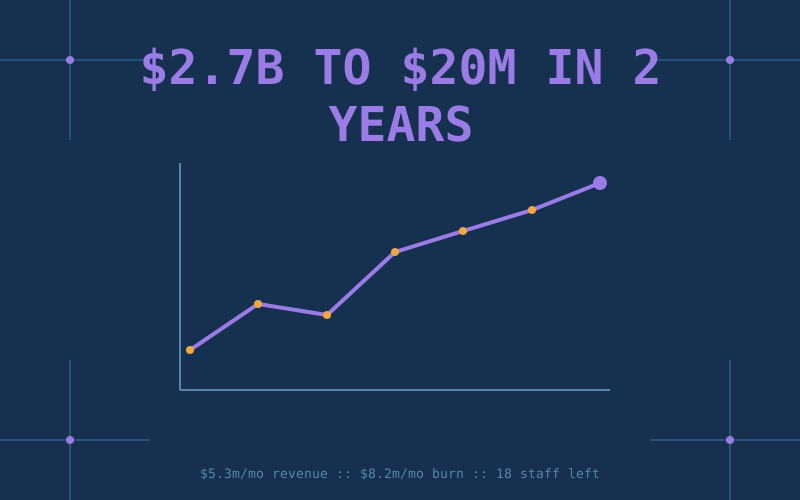
Character.AI filed a voluntary Chapter 11 petition in the District of Delaware on October 12 and told users the platform will be wound down if the court-supervised sale does not produce a buyer willing to keep it running. Disney, which hired the company's CEO and most of its engineers in September, is the stalking-horse bidder at $20 million. What Disney is buying is a non-exclusive, perpetual license to the code and nine patent entries. It is not buying the app, the user data, or the trained models. The first-day declaration filed by current CEO Colin Adams, as read by PPC Land and 404 Media, shows why: revenue peaked at about $5.3 million a month while the company burned $8.2 million a month in August, and a year of shopping the company to 28 potential buyers produced one offer nobody could use.
What actually got filed
The debtor is Character Technologies, Inc., case 26-11603 before Judge Brendan Linehan Shannon, with Stretto as claims agent. The petition checks the $50 million to $100 million box for both estimated assets and estimated liabilities. Wilson Sonsini is proposed counsel and Houlihan Lokey is the banker, hired in September after the previous banker's year-long engagement ended without a deal.
Disney Worldwide Services signed an exclusivity agreement, a binding term sheet and a transition services agreement on September 18, the same day Disney announced Karandeep Anand as its first chief technology officer. According to the bidding procedures motion as reported by PPC Land, Disney has already paid $7.5 million of the $20 million, $5.5 million of it non-refundable, with $12.5 million due at closing. Its bid protections top out at $700,000, so a rival has to open at $21.7 million in cash with a 10% deposit and no financing or diligence conditions.
The license itself covers code, documentation and tooling in 25 named areas, including post-training and reward models, the inference and serving stack, the safety and age-assurance systems, and four issued US patents plus pending applications. Explicitly excluded: the Character.AI brand, domains and apps, all end-user data and chat logs, the training data, and the finished models. Character.AI keeps ownership of everything and can license the same code to anyone else. Disney gets 30 days of access to the GitHub and Google Drive repositories, delivered as-is with no warranty.
The numbers in the declaration
The Adams declaration is the first time Character.AI's actual economics have been on the record, and they explain the one-bid auction. Both PPC Land and 404 Media read the same document and report the same figures.
- Revenue: total revenue from all sources peaked at about $5.3 million a month. Subscriptions peaked at about $2.8 million a month and at times fell below $1 million. In-app advertising launched in mid-2025 at roughly $0.5 million in its first full month and reached about $2.5 million in August 2026.
- Costs: operating expenses in August 2026 were about $13.3 million, excluding legal fees, down from an average of $21.9 million a month in the second half of 2024. Compute alone ran about $13.8 million a month in 2024 and about $10 million a month in 2025. From January through August 2026 the company spent $56.1 million on compute, about 45% of operating expenses, and $19.7 million on salaries and benefits.
- Burn: net cash burn was $8.2 million in August 2026, which the declaration frames as a major improvement. Unrestricted cash at the petition date was about $57.4 million with no funded debt. The declaration's phrase for the situation is "a classic 'melting ice cube' scenario."
- Users: the declaration describes approximately 12 million monthly active users spending about 120 minutes a day, per PPC Land's reading. A separate notice motion counts about 163 million current and past accounts. TechCrunch notes the company claimed 20 million monthly actives in October 2024, before it restricted open-ended chat for under-18s in October 2025.
Think of it as a cinema where every seat is full two hours a day, tickets are a few cents, and the projector bulb is the single biggest line item. More viewers means more bulb. Character.AI's own fix list in the declaration reads the same way: move inference to cheaper GPU capacity, add ads, add in-app purchases, cut headcount. Ads did grow fivefold in thirteen months. The gap was still $8 million a month.
Acquihired twice
This is the second time the company has been emptied out from above. In August 2024, Google paid a reported $2.7 billion for a non-exclusive license to Character.AI's models and rehired co-founders Noam Shazeer and Daniel De Freitas along with part of the research team, a figure The Wall Street Journal reported and Google never confirmed. Shazeer, who co-authored the Transformer paper, has since left Google again for OpenAI in June 2026. General counsel Dominic Perella ran the company until Anand, a former Brex and Meta executive, took over in June 2025 and pushed into video feeds and microdramas.
Round two looks like round one with a smaller cheque to the company and a bigger one to the people. The wage motion, as read by PPC Land, says Character.AI had 86 full-time employees at the end of September. Sixty-six had accepted offers from Disney, 56 had formally resigned, and 10 more on H-1B, TN or F-1 visas were expected to follow once their immigration paperwork cleared. Eighteen remained on the petition date, about six of them in trust and safety. The term sheet filed as an exhibit estimates Disney will spend about $180 million over three years on compensation and retention for the roughly 65 hires, including a $30 million retention pool. That is nine times what the bankrupt estate gets.
The transition services agreement is how the two sides square that. Disney's new employees, the old Character.AI engineers, keep the platform running at no fee, capped at 20% of each person's week, until February 18, 2027 at the latest. If a rival bidder wins, that bidder may interview and hire those same people, and Disney can withhold up to 20% of them. Disney bought the band and left the venue, then agreed to let the band play weekends there for a while.
Why nobody else bid
The declaration says the prior banker approached about 28 parties, "largely strategic and financial," between August 2025 and August 2026. One proposal came back and was "ultimately not deemed to be actionable." The feedback, in the document's words, was that "the litigation and regulatory overhang on Character was too great."
A Florida mother sued in October 2024 after her 14-year-old son died by suicide following months of conversations with a bot on the platform. In January 2026 Character.AI, its founders and Google settled that case and four others in New York, Colorado and Texas on undisclosed terms. Kentucky's attorney general sued on January 8, 2026. Pennsylvania sued on May 1, 2026 over a bot that presented itself as a licensed psychiatrist. Both states appear on the creditor list. Disney itself sent a cease-and-desist on September 30, 2025 over unauthorized Star Wars, Marvel and Pixar bots, as Engadget reported from Axios, which the company honored by pulling the characters. A year later Disney is the only bidder.
The top unsecured creditors tell the compute story again: Google at $4.15 million in trade payables, DigitalOcean at $1.95 million, and Fireworks.ai at $813,900, marked disputed.
What happens to 163 million accounts
The company's position in the notice motion is that none of those users are creditors, so none will be mailed anything. Notice goes on the Stretto site and the blog. Subscriptions keep billing for now, and the company says it will warn subscribers before paid features change. Chats, voice recordings and uploaded media stay in the estate because the Disney license excludes them, which cuts both ways: Disney gets no rights to them, and whoever buys the platform, if anyone does, inherits them under a privacy policy that already allows disclosure in a sale. Export and delete still work in the app.
If the November 20 bid deadline passes with no qualifying offer, the stated outcome is a wind-down. Disney's transition staff would then be managing the shutdown of the product they built.
What builders should take from it
The companion-app category has had a lot of confident revenue estimates and no audited numbers. Now there is a sworn declaration. Tens of millions of people spending two hours a day produced $2.8 million a month in subscriptions at the peak. Ads quintupled in a year and still landed at $2.5 million. Compute ate 45% of spend even after moving to cheaper GPUs. If your product's engagement metric is minutes, your cost metric is tokens, and the two grow together. Pricing per message or per hour would have been uglier for growth and far better for survival.
The exit structure is the other lesson. A non-exclusive license plus a hiring spree has now taken out Character.AI twice, Google in 2024 and Disney in 2026. The Disney term sheet states that the parties expect no antitrust or other regulatory clearance. If you build a consumer AI company, assume the people are the asset and the company is the wrapper, and plan your cap table accordingly. If you build on a consumer AI platform, read its privacy policy's sale clause today.
Key Takeaways
- Character.AI filed Chapter 11 in Delaware on October 12 and will wind down the platform if the sale produces no operating buyer by the late-November auction.
- Disney's $20 million stalking-horse bid buys a non-exclusive, perpetual license to code and patents only. Users, data, brand, apps and trained models are excluded.
- The CEO's declaration puts peak revenue at $5.3 million a month against $13.3 million in August opex and an $8.2 million burn, with compute at 45% of spend.
- Sixty-six of 86 employees moved to Disney, which budgets about $180 million over three years for them, nine times its bid for the company.
- Twenty-eight potential buyers over a year yielded one unusable offer, with "litigation and regulatory overhang" the stated reason.
- Rival bids must open at $21.7 million in cash by November 20; the outside closing date for Disney is December 17.
Sources: Character.AI blog, Stretto case site (In re Character Technologies, 26-11603), PPC Land on the Adams declaration, PPC Land on the bidding procedures motion, PPC Land on the wage motion, PPC Land on the sale process, 404 Media, TechCrunch, The Verge, Disney press release, Engadget