AI Bug Hunters Filed 1,500 Critical CVEs in a Month. Now Nobody Can Triage Them.
TL;DR
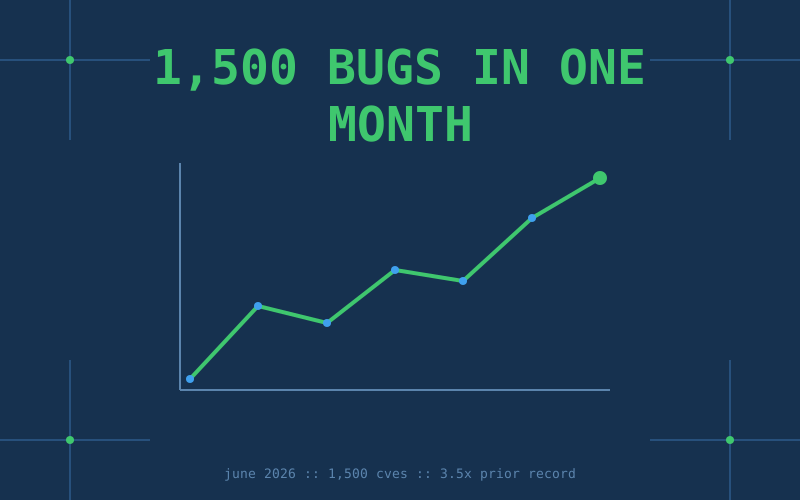
In June 2026, 21 organizations reported about 1,500 high-severity and critical CVEs, more than 3.5 times the previous monthly record, according to reporting compiled by The Decoder. The cause is not a sudden collapse in software quality. It is that AI models got genuinely good at finding real bugs that have been sitting in plain sight for years, and they do it at machine scale. The Forum of Incident Response and Security Teams (FIRST) now projects roughly 66,000 CVEs for all of 2026. The uncomfortable part for anyone who ships software: the finding was never the bottleneck. Sorting, validating, and patching the flood is, and that work still runs at human speed.
The numbers, and where they come from
The June spike is the sharpest single data point, but it sits on top of a year-long ramp. VulnCheck, one of the organizations authorized to issue CVE IDs, tracked year-to-date disclosure increases across major projects that read like a denial-of-service on the disclosure system itself: Chrome up 563%, GitHub up 476%, Mozilla's Firefox engine up 157%, with VMware and Apache close behind. These are not fringe libraries. They are the substrate half the internet runs on.
FIRST raised its full-year forecast to about 66,000 CVEs, up from a February median of 59,427, after actual disclosures ran roughly 6,420 above the projected pace through April. It pinned specific numbers to the cause: a 449% year-over-year jump in GitHub Security Advisory volume, a 164% Q1 spike from Mozilla's CVE-issuing team that it attributed directly to AI-assisted tooling run against Firefox, and a 3,119% increase in VulnCheck's last-resort disclosure activity. When a forecast gets revised up by thousands mid-year, something structural changed.
Why now: the models learned to hunt
The inflection traces to April 2026, when Anthropic disclosed that its Claude Mythos Preview could find software vulnerabilities on its own, and its internal "Glasswing" program has reportedly surfaced more than 10,000 high-severity or critical flaws, some still unpublished. It was not alone. OpenAI ran a GPT-5.5-Cyber variant against open-source projects, and Microsoft and Google pointed their own internal models at their codebases. GitHub's own analysis found the surge is broad, not a single loud actor: no single reporter accounts for more than about 3% of the volume, and no single project for more than about 7%. This is distributed adoption, the whole industry picking up the same new power tool at once.
What the models are good at is unglamorous and exactly right for the job: reading enormous amounts of code without getting bored, and pattern-matching against classes of bug (use-after-free, injection, missing bounds checks) that a tired human reviewer skims past on line 4,000. These are not exotic zero-days conjured from nothing. They are the bugs that were always there, that nobody had the patience to go find.
The reversal: finding got cheap, sorting got expensive
For twenty years the security industry organized itself around scarcity of discovery. Finding a real vulnerability took a skilled human, so the entire pipeline downstream (triage, validation, prioritization, patching) was sized for a trickle. AI just turned the trickle into a firehose while leaving the pipes the same diameter.
Think of it as a metal detector that used to beep once an afternoon and now beeps on every square foot of the beach. The detector got better, which is genuinely good news, but the person with the shovel did not get faster, and there is only one of them. The work was never the finding. It was always the digging.
What this actually means for you
If you ship anything with a dependency tree, your CVE dashboard is about to look terrifying, and most of that terror is noise. Concrete consequences:
- Your scanner will light up red. A
npm auditor a Dependabot inbox that used to surface a handful of issues a month will now surface dozens. Volume is not severity. A critical CVE in a code path your app never calls is still, to you, a false alarm with a scary CVSS score. - Reachability beats CVSS. The number that matters is not the severity rating, it is whether the vulnerable function is actually reachable from your code and exposed to untrusted input. Tools that do reachability analysis just went from nice-to-have to load-bearing.
- Maintainer burnout is the real supply-chain risk. A solo open-source maintainer now gets AI-generated vulnerability reports faster than they can read them, some of them low-quality. The danger is not the bugs. It is a burned-out maintainer walking away from a package you depend on.
- Patch cadence has to go up. If your process assumed a quarterly dependency bump was fine, it no longer is. The half-life of "unpatched but nobody's looking" just collapsed, because now something is always looking.
The honest caveats
Keep two things straight, because the headline number invites panic it does not fully deserve. First, more CVEs does not mean less secure software. As one analyst put it, the surge reflects more aggressive research and better reporting, not a decline in software security itself. The bugs were already there; now they have names. In the long run, found-and-patched beats present-and-hidden.
Second, disclosed is not the same as exploited. The count of vulnerabilities that are actively exploited in the wild has not risen at anything like the 3.5x rate of disclosures. That gap is the whole game: it means most of the flood is, for any given defender, background noise you can triage down, not an emergency you must patch tonight. The failure mode to avoid is treating every red badge as a five-alarm fire, exhausting your team, and having nothing left when the one genuinely reachable, genuinely exploited bug shows up. And yes, the same models filing these reports are increasingly the ones you will use to triage them, which is either poetic or the setup for a very tired on-call rotation.
Key Takeaways
- June 2026 saw about 1,500 high-severity and critical CVEs from 21 organizations, over 3.5x the prior monthly record, driven by AI models hunting bugs at scale.
- FIRST raised its 2026 forecast to roughly 66,000 CVEs (from a 59,427 February median), citing a 449% jump in GitHub advisories and AI-attributed spikes at Mozilla and elsewhere.
- The trigger was AI models (Anthropic's Claude Mythos Preview and Glasswing program, OpenAI's GPT-5.5-Cyber, plus Microsoft and Google internal tools) getting good at finding long-dormant real bugs.
- Discovery is no longer the bottleneck; triage, validation, and prioritization are, and that work still runs at human speed.
- For builders: expect noisy scanners, prioritize by reachability over raw CVSS, raise patch cadence, and watch for maintainer burnout as the sharpest supply-chain risk.
- More disclosures is not less security, and disclosed is not exploited: actively exploited counts did not rise at the same rate, so triage down the noise instead of panicking.
Sources: The Decoder, FIRST 2026 Mid-Year Vulnerability Forecast, VulnCheck: AI-Assisted Vulnerability Discovery, GitHub Advisory Database