Google Cloud Grew 82%. Alphabet's Free Cash Flow Still Went Negative.
TL;DR
Alphabet reported Q2 2026 revenue of $119.8 billion, up 24% year over year and about $3 billion ahead of estimates, with Google Cloud up 82% to $24.8 billion and a cloud backlog of $514 billion. Then came the other half of the story: full-year capex guidance jumped to $195-205 billion from $180-190 billion, Q2 capex alone hit $44.9 billion, and free cash flow went negative $5.9 billion. Alphabet is now funding the buildout with stock sales and bonds, 2027 is guided "significantly" higher, and the stock fell about 4.9% after hours. For builders, both halves matter: the demand for AI compute is verifiably real, and even Google can no longer pay for it out of pocket.
The quarter, before the bill arrives
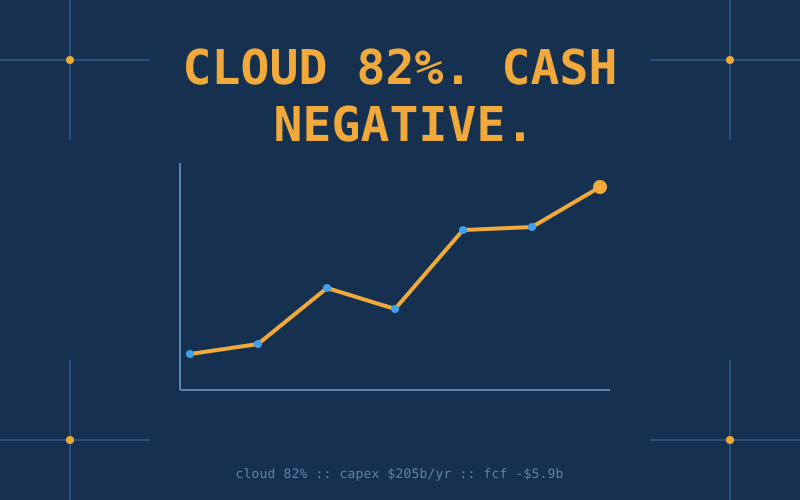
On the revenue side there is nothing to complain about. Per the Q2 numbers, total revenue of $119.8 billion beat the roughly $117 billion consensus, search and other ads grew 17%, YouTube ads grew 13%, and Google Cloud grew 82% to $24.8 billion. Cloud operating income tripled to $8.8 billion from $2.8 billion a year earlier, so the growth is arriving with margin, not despite it.
Headline profit needs an asterisk the size of a datacenter. Net income printed at $112.1 billion and EPS at $9.11 against expectations near $2.91, but that includes a $99.0 billion net gain in other income, almost all unrealized gains on equity stakes. Alphabet's venture portfolio got marked up by the same AI boom Alphabet is spending into, which is the balance-sheet equivalent of the ouroboros doing quite well for itself.
The demand side is not vibes
The most useful numbers in the release are the usage figures in Sundar Pichai's earnings remarks, because they are the demand curve the capex is chasing. Model APIs are now processing roughly 22 billion tokens per minute, up from 16 billion just last quarter. Over 9 million developers build with Google's models monthly, nearly 500 cloud customers each processed more than a trillion tokens in the past year, and more than 2,000 enterprises crossed 100 billion tokens.
The consumer side keeps pace: the Gemini app is at 950 million monthly active users with daily actives tripling over the past year, and nearly 90% of the Fortune 100 now uses Gemini Enterprise. Even the free stuff is moving at absurd scale: Gemma has passed 900 million downloads, over 300 million of them Gemma 4 since April, and Antigravity, Google's agentic development platform, is at 2.4 million weekly active users.
Then there is the $514 billion cloud backlog. Backlog is like a restaurant's reservation book: every booked table is a real commitment, but none of it is revenue yet, and you still have to build the dining room before anyone eats. That is precisely the argument Alphabet is making for the capex line: customers have already signed for years of capacity that does not exist yet, and existing customers are exceeding their commitments by more than 50%.
The bill: $205 billion, then more
Now the half that knocked the stock down. Alphabet raised full-year 2026 capex guidance to $195-205 billion, up from the $180-190 billion it guided earlier this year, citing accelerated delivery of capacity to meet demand. Q2 capex alone was $44.9 billion. And the guidance came with a kicker: "we continue to expect our CapEx to increase significantly in 2027."
For scale: the new midpoint of $200 billion a year is roughly the entire market cap of a Fortune 50 company, spent annually, mostly on chips, land, power, and cooling. Investors took the point and sent the stock down about 4.9% after hours, a familiar reflex at this point: beat the quarter, raise the capex, lose the multiple.
The line every builder should stare at
Here is the structural fact buried under the beat: Q2 free cash flow was negative $5.9 billion, because $44.9 billion of capex outran what the entire business generated in operating cash. It took two decades of competitors failing to dent Google's money printer. The GPU bill managed it in one quarter.
The gap is being financed the old-fashioned way: Alphabet raised $49.6 billion issuing stock in June and pulled in $20.3 billion from senior unsecured notes during the quarter. This is the same pattern Nikkei flagged across big tech earlier this week when it tallied $1.65 trillion in AI obligations sitting outside reported debt: the buildout has outgrown even hyperscaler cash flows, so it is increasingly paid for with paper. Alphabet is at least doing it on the balance sheet where you can see it.
What this means for you
First, capacity stays scarce. When the largest cloud vendors are pre-sold half a trillion dollars of capacity and still accelerating delivery, the spot market for serious accelerators is not loosening any time soon. If your product depends on cheap inference, the relevant trend is tokens per minute doubling roughly yearly at Google alone, and price cuts arriving only where competition forces them.
Second, the demand numbers are the strongest public evidence yet that AI usage is compounding rather than plateauing: 16 billion to 22 billion tokens per minute in one quarter is a 37% sequential jump on an already enormous base. The bear case for the buildout has to explain those tokens away, and "it is all demos" gets harder to argue when 2,000 enterprises each burned 100 billion tokens.
Third, watch the financing, not just the spend. Negative free cash flow at Alphabet is a choice, not distress, but it means the AI trade's downside now routes through credit and equity markets, not just through vendor order books. If usage growth ever stops justifying capex growth, the adjustment will be sharp, and it will hit every GPU roadmap you depend on.
The caveats
Keep the asterisks attached. The $112.1 billion net income figure is mostly unrealized equity gains and says little about operations. A single negative-FCF quarter at a company with Alphabet's cash pile and $8.8 billion of quarterly cloud operating income is not a liquidity event; it is a capital-allocation decision investors get to disagree with. The after-hours drop can reverse by Friday. Search ad revenue, per Bloomberg's read, came in slightly below street estimates even while growing 17%. And guidance is guidance: the same company moved its own capex range by $15 billion in three months, in the expensive direction.
Key Takeaways
- Alphabet's Q2 2026: revenue $119.8 billion, up 24% and ahead of estimates; Google Cloud up 82% to $24.8 billion with operating income tripling to $8.8 billion.
- Cloud backlog reached $514 billion, and model API throughput hit roughly 22 billion tokens per minute, up from 16 billion last quarter.
- Full-year 2026 capex guidance rose to $195-205 billion from $180-190 billion, with 2027 flagged to "increase significantly."
- Free cash flow went negative $5.9 billion; the gap was financed with $49.6 billion of stock issuance and $20.3 billion of bonds.
- Headline net income of $112.1 billion includes a $99.0 billion unrealized gain on equity stakes; read operations, not EPS.
- The stock fell about 4.9% after hours on the capex raise, the now-standard market response to hyperscaler earnings: good quarter, terrifying invoice.
Sources: Google (Alphabet Q2 2026 earnings remarks), Yahoo Finance (Q2 results), Yahoo Finance (capex guidance and after-hours reaction), TradingKey (capex detail), Alphabet Investor Relations