They Vibe-Coded an AI Agent in 14 Days. The Moat Was Already Built.
TL;DR
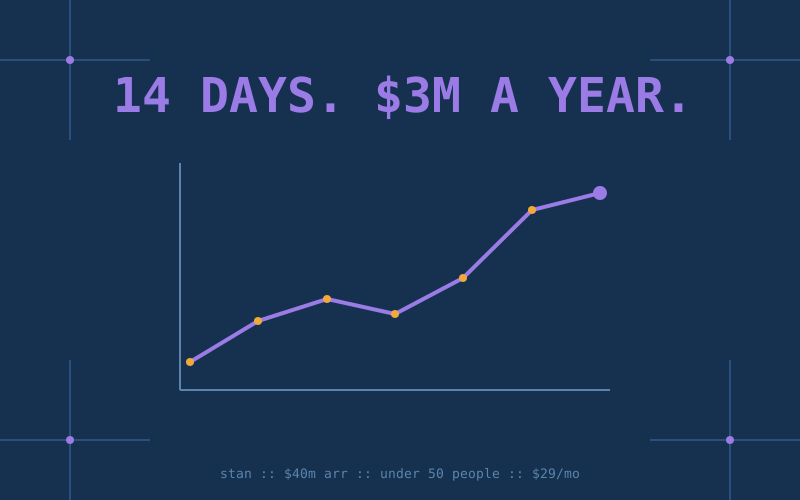
Stan, a creator storefront company, told Indie Hackers this week that it is at $40 million in annual recurring revenue with a team of under 50 people. The AI part of that story is Stanley, an "AI Head of Content" the two cofounders vibe-coded in 14 days in mid-2025. By the company's own account it reached $200,000 in ARR within six weeks of launch, $1 million by October 2025, and $3 million across two versions by July 2026. The interesting part is not the agent. It is that a two-week wrapper landed in front of more than 80,000 paying creators on day one, which is the piece nobody can vibe-code.
The numbers, and where each one comes from
Stan sells a $29-a-month storefront for creators (a link-in-bio page, digital products, courses, bookings) and takes no cut of sales. Its pricing page lists two tiers, Creator at $29 and Creator Pro at $99, and repeats the zero-transaction-fee pitch it uses against Gumroad and Linktree.
The revenue curve is unusually well documented for a private company because CEO John Hu publishes shareholder letters. The 2024 letter puts ARR at $28.3 million at the end of 2024, doubled from $14.7 million a year earlier, on a 40 percent EBITDA margin. Sacra, which tracks private SaaS, estimates roughly $35 million at the end of 2025 and $40 million by April 2026. The September 1 Indie Hackers interview with cofounder Vitalii Dodonov gives the same $40 million as $3.3 million a month.
Headcount is the founder-reported number to hold loosely: "fewer than 30 people" at $30 million ARR and "under 50" at $40 million, per Dodonov. At face value that is north of $800,000 of revenue per employee. Funding is a single $5 million seed round, per Sacra and the founders' own retellings, plus an equity stake from podcaster Steven Bartlett, who became a co-owner and board member in May 2025 according to a HubSpot profile of the company.
The company's March 2026 press release claims more than 80,000 active users and more than $500 million earned by creators through the platform since 2021. Sacra estimates average revenue per customer at about $437 a year, down from $491 in early 2024, which is what you would expect when most customers sit on the $29 tier.
Fourteen days in London
Stan's own day-by-day writeup of the Stanley build reads like a lab notebook, and the details are more useful than the headline. The cofounders decamped to London with, in their words, no idea how to build an AI agent. Dodonov "vibe coded" the prototype. By day two they had narrowed the target to LinkedIn creators with more than 2,000 followers and were scraping a user's posting history to learn their voice.
- Day 5: cold emails to big LinkedIn names, including Justin Welsh, Lara Acosta and Bartlett.
- Day 6: testers said the output felt "stiff, safe." The prompts were rewritten.
- Day 7: 100 people on an alpha waitlist.
- Day 9: they swapped the model underneath from ChatGPT to Claude and stripped out conflicting instructions.
- Day 10: first two paying customers.
- Day 13: Welsh, over dinner, said Stanley "knows me better than Claude."
- Day 14: launch. More than 500 beta applications, more than 200 paying customers, more than 2,000 comments on the launch post.
Hu's as-told-to essay for Business Insider (syndicated on Yahoo Finance) fills in what happened next: the LinkedIn version shipped in June 2025, crossed $200,000 in ARR within six weeks, and hit $1 million in October 2025. An Instagram version followed this spring, and as of July the two together bill $3 million a year. The iOS app lists a "Stanley Pro" tier at $44.99 a month with a three-day trial. Dodonov describes web pricing as "dynamic and service-driven," which is a polite way of saying it is not on a page.
The part you cannot vibe-code
Strip the AI out and the mechanism is plain. Stan had spent four years accumulating creators who already pay it monthly and already trust it with their revenue. Stanley was a new SKU sold to that list, with the launch post doing the work an ad budget would normally do. In an August 2024 writeup, seed investor Forerunner Ventures noted the company had spent nothing on paid advertising to that point.
Think of a food truck with a line around the block adding a new item to the menu. The recipe took two weeks. The line took four years, and the line is why the new item sold 200 plates on the first night.
Hu's essay boils his method down to four steps, and three of them are about distribution, not code: understand the customer deeply, fake the product by hand in early interviews before automating it (the "Wizard of Oz" test), build in public so the beta list fills itself, and use the agent to write its own personalized outreach emails. Only the last one is really an AI trick.
Dodonov's version, in the Indie Hackers interview, is blunter: the biggest threat to growth "isn't always competition or execution, but building the wrong thing really well." Stanley shipped with a narrow target (LinkedIn creators above 2,000 followers) and got wider only after it paid for itself.
Pricing tells you who the product is for
Stanley's $44.99 iOS tier is more than the $29 storefront that anchors the whole company. That is the tell: the agent is priced as labor, not software. "AI Head of Content" is a job title, and Stan is charging a slice of what a creator would pay a human to do the job, not a markup on what a model API costs. For a wrapper that switched models on day nine, that spread is the entire business.
Caveats, straight-faced
- Every operating number is founder-reported. The ARR figures come from Hu's letters and the founders' interviews. Sacra's estimates agree with them, but Sacra also leans on founder disclosures. One third-party tracker, Latka, lists Stan at $21.9 million in revenue as of September 2025 and about 171 employees, which contradicts both the letters and the "under 50" claim. We could not reconcile the two, so treat headcount as a claim, not a fact.
- Growth is slowing. Sacra pegs 2025 growth at about 24 percent, down from 93 percent in 2024 (the company's own letter says it doubled that year). The 2024 letter also admits a surge of "master resell rights" course sellers produced a temporary spike of 30,000 customers followed by a plateau.
- Stanley is a rounding error, for now. $3 million is about 7.5 percent of a $40 million business. The story is how fast it got there, not what it is.
- "$200K from one post" and "$200K within six weeks" are different claims. The build log credits the launch announcement; the essay gives a six-week window. Both are the company talking. Take the slower one.
- The app is rough. Its 4.6-star App Store rating sits on 455 ratings, and the critical reviews cite glitches and syncing errors.
Key Takeaways
- Stan reports $40 million ARR with under 50 people and a 40 percent EBITDA margin in 2024, on a $29-a-month storefront with no transaction fees. All of it is founder-reported; Sacra broadly agrees, Latka does not.
- Stanley, the AI content agent, was built in 14 days, switched from ChatGPT to Claude on day nine, and launched to more than 200 paying customers because more than 80,000 creators already paid Stan every month.
- Company-reported Stanley revenue: $200,000 ARR in six weeks, $1 million by October 2025, $3 million by July 2026 across LinkedIn and Instagram versions.
- The agent is priced as labor: $44.99 a month on iOS against the $29 storefront. The margin lives in that spread, not in the model.
- The replicable pattern is distribution first, a narrow target, a hand-faked product before automation, then a small model wrapper. The model is the least durable part, and they swapped it once already.
- Growth is decelerating and Stanley is 7.5 percent of revenue. The next shareholder letter is the number to watch.
Sources: Indie Hackers: Going all-in and hitting $30M ARR in three years (September 1, 2026), Stan: How We Built a $1M+ AI Agent in 14 Days, Business Insider via Yahoo Finance: John Hu on vibe coding Stanley (July 8, 2026), Stan's 2024 Shareholder Letter, Sacra: Stan revenue, funding and growth rate, PR Newswire: Stan launches Stanley for LinkedIn (March 17, 2026), Stan: Meet Stanley, Stan Store pricing, App Store: Stanley: AI Head of Content, Forerunner Ventures on Stan (August 2024), HubSpot Scaling Smarter: John Hu and Stan, Latka: Stan