A $49.99 Echo Dot Now Costs $79.99. AI Ate the RAM.
TL;DR
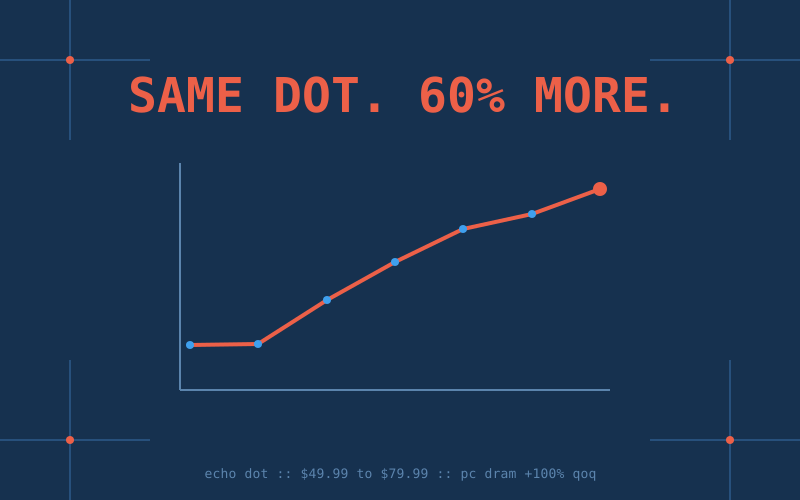
On August 21, Amazon repriced its entire device lineup overnight and gave Fortune a one-sentence reason: memory and storage components cost too much now. The base Echo Dot went from $49.99 to $79.99, a 60% jump with no change to the hardware. Fire TV, Kindle and eero moved too. That sentence is carrying an enormous amount of weight, because the thing making memory expensive is the AI buildout, and per TrendForce it has been repricing DRAM for three straight quarters. The bill has finally reached the shelf.
What actually changed
No announcement, no launch event, no new SKU. Amazon adjusted list prices across four product lines in a single night, and a reporter noticed. Here is what moved.
Amazon's full statement is unusually plain: "The consumer electronics industry is facing significant increases in memory and storage component costs. After absorbing these increases for as long as we could, we recently adjusted pricing across our product lines."
Note the tense. Amazon has been eating this for a while. An Echo Dot is a small SoC, a speaker, a microphone array and some flash, and when the flash and the DRAM double there is nowhere left in that bill of materials to hide.
Why memory, and why now
Memory makers run finite wafer capacity, and in 2026 they pointed it at whoever paid the most. High bandwidth memory and server DRAM for AI accelerators eat far more wafer area per shipped gigabyte than the commodity LPDDR going into a smart speaker, and they sell at margins commodity parts have never seen. So the fabs made those instead.
Picture a bakery that has always made wedding cakes and dinner rolls in the same ovens. Wedding cakes start paying ten times as much per oven-hour. The ovens do not get any bigger. You are still welcome to buy a dinner roll, and it now costs four dollars.
TrendForce's February forecast for the first quarter of 2026 is the moment this stopped being a supply wobble and became a repricing.
Those were forecasts, and the actuals landed at the top of the range. TrendForce's June report put first-quarter DRAM industry revenue at $97 billion, up 81% quarter over quarter, with conventional DRAM contract prices up roughly 93% to 98%. Samsung took 38.5% of that at $37.32 billion, SK hynix 28.8%, Micron 22.4%.
The detail underneath those numbers is the one that hits you. TrendForce attributes the surge to the shift from AI training to inference, which pushed data centers to buy broad RDIMM capacity rather than only specialty HBM. Training demand was largely a separate product line. Inference demand is ordinary server DRAM, made on the same lines as the DRAM in your laptop.
Raspberry Pi has been narrating this for nine months
If Amazon's overnight move felt abrupt, Raspberry Pi has been publishing the same story in installments since last year, with receipts. The 16GB Pi 5 launched at $120.
Three increases, each one its own blog post. The December 2025 post blamed "the recent unprecedented rise in the cost of LPDDR4 memory" driven by "competition from the AI infrastructure roll-out." The February post said some parts had more than doubled inside a single quarter. The April post put a number on it: a seven-fold increase over the year in the price of the LPDDR4 used on the Pi 4 and Pi 5.
One line in that April post is quietly the best procurement advice in the whole story. The Pi Zero, the Pi 3 and the older Compute Modules are not going up, because they use LPDDR2 and Raspberry Pi holds several years of inventory of a part nobody else wants. Being unfashionable turned out to be a hedging strategy.
Apple said it out loud on an earnings call
On Apple's July 30 earnings call, Tim Cook's last, the question was why Mac and iPad prices had gone up in June. The answer, per MacRumors: "We reluctantly raised prices... we're in what I would characterize as a 100-year flood on memory pricing with exponential increases in memory prices."
Three of the largest hardware buyers on the planet gave the same reason inside eight weeks. That is the difference between a company decision and a market condition.
Amazon is on both ends of this invoice
Here is the part worth sitting with. On that same July 30 date, Amazon reported AWS revenue of $42.2 billion, up 37% year over year and its fastest growth in eighteen quarters, and Andy Jassy raised the 2026 capital expenditure plan from roughly $200 billion to roughly $220 billion, citing higher memory costs. Even at $220 billion, he said, Amazon will not "have enough capacity to meet all the demand we have in 2026. And I believe this dynamic will also be true in 2027, too."
So Amazon added $20 billion to its capex because memory got expensive, then three weeks later added $30 to an Echo Dot because memory got expensive. Same invoice, arriving at both ends of the same company.
What this means if you buy hardware
- Memory is the line item that moves now. For a homelab box or an inference node, RAM and NVMe are no longer the cheap part you round up at the end of the spec. Price them first, then decide what GPU you can still afford.
- Low-capacity SKUs are the hedge. Raspberry Pi shipped a 1GB Pi 5 at $45 and a 3GB Pi 4 specifically because the memory tier is what carries the increase. The same logic applies to buying a 32GB machine now and adding sticks later, except the sticks are the expensive part.
- Do not wait for a dip. TrendForce's July note puts server DRAM up another 13% to 18% quarter over quarter in 3Q26, and projects RDIMM bit supply growing only 15% to 20% year over year into 2027, well behind server CPU shipment growth. Nobody in the supply chain is forecasting relief.
- Older generations get relatively better. DDR4 platforms, used enterprise gear and anything on a memory type the AI buildout does not want are the closest thing to a discount left in the market.
Key Takeaways
- Amazon repriced Echo, Fire TV, Kindle and eero overnight on August 21, 2026, citing "significant increases in memory and storage component costs." The base Echo Dot went from $49.99 to $79.99, up 60%.
- TrendForce forecast 1Q26 contract price increases of 100% for PC DRAM, roughly 90% for server and mobile DRAM, and 55% to 60% for NAND flash. Actual conventional DRAM contract prices came in at roughly 93% to 98% quarter over quarter.
- First-quarter DRAM industry revenue hit $97 billion, up 81% quarter over quarter, driven by inference workloads buying broad RDIMM capacity rather than only HBM.
- A 16GB Raspberry Pi 5 has gone from $120 at launch to $145, then $205, then $305, on a stated seven-fold rise in LPDDR4 pricing over a year.
- Apple raised Mac and iPad prices in June, with Tim Cook calling it "a 100-year flood on memory pricing" on his final earnings call.
- Amazon raised 2026 capex from about $200 billion to about $220 billion citing the same memory costs, and still expects to be capacity-short through 2027.
Sources: Fortune: Amazon quietly hiked prices on Echo, Fire TV, Kindle and eero, TrendForce: 1Q26 memory price outlook, TrendForce: 1Q26 DRAM industry revenue up 81% QoQ, TrendForce: server DRAM contract prices in 3Q26, Raspberry Pi: 1GB Pi 5 and memory-driven price rises, Raspberry Pi: more memory-driven price rises, Raspberry Pi: a new 3GB Pi 4 and more price increases, Raspberry Pi 5 product page, MacRumors: Tim Cook on Apple price increases, Fortune: Jassy on Amazon's $220 billion capex.