Apple Fixed the Slow Half of Local LLMs. It Costs $1,500 More.
TL;DR
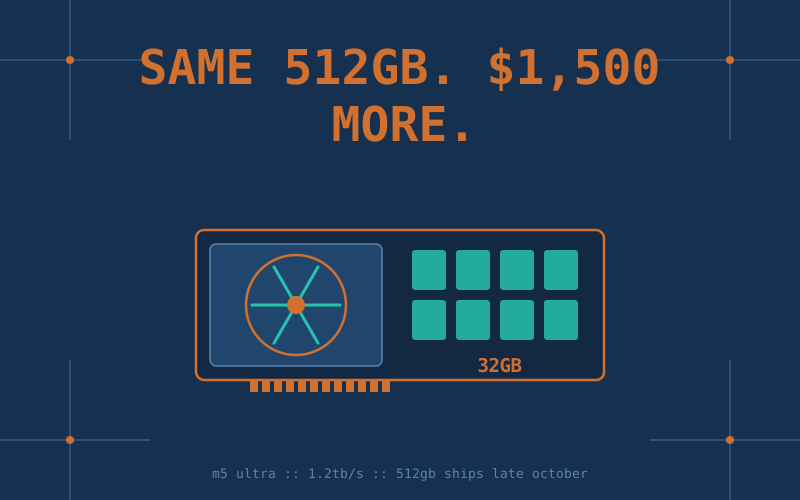
On 25 August Apple announced M6 and M5 Ultra, and the new Mac Studio is the first Apple desktop whose launch copy is largely a pitch about running large models on your own desk. The number that matters for local inference is 1.2TB/s of unified memory bandwidth, which Apple puts at 50% above M3 Ultra. The number that did not move is the memory ceiling: still 512GB, same as the 2025 machine. The entry Ultra now starts at $5,499, up from $3,999, for an identical 96GB and 1TB base configuration.
What actually shipped
Two machines, four chips. The Mac mini gets M6 (12-core CPU built on a 2nm process, 12-core GPU, up to 32GB at 170GB/s, $899) and M5 Pro (up to 64GB at 307GB/s, $1,699). The Mac Studio gets M5 Max (18-core CPU, up to a 40-core GPU, up to 128GB at 614GB/s, $2,499) and M5 Ultra (up to a 36-core CPU, up to an 80-core GPU, up to 512GB at 1.2TB/s, $5,499). Pre-orders opened 25 August, machines ship 22 September, and the 512GB Ultra configuration slips to late October.
M5 Ultra is built the way the name suggests and then some. Apple says it uses UltraFusion to "connect two dual-die M5 Max chips to form the quad-die architecture," which it calls a first for Apple silicon. M3 Ultra was two M3 Max dies. This is four dies pretending very hard to be one.
The $899 Mac mini therefore ships a newer-generation chip than the $5,499 Mac Studio. Apple's naming committee has stopped taking questions.
The part that got faster is the part Apple was bad at
Running a model locally is two jobs with opposite appetites, and Apple silicon has always been good at exactly one of them.
Prefill is chewing through your prompt. It is one enormous batch of matrix multiplies, so it is compute bound. Decode is emitting one token at a time. Each step has to stream the active weights out of memory, so it is bandwidth bound.
Prefill is reading the whole brief before you answer. Decode is then saying the answer one word at a time, fetching each word from a very large filing cabinet. Reading wants a big desk and a lot of thinking at once. Speaking wants a wide hallway to the cabinet. Apple silicon always had a spectacular hallway and a small desk, which is why a Mac could stream tokens pleasantly but made you wait through a long prompt.
M5 Ultra is Apple buying a bigger desk. Its 80-core GPU "brings Neural Accelerators to the Ultra chip for the first time," Apple's per-core matrix units, and Apple claims up to 4.3x the peak AI compute of M3 Ultra and up to 9.8x faster LLM prompt processing than M1 Ultra. On the Max side the claim is 3.9x faster AI than M4 Max.
Bandwidth still sets the hard limit on token generation, and the arithmetic is unforgiving. Divide bandwidth by the bytes a decode step has to touch. At 1.2TB/s, a step reading 20GB of active weights tops out near 60 tokens per second before any overhead at all. Nothing about Neural Accelerators changes that division. They change how long you stare at the screen before the first token appears.
Worth noting who Apple picked to make the point: the prompt-processing claims are measured in LM Studio, a third-party local-model app, cited by name in Apple's own press release. That is a small but real signal about who Apple thinks buys a $5,499 desktop.
The ceiling did not move. The price did.
512GB was already the Ultra ceiling in March 2025, when M3 Ultra shipped with "over 800GB/s" and the same "up to 512GB" configuration. If your reason for wanting an Ultra is that a 400B-parameter mixture-of-experts model does not fit anywhere else, this generation gives you nothing new. You get the same capacity, faster.
What did change is the bill. Every tier moved up several hundred dollars for the same base memory and the same base SSD.
Four boxes, three times the speed
Buried in the Mac Studio release is a claim Apple has never really made before: "A cluster of four Mac Studio systems delivers up to a remarkable 3x faster AI inference than a single system."
Read that as written. Four machines, 3x, which is 75% of linear scaling and honestly not bad for tensor or pipeline parallelism over an external interconnect. It is also Apple, in an official press release, telling you the answer to a model that does not fit is to buy more Mac Studios. Four fully loaded Ultras is a number you should probably not compute in front of your accountant.
The gotchas before you pre-order
- The 614GB/s is not the base machine. Per Apple's tech specs, the $2,499 M5 Max ships a 32-core GPU at 460GB/s. You need the 40-core GPU configuration to reach 614GB/s.
- Same for the Ultra. The $5,499 base is a 30-core CPU and 64-core GPU. The 36-core CPU and 80-core GPU that carry every headline claim are an upgrade, and 512GB is only offered on that upgraded tier.
- 512GB does not ship on 22 September. Apple lists it as late October, so the configuration the local-model crowd actually wants is the last one out the door.
- 4.3x is peak AI compute, not tokens per second. Peak matmul throughput and real decode speed are different measurements, and the second one is still governed by that bandwidth division above.
- All of these numbers are Apple's. Nobody outside Cupertino has run llama.cpp or an MLX workload on one of these yet. Wait for third-party prefill and decode numbers on a named model at a named quantization before you commit $5,499.
Key Takeaways
- M5 Ultra hits 1.2TB/s unified memory bandwidth, 50% over M3 Ultra, and is Apple's first quad-die chip, built from two dual-die M5 Max chips joined by UltraFusion.
- Neural Accelerators reach the Ultra tier for the first time, which targets prompt processing (compute bound), not token generation (bandwidth bound).
- The 512GB memory ceiling is unchanged from March 2025, so this generation buys you speed on the same capacity, not a bigger model.
- Ultra entry pricing went $3,999 to $5,499 for the same 96GB and 1TB base, with the Mac mini up $300 and the Max Mac Studio up $500 on identical base memory.
- Apple now benchmarks its desktops on LM Studio prompt processing and openly markets four-machine inference clusters at up to 3x a single system.
- Pre-orders opened 25 August and machines ship 22 September, but the 512GB Ultra configuration is late October.
Sources: Apple Newsroom: M6 and M5 Ultra, Apple Newsroom: Mac Studio with M5 Max and M5 Ultra, Apple Newsroom: Mac mini with M6 and M5 Pro, Apple Mac Studio tech specs, Apple Newsroom: M3 Ultra (2025), Apple Newsroom: M4 Mac mini (2024), 9to5Mac, MacRumors