38.5% of July's Music Had AI in It. Apple Plans to Ask Nicely.
TL;DR
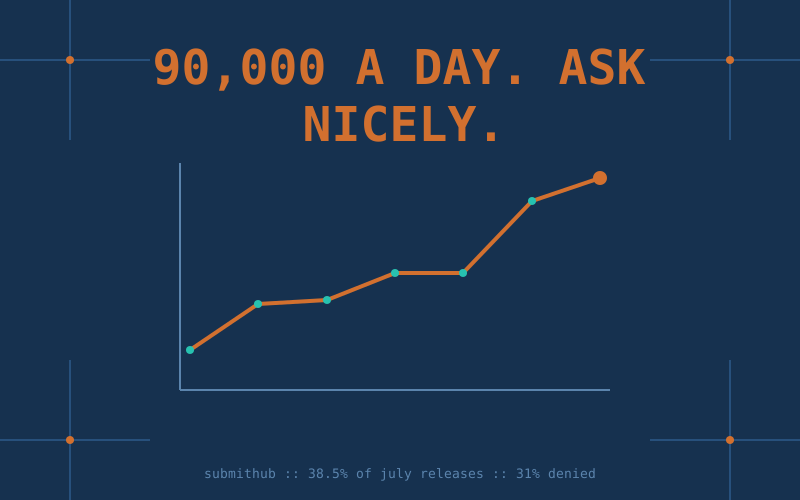
On August 20, Apple Music emailed content providers to say AI Transparency Tags are no longer optional: any track where generative AI produced a material portion must be tagged, and listeners will see a "Made With AI" label later this year. Apple runs an in-house AI detector and has decided not to make it the source of truth. Two independent datasets from the same week show the cost of that decision. SubmitHub ran its classifier over more than a million July releases and found 38.5% carried some AI involvement, while 31% of flagged artists insisted they had used none. Deezer, which detects instead of asking, says fully AI-generated tracks passed 50% of daily uploads in June, around 90,000 per day.
What Apple actually changed
In March, Apple quietly introduced AI Transparency Tags in the content delivery feed. They were optional and only partners could see them. The August 20 memo, obtained by Music Business Worldwide, flips both properties: the tags become required "in any instance where AI was used to create a material portion of the content," and the result becomes a public badge on the track.
Apple's stated reasoning is that "content providers are best positioned to know how their content was created." That is true, and it is also the problem. The party best positioned to know is the same party with the strongest reason to stay quiet.
Three things Apple did not publish: a launch date, an enforcement mechanism, and a definition of "material portion." That last omission is the one that will generate support tickets. A producer who used a stem separator, an AI mastering chain, and a generated vocal double now has to guess which of those crosses Apple's line, with no documentation and a public badge on the other side of the guess.
The disclosure gap, measured
SubmitHub, the service that pipes independent tracks to playlists and blogs, launched an AI detector called SH Labs this summer and now licenses it to Bandcamp, Traxsource, and GEMA. It pointed the classifier at more than a million July releases. The breakdown: 23.2% fully AI-generated, 15.3% AI-generated audio that a human then modified or processed, 38.5% combined.
The number that should interest anyone building a disclosure system is a different one. Of artists whose releases the detector flagged this year, 31% told the platform they had used no AI tools at all.
Read that honestly, because it cuts two ways. Either roughly a third of flagged artists are declining to disclose, or the classifier has a real false-positive rate, or some mix of the two. No AI-audio detector has published a confusion matrix over a million-track corpus, so 31% is the size of the disagreement, not proof that anyone lied. Either way it is the exact quantity Apple's policy assumes away.
"I think the path forward for AI music is disclosure. People should be able to decide for themselves whether they want to engage with AI-generated music." Jason Grishkoff, SubmitHub founder
Notice that even the person who built the detector frames disclosure as the goal. The detector exists because the disclosure does not arrive on its own.
Deezer ran the other experiment
Deezer has been running the opposite policy since January 2025: detect first, tag automatically, ask nobody. Its numbers are the best public series on this and they come from the platform itself.
- April 2026: 44% of daily uploads were fully AI-generated, roughly 75,000 tracks a day, over 2 million a month.
- June 2026: that crossed 50% for the first time, around 90,000 tracks a day.
- 2025 total: 13.4 million AI tracks detected and tagged in the first year of the system.
- Listening: all of it still accounts for only 1-3% of total streams.
That last line is the shape of the whole problem. Half of everything arriving at the door is synthetic, and almost nobody is listening to it. Deezer found that up to 85% of streams on fully AI-generated tracks were fraudulent in 2025, against about 8% fraud across the catalogue as a whole. This is not an audience, it is a mailroom being used as a money laundry.
Why this matters if you ship provenance metadata
Strip the music out and this is a generic systems problem that a lot of people are about to hit: you have a content pipeline, you need to know what a machine made, and you have to choose between asking the uploader and measuring the artifact.
Self-attestation degrades with incentive
A field the publisher fills in about themselves is a trust assumption wearing a database column. It holds while nobody gains from lying and collapses at exactly the rate the payoff grows. It is a nutrition label written by the person selling the cake, with no inspector anywhere in the building.
The failure is asymmetric, and backwards
The conscientious producer tags the track. The upload farm running 90,000 submissions a day does not, because the entire point of the operation is to look like catalogue. So a self-reported badge lands on the careful independent artist and misses the fraud it was built to surface, which is roughly the opposite of the intended outcome.
Detection is not free either
Deezer claims 99.8% accuracy and says it can name the generator behind a track, distinguishing Suno from Udio. Even at that rate, 90,000 tracks a day means roughly 180 misclassified tracks daily, each one attached to a human being who now has to appeal. The 31% disagreement in SubmitHub's data is a hint that real-world accuracy on a heterogeneous corpus is not the number on the slide.
Binary tags cannot describe the middle
SubmitHub's split is the most useful thing in the dataset: 23.2% fully generated, 15.3% generated-then-processed by a human. That second band is where a growing share of working producers now live, and it is the band a single "Made With AI" badge flattens into the same bucket as a prompt-and-upload track. Apple's undefined "material portion" is doing all the work there, and it is doing it invisibly.
What to watch
Apple has not said what happens to a distributor that mislabels, which means today the policy is a norm rather than a rule. Three things would turn it into one: a published penalty, a public cross-check of submitted tags against Apple's own detector, and money attached to the tag. Right now the badge is informational, and an informational badge costs a fraud operation nothing to ignore.
Also worth watching: whether the label lands per track or per artist. Coverage of the memo puts AI music at under 0.5% of listening on Apple Music, which is a comfortable number to publish. It is comfortable partly because nobody is counting the half of the middle band that will never get tagged.
Key Takeaways
- Apple Music made AI Transparency Tags mandatory on August 20 and will show a "Made With AI" label later in 2026, with no published launch date, enforcement mechanism, or definition of "material portion."
- Apple has an in-house AI detector and is still relying on labels and distributors to self-report, which puts the only decision point in the hands of the party least motivated to disclose.
- SubmitHub's scan of over a million July releases found 38.5% with AI involvement: 23.2% fully generated, 15.3% AI audio processed by a human.
- 31% of artists whose tracks the detector flagged said they used no AI. That is either a disclosure gap or a false-positive rate, and nobody has published the data to settle which.
- Deezer, which detects rather than asks, saw fully AI-generated tracks pass 50% of daily uploads in June 2026 at around 90,000 a day, up from 10,000 a day in early 2025, while still drawing only 1-3% of streams.
- If you are designing provenance metadata for any content pipeline, assume self-attested fields fail first under adversarial load, and budget for the appeals that classifier-based tagging generates.
Sources: Music Business Worldwide, MacRumors, DJ Mag, MusicRadar, NME, Deezer Newsroom (July 2026), Deezer Newsroom (April 2026), TechCrunch