His Subscribers Went 191 to 45. He Published the Whole Chart.
TL;DR
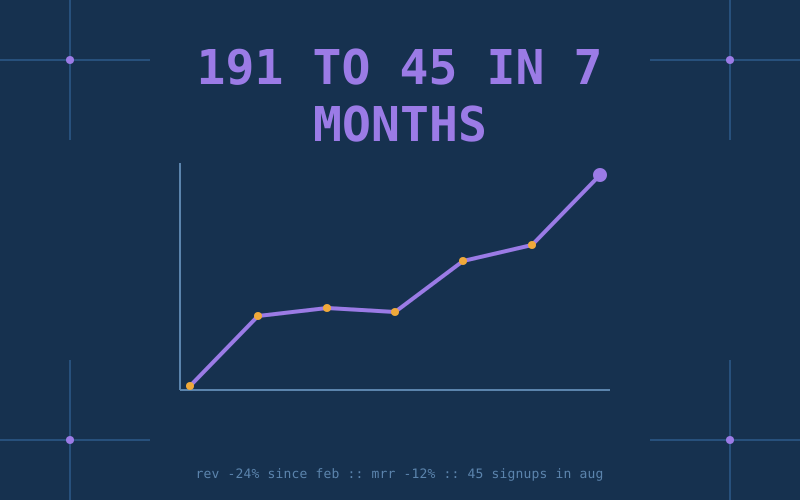
On August 28, Angus Cheng published eight months of Stripe numbers for Bank Statement Converter, the PDF-to-spreadsheet tool he has run alone since 2021, under the headline "My business is dying". New paying subscribers fell from 191 in January 2026 to 45 in August. Revenue is down 24 percent from the February peak, monthly recurring revenue down 12 percent, and MRR growth has been negative every month since April. Cancellations, by his account, held roughly steady. The bottom of the funnel is fine. The top of it evaporated. Cheng offers three possible explanations and declines to pick one, which is the most honest thing in the post.
The numbers, published in full
This is not a founder teasing a vibe. It is two tables straight out of Stripe, dropped on a company blog that has been posting revenue since 2022. Here is the acquisition side.
Note the shape. There is no cliff, no botched pricing change, no Google penalty you could point at and date. It is a smooth, monotonic slide across eight months, which is what a market leaving looks like rather than a mistake being made.
The revenue side tracks it with a lag, because subscriptions decay slower than signups.
For scale, the Hong Kong dollar is pegged near 7.8 to the US dollar, and Cheng anchors it himself: in his February 2023 numbers post he noted that HK$57,820 of MRR meant he had "exceeded $7000 USD."
Churn held. Acquisition collapsed.
This is the diagnostic detail that makes the post worth reading. Cheng writes that "the rate of cancellation is about the same," so existing customers are not fleeing to a competitor in a wave. Fewer people are arriving at all.
Compare against his own history. In January 2023 he booked 57 new subscribers and in February 2023 he booked 75, a record he was pleased about at the time. By January 2026 he was doing 191 a month. August 2026 came in at 45, which is below where he was three years and a large chunk of growth ago.
The business did not fail to grow. It grew for years, then the demand for it started going somewhere else.
Three suspects, no conviction
Cheng names three possible causes and commits to none, which is more discipline than most postmortems manage.
- He stopped building in public. No revenue graph on Twitter since September 2025. He adds a sharp reason for stopping: sharing the numbers "a lot of people started using AI to build their own bank statement converter applications." He also concedes the Twitter attention never converted well anyway.
- People are doing it in a chatbot. His framing is precise, not panicked: this "works pretty well if you only have a few pages," and he suspects a lot of users are running conversions on free chatbot tiers.
- A competitor got better. "I have a lot of competitors, because I built this application in public."
All three are downstream of the same thing, which is why he cannot separate them. A tool that writes code, a tool that converts a PDF, and a tool that summarizes your search results instead of sending you to a vendor are all the same tool now.
The measurable part
Cheng has no traffic data in the post, so his hypotheses stay hypotheses. But the demand-side shift he is describing has been measured by people who are not him.
SparkToro, using Similarweb clickstream data, found that 68.01 percent of US Google searches in January through April 2026 ended without a click, up from 60.45 percent in 2024. The Pew Research Center, tracking real browsing behavior from 900 US adults across 68,879 searches in March 2025, found users clicked a traditional result in 8 percent of visits when an AI summary was present versus 15 percent when it was not. Clicks on links inside the summary itself: 1 percent.
Neither study is about bank statements. Both describe the pipe that a search-acquired, long-tail utility SaaS depends on, narrowing by roughly a third while the thing at the other end of the pipe learned to do the job itself.
The moat is real, and almost nobody needs it
Here is the cruel part. Cheng's product is genuinely, verifiably harder than a chatbot prompt, and he documented exactly how two weeks earlier in "Why not always OCR?". There is no generic parser for bank statements, so he classifies each document and dispatches to a bank-specific one.
val documentType = classify(file);
switch (documentType) {
  "HSBC_HK_1"     -> parse_hsbc_hk1(file);
  "BARCLAYS_UK_1" -> parse_barclays_uk1(file);
  else            -> parse_generic(file)
}
Classification runs off signals that only exist in the raw PDF: a text string in an exact bounding box, an embedded image with an exact MD5, a specific sequence of vector drawing commands. He also leans on encoding order to figure out where one multi-line transaction description ends and the next begins, because in some statements the date and amount are vertically centred against a three-line description and position alone will not tell you.
A PDF stores text roughly in the order a printer would draw it, column by column. OCR flattens that into a picture and then guesses the reading order back, which is like transcribing a spreadsheet from a photograph of it: the numbers survive, the structure does not. That is before you get to language coverage, where he notes Amazon Textract handles English, German, French, Spanish, Italian and Portuguese, and not Chinese, Japanese, Arabic, Indonesian, Russian or Vietnamese.
All of that engineering matters enormously at 300 pages across a Hong Kong bank, a UK bank and a Swiss bank. It matters not at all to the person with four pages who wants a CSV before lunch. The buyer who needed the moat was always a minority of the funnel, and the majority just got a free alternative that is good enough for them.
What he did not publish
Cheng gives percentages and deltas but no absolute 2026 MRR. You can back into a rough one: the monthly changes from March through August sum to about negative HK$38,700, and if that represents the stated 12 percent decline, February MRR sat somewhere near HK$320,000, call it US$41,000 a month. Treat that as arithmetic and not as a number he stated, since August is not a finished month and his two percentages may be computed over different windows.
The other caveats are the obvious ones. This is one self-reported business in one niche, the causal story is his own speculation, and a founder who titles a post "My business is dying" is not writing a neutral document. What is not in doubt is the subscriber table, because it came out of Stripe.
What a builder should take from it
The uncomfortable read is that "AI kills SaaS" is too coarse. Nothing here says a document extraction business is dead. It says that the free tier of a general chatbot is now a credible substitute for the shallow end of a specialist product, and the shallow end is where most of the signups live. Your power users are not the ones you lose. Your trial-to-paid conversion is.
If your acquisition is search-shaped and your value is a single narrow transformation, both of your load-bearing assumptions moved this year. The distribution channel got narrower and the substitute got free. Cheng's plan, for the record, is to read Stripe's cancellation reasons for the first time, email cancelled users to ask what they switched to, and buy tram and bus advertising in Hong Kong. It is not a bad list. The first item is the one every other founder in his position should copy this week.
He is also explicitly not getting a job, on the grounds that his friends describe modern employment as "managing AI agents and reading Pull Requests." Whatever else is true, he is consistent about which side of the technology he wants to be on.
Key Takeaways
- The funnel broke at the top, not the bottom. New subscribers fell 191 to 45 across eight months while cancellation rates stayed roughly flat, which points at demand disappearing rather than customers defecting.
- Revenue lags signups. Revenue is down 24 percent and MRR only 12 percent from the February 2026 peak, because subscription bases decay slowly. If acquisition does not recover, the MRR number has further to fall.
- The founder refuses to name a cause, and he is right to. Stopping build-in-public, chatbot substitution, and a better competitor are all plausible and he has no traffic data to separate them.
- The independent data supports the demand-side story. Zero-click US Google searches hit 68.01 percent in early 2026 per SparkToro and Similarweb, and Pew measured clicks falling from 15 percent to 8 percent when an AI summary appears.
- Depth is not a defence if most buyers are shallow. Per-bank parsers keyed on image hashes and vector command sequences beat any chatbot at 300 pages, and are irrelevant to the four-page user who makes up the volume.
- Read your cancellation reasons. Cheng had been collecting them in Stripe for years and had never once looked. That is a free diagnostic sitting in most people's dashboards right now.
Sources: Bank Statement Converter, "My business is dying", Bank Statement Converter, "Why not always OCR?", Bank Statement Converter, "Week 101 - February Sales Numbers", Bank Statement Converter, "Week 97 - Revenue Numbers", SparkToro, Pew Research Center, Hacker News discussion