AI-Exposed Consulting and Legal Jobs Grew in October as Document-Prep Work Fell 17%
TL;DR
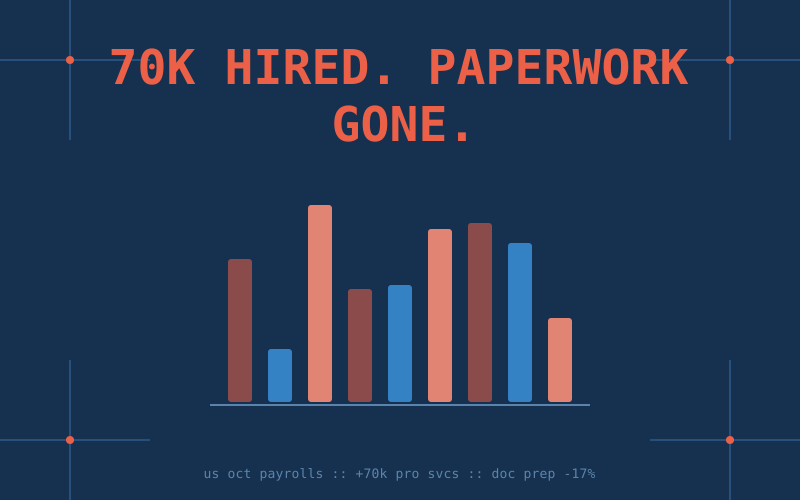
The Bureau of Labor Statistics' October Employment Situation, released November 6, counts 70,000 new jobs in professional and business services, the sector's largest one-month gain since July 2022, against an average monthly gain of 15,000 over the prior year. Management consulting added 17,300 jobs in October, legal services 2,400, accounting 2,300: three of the professions most often ranked as AI-exposed. Meanwhile document preparation services employment is down 17 percent year over year through September. Advisory headcount is growing; work shaped like paperwork is disappearing.
What the report says
Total nonfarm payrolls rose 165,000 in October and unemployment sat at 4.1 percent. Professional and business services contributed 70,000 of that: professional, scientific and technical services added 33,000, administrative and support services 28,000, management of companies 9,000. The sector has added 269,000 jobs since its recent low in October 2025. Every number in this post comes from the release and its detail table, and I recomputed the year-over-year figures from the published levels myself.
The Wall Street Journal's Ian Hodgson connected the same numbers to the AI debate on November 8. "All are industries frequently ranked as among the most exposed to AI," the paper writes of consulting, legal and accounting. Harvard economist David Deming put it harder: "I don't know how you could look at this report and conclude that we're entering anything like a white-collar job apocalypse."
Where the losses actually are
Document preparation services is a small category, 27,800 jobs as of September, and it is shrinking fast: 33,500 a year earlier, 40,100 in January 2024. That is a 17 percent drop over the year and a 31 percent drop inside three years, declining every single month on the way down. If you want one BLS series that tracks the work AI eats first, this is the cleanest one the agency publishes.
Hodgson's piece points the same direction at the task level, with pressure concentrating on call-center workers, data-entry keyers and junior copywriters. Those sub-industries sit below what the public tables break out, so I am not quoting numbers for them; the direction is the point.
The awkward number for builders
One AI-adjacent category in the table went the other way. Computer systems design and related services, the series covering most software jobs, employed 2,354,100 people in October, down 25,600 from a year earlier, a 1.1 percent decline, even with a 3,200 gain in October itself. Over the same twelve months, consulting headcount grew 2.5 percent and legal services 1.9 percent. The profession that buys AI is hiring; the profession that builds it is trimming, slightly. One point on a base of 2.35 million is a small move, but the sign deserves attention in an industry whose plans assume software headcount grows forever.
What a payroll survey cannot see
The establishment survey counts jobs, not output. It is a census of seats, not a stopwatch on the work moving through them: a consultant who now closes in a day what took a week in 2024 stays invisible in these tables until a seat disappears. Two things inside the same release hint at where the pressure hides instead. The number of people working part time for economic reasons, cut hours or no full-time work found, jumped 339,000 to 4.8 million. Average hourly earnings rose 3.1 percent over the year, which is ordinary. The Bank of England's company survey, covered here Saturday, found firms using agents report less hiring rather than more firing, and US payrolls now show the same pattern in a second dataset.
Legislating ahead of the data
Lawmakers are not waiting for the apocalypse to appear in the tables. In the Philippines, Senator Erwin Tulfo filed Senate Bill 2563 on November 8, requiring six months' notice before AI-driven layoffs and roughly double the usual separation pay. Bills like that legislate on the assumption that displacement is already happening at scale. October's numbers hand an inconvenient data point to anyone drafting on that assumption, at least in the United States.
If you build or hire
- Your buyers are hiring. Consultancies, law firms and accounting shops grew headcount all year and added aggressively in October. Growing headcount usually means growing software budgets, and the AI-leverage pitch lands better than the AI-replacement pitch with people who are recruiting.
- The compressing segment is task-shaped labor: document prep, data entry, call centers. If your product replaces exactly that work, the labor it prices against is melting even while total white-collar employment grows.
- The junior rung is where AI bites first, per the Journal's reporting. Teams that hire juniors for task-shaped work should expect fewer requisitions, and the ones that remain will demand judgment sooner.
- Do not build a layoff wave into your plans on the strength of the AI narrative. The payroll data does not contain one yet; slower hiring and a thinner entry level are what it does contain.
Caveats
- October figures are preliminary. This release revised August up 53,000 and September up 31,000, and November's release can move October too.
- Payroll counts measure jobs, not hours per person or output per hour. AI can eat tasks for years before it eats a seat, and this survey would not catch it.
- Document preparation services counts 27,800 jobs in total. Large percentage moves on small bases describe a niche, not an economy.
- The year-over-year sub-industry figures here are arithmetic I ran on BLS published levels, not growth rates BLS prints.
- "AI-exposed" rankings come from external research the Journal cites, not from BLS, and one strong month for consulting is one month.
Key Takeaways
- Professional and business services added 70,000 US jobs in October, the largest monthly gain since July 2022, against a 15,000 monthly average over the prior year.
- Consulting added 17,300 October jobs, legal 2,400 and accounting 2,300; over the full year consulting is up 45,700 jobs and legal 22,800.
- Document preparation services employment fell 17 percent year over year through September and is down 31 percent since January 2024.
- Computer systems design, the software-jobs series, is down 25,600 jobs year over year while its consulting customers kept hiring.
- Involuntary part-time work jumped 339,000 to 4.8 million in the same report, a reminder that hours may take the pressure before headcount does.
- Harvard's David Deming, via the Journal: nothing in this report looks like a white-collar job apocalypse.
Sources: BLS Employment Situation, October 2026, BLS Table B-1, BLS series CES6056141001, Wall Street Journal, Ian Hodgson, AI Weekly, Manila Times on SB 2563