Coinbase CEO Brian Armstrong Now Runs His Day Through a Chief of Staff Agent
TL;DR
Coinbase CEO Brian Armstrong says he has rebuilt his workday around a hierarchy of always-on agents. In a post on X on November 7, he described "one lead agent for each area of focus, running all the time, and a chief of staff agent that oversees them," with sub-agents that "write code, test it, chase reviews, and coordinate with team members." Everything he needs to decide on lands in one prioritized queue in a local web app, which he clears in batches, mostly by voice. The part worth copying is the queue, plus his claim that the system keeps "distilling my judgment into a 'Brian brain'." Every change still goes through the same human review and security checks.
What he actually posted
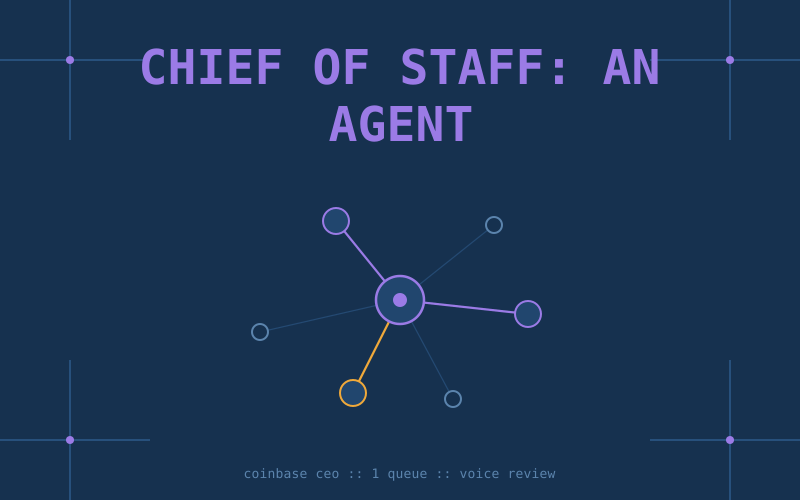
Armstrong, co-founder and CEO of the publicly traded crypto exchange Coinbase, put the breakdown on X on Saturday, November 7. The org chart he describes has three layers. At the bottom, sub-agents write code, test it, chase reviews and coordinate with team members. Above them, one lead agent per area of focus runs all the time and manages its own sub-agents. At the top, a chief of staff agent oversees the leads. The leads also "bring back ideas I hadn't considered," he wrote, which means they do some scoping on their own instead of only closing tickets. His chief of staff never sleeps and cannot quit for a rival exchange.
None of the specifics an engineer would ask for are in the post: no model names, no agent count, no stack, no cost figures. What is there is the shape of the workflow, which is more than most executives share.
The queue is the part to steal
The most copyable line in the post is the plainest one: "Everything I need to decide or review comes into one prioritized queue, a simple local web app." Product reviews arrive with screenshots and a video demo of the feature attached. He clears the queue in batches, mostly by voice and keyboard shortcuts, and says working from one queue "instead of switching between dozens of chats, has cut a lot of mental overhead."
Run more than two agents and you already know the failure mode. Each one lives in its own window, each one wants attention, and the hours the agents save get spent babysitting them. Agents are cheap now. Attention is the bottleneck, and Armstrong's fix is to make the agents queue up like everyone else.
The Brian brain
The bigger claim is about judgment. The system, he writes, "keeps learning my preferences and distilling my judgment into a 'Brian brain'," and "the goal is fewer corrections per change." A good human chief of staff does this too: after a few months they know which memo will come back marked up, and why. Armstrong is trying to get software to that point, with every approval and rejection in the queue doubling as feedback.
He did not say which models run it, how many agents exist, or where the preference data lives. At a company that holds customer funds and answers to regulators, those are the first questions anyone should ask.
Humans still sign off
Armstrong drew the line plainly: "Every change still goes through the same human review and security checks." And: "It is eliminating tasks, not human judgment." The agents write and test code; they do not ship it. By his own description this is also a personal workflow. Nothing in the post says Coinbase rolled it out to anyone else.
The trajectory
This continues a path Coinbase has been on all year. In April, The Block reported the company was testing Slack and email agents named Fred and Balaji, modeled on co-founder Fred Ehrsam and former CTO Balaji Srinivasan, and Armstrong said then he suspects Coinbase "will have more agents than human employees at some point soon." In February the company shipped Agentic Wallets so agents can hold and move funds. The same week as his post, Perplexity launched Teammates, always-on agents that own ongoing work for Max subscribers. Agent demos are cheap now; the logistics of supervising them is turning into the actual product category.
What to steal on Monday
- Build the queue before adding agents. One prioritized list, one place to look. If agents can interrupt you, they will.
- Attach proof to every item. Screenshots plus a short video demo per review means you verify the work instead of redoing it.
- Batch your decisions. Voice input and keyboard shortcuts, then close the laptop. Interleaved review is how a day disappears.
- Store every correction where the system can reuse it. Preferences that live in chat history die in chat history.
- Keep a human on the approval step for anything touching money, customers or production. Armstrong runs an exchange and still put that in writing.
Caveats
- Every claim here is self-reported by Armstrong in an X post. No agent count, no model names, no tooling details, no figures on time saved.
- His stated metric, fewer corrections per change, has no baseline and no numbers behind it yet.
- This is one CEO's personal setup; Coinbase has not announced any rollout of it.
- The post does not cover what happens when a lead agent is confidently wrong, which is the failure mode a review queue sees most.
Key Takeaways
- Coinbase CEO Brian Armstrong says he now runs his day through always-on agents: sub-agents that write and test code, one lead agent per focus area, and a chief of staff agent overseeing the leads.
- All decisions and reviews land in one prioritized queue in a local web app, with screenshots and a video demo per item, cleared in batches mostly by voice. The queue is the reusable design.
- He says the system "keeps learning my preferences and distilling my judgment into a 'Brian brain'", with the stated goal of fewer corrections per change; no numbers shared.
- Every change still goes through the same human review and security checks, which he frames as eliminating tasks rather than judgment.
- It continues Coinbase's year of agent work: the Fred and Balaji Slack agents in April, his more-agents-than-employees prediction, and Agentic Wallets in February.
- No models, stack, costs or rollout details were disclosed, so treat it as a workflow blueprint from one CEO, with the same week's Perplexity Teammates launch as the commercial echo.
Sources: Brian Armstrong on X, November 7, 2026, State of AI, Pivot News, The Block, April 20, 2026, Perplexity: Teammates