Burning Glass Institute Counts 1.5 Million Missing White-Collar Jobs as AI Slows Junior Hiring
On this page 9 sections
TL;DR
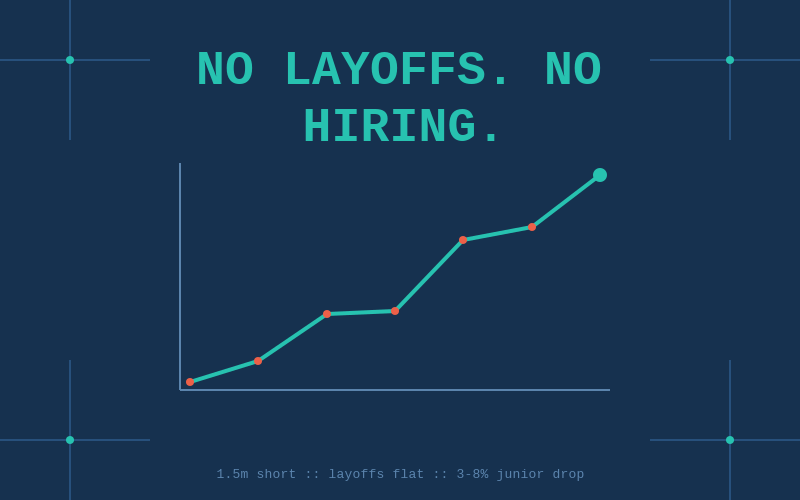
Burning Glass Institute and RAISE US, the workforce nonprofit led by former Commerce Secretary Gina Raimondo, released Fewer Rungs, New Bridges on November 23, and its central number is a quiet one. Finance, insurance, information, and professional and business services employed 31.9 million people in August 2026, about 1.5 million fewer than their 2005-2019 growth path predicts. Nobody got fired to produce that gap: layoff rates in those industries are close to normal, hiring rates sit well below pre-pandemic levels, and output kept growing. Meanwhile the occupations split by what AI does to them. Jobs AI could mostly help someone do added 1.4 million positions between May 2023 and May 2025, while jobs AI could mostly do itself shed 820,000. In the industries where AI use is most widespread, the share of postings open to beginners ran 3-8% below its own 2021-26 average in the year through June 2026.
The 1.5 million jobs that never arrived
The shortfall is a counterfactual, and the report shows its work. Take employment in those four industries from January 2005 to December 2019, extend that 1.2% yearly growth rate forward, and compare it with the 31.9 million actually employed in August 2026. The difference is about 1.5 million. Since April 2023 those industries have shed roughly 700,000 jobs while the rest of the economy added 4.4 million without a recession. No press release announces a job that was never posted, which is why this shows up as a hiring slowdown rather than a layoff wave.
The industries kept producing. From Q2 2023 to Q2 2026, real value added rose 6% in professional and business services, 11% in finance and insurance, and 29% in information, per BEA data cited in the report.
Tilt, not exposure, decides what grows
The report rates every task in an occupation on two questions: could AI do it alone, and could AI help a person do it faster or better. Exposure is the share of tasks AI can touch. Tilt is the balance between the two, and it is what separates the growers from the shrinkers: whether AI shows up holding a power drill or holding your job. Among the third of occupations most exposed to AI, employment in those tilted toward automation fell about 820,000 between May 2023 and May 2025, while those tilted toward augmentation added 1.4 million.
The report's own example is customer service representatives and software developers, similarly exposed occupations whose employment went opposite directions. In the same line of work, computer programmers declined 12.5% a year over the window while data scientists rose 16.7%. The most automation-tilted fifth of occupations kept pace with the average job in 2015-19 and have grown 2.3 percentage points a year slower since 2023. The Bureau of Labor Statistics expects the split to persist, projecting growth through 2035 for 89% of augmentation-leaning occupations against 45% of automation-leaning ones. Routine skills, the ones AI can perform on its own, fell from 34.0% of the skills employers name in postings in 2018-22 to 31.1% in 2023-25.
"The question isn't simply which jobs are exposed to AI. It's whether AI can do the work itself or help a worker do it better. That distinction is already showing up in employment trends."
Matt Sigelman, president of the Burning Glass Institute, November 23, 2026
The first rung, measured by industry
Entry level here means a posting asking for three years' experience or less. Across all US postings that share barely moved, down 0.2% against its 2021-26 average, and the 50 employers posting the most jobs raised theirs by 3.7%. The pullback concentrates where AI use is most widespread. In the four sectors BGI's adoption model scores highest, information, educational services, professional and technical services, and finance and insurance, the share of postings open to beginners in the year through June 2026 sat 3-8% below each sector's own average. Educational services fell 7.6% below baseline and information 4.6%, from 27.3% of postings to 26.1%.
The companies furthest along give a preview of where this goes. Anthropic reported in October that the junior share of its technical hires fell from 27% to 9% as agent hours came to outnumber employee hours six to one, and the junior share of technical-department headcount slipped from 21% to 14% since early 2025.
For outcomes, the report leans on a September Census Bureau working paper that follows graduates of more than 350 colleges into state earnings records. Among the most AI-exposed tenth of college majors, mostly computer science and adjacent fields, the share employed within three months of graduation fell about 5 percentage points since 2022 against graduates of the least exposed majors, and earnings two quarters after graduation fell about 13%. Unemployment for graduates aged 20-24 and 25-34 now sits at the 63rd percentile of its own record since 2003; for graduates aged 55-64 it sits at the 35th.
The bridge math
The second half of the report is about routes up. It takes 2,741 well-established step-up moves into occupations facing worker shortages, where pay does not fall and the destination leans further toward AI helping workers, and sizes each skills gap from what destination postings ask for that starting postings do not. Every missing skill gets sorted into four types. Across the moves, weighted by gap size, AI can handle 5% outright and coach a newcomer through another 26%, so a newcomer can cover 31% of the gap with AI alongside. Another 46% of the gap sits in skills where AI mainly makes people who already have them faster, and 23% is hands-on or credentialed work AI barely touches.
The variation is wide. A bank teller moving into accounting could use AI to close nearly three-quarters of the gap, a move the announcement pegs at roughly a 40% pay increase. Moves into software development or data science average about four-fifths newcomer-closable; moves into medical assisting or sales management average about a quarter. And on almost one in four of the 2,502 moves where skills can be compared, the two jobs grew more alike each year from 2023 through 2025 than in 2022. Customer service representatives and management analysts became 10.0% more alike in what their postings ask for, with problem solving and communication accounting for more than two-thirds of the rise.
Some of these bridges are already carrying traffic. Of 2,662 moves measurable on take-up, 232, about one in ten, drew a markedly growing share of the people leaving the starting occupation, and their take-up typically rose 62% against 7% for step-ups overall. Customer service to personal financial advising, fast food to event planning, and retail sales to fundraising management each more than doubled. Bank teller to financial advisor rose 81%, customer service to sales manager 79%, computer support specialist to information security analyst 43%. One honest footnote: the shift predates ChatGPT, with take-up already up 15% between 2014-16 and 2017-19, so AI may be accelerating a route that was widening on its own.
Who the bridges skip
The workers most exposed to automation are the least equipped to cross. People without a bachelor's degree hold 80% of jobs in automation-leaning occupations, against 64% of all jobs. Of the 1,431 step-up routes that start in a job typically requiring no degree, 1,202, more than four in five, lead to one that usually asks for a degree. Routes between two no-degree jobs are rare, only 229 of the 2,741, and hardest for AI to help with: hands-on and credentialed skills make up 46% of those gaps, and AI can cover 17%. About 40% of people who do cross the degree line manage it without holding one, which suggests some employers already treat "bachelor's required" as negotiable.
Read the fine print
The authors are upfront about limits, and the caveats deserve to travel with the headline. None of the data can isolate AI's effect from higher interest rates, more remote work, or the unwinding of pandemic-era hiring; the report claims alignment with AI adoption and exposure, and says where other explanations stay open. BGI's adoption estimates are modeled from Census business surveys, AI-related postings, and Ramp AI Index spending data, under a narrower definition of business AI use than the Census headline measure. The occupation employment numbers come from a pooled BLS survey the agency itself warns against reading as a time series. The 1.5 million figure is net of everything, offshoring included, and of any jobs AI created. Career-history data over-represents graduates.
What to do with this if you build or hire
- Protect the rung on purpose. The report's argument for keeping junior hiring is arithmetic: the seniors of 2035 are the juniors of 2026, in occupations already short of people. Cutting the intake is the cheap year and the expensive decade.
- Design entry work where AI coaches, not where AI does. The 31/46/23 split is a staffing tool: give beginners tasks from the 31% slice, and pair the rest with mentoring, rotations, and supervised practice.
- Recruit along the bridges that already carry traffic. Bank teller to financial advisor and computer support to information security are growing on their own. Skills-first screening helps here, since 40% of degree-line crossers moved without the credential.
- Teach and prove the shared skills. Where jobs converged, communication and collaboration did most of the converging. If you run training, make people practice these and leave evidence they can show an employer.
Key Takeaways
- White-collar industries (finance, insurance, information, professional and business services) employed 31.9 million in August 2026, about 1.5 million below their 2005-2019 trajectory, with layoffs near normal and hiring well below pace.
- Among the most AI-exposed third of occupations, augmentation-tilted jobs added 1.4 million between May 2023 and May 2025 while automation-tilted jobs lost 820,000; what separates the growers is tilt, and exposure alone explains little.
- The entry-level share of postings sits 3-8% below its own average in the four most AI-adopting sectors, including information at 27.3% down to 26.1%, while the economy-wide share barely moved at minus 0.2%.
- Anthropic's junior share of technical hires fell from 27% to 9% as agent hours outnumbered employee hours six to one; a Census paper finds the most AI-exposed majors down 5 points on initial employment and 13% on early earnings since 2022.
- Across 2,741 step-up moves, AI can help a newcomer close 31% of the skills gap, mainly speeds up people who already have the skills for 46%, and cannot reach the 23% that is hands-on or credentialed.
- The authors cannot isolate AI from interest rates, remote work, or the pandemic unwind, so the report shows strong alignment and stops short of proven cause.
Sources: RAISE US announcement, Nov 23, 2026, Fewer Rungs, New Bridges (Burning Glass Institute and RAISE US, November 2026), Semafor, Nov 23, 2026, NPR, Nov 23, 2026, Data Phoenix, Nov 23, 2026, Anthropic, How employment is changing at Anthropic, Oct 16, 2026, US Census Bureau, CES-WP-26-56, Sept 2026