Tidal Bans Fully AI-Generated Music From December 9, Deleting 29 Million Tracks
On this page 7 sections
TL;DR
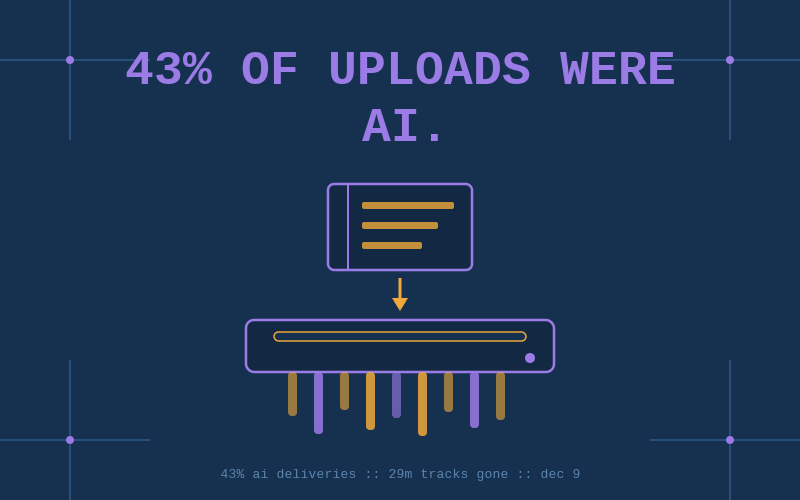
Tidal, the streamer owned by Block, announced on November 24 that it will reject and remove every track it detects as wholly AI-generated, starting December 9. It is the first big on-demand streaming service to go past labeling into an outright ban. The number behind the call: 43 percent of tracks delivered to Tidal in the past 90 days were detected as AI-generated. The purge deletes more than 29 million tracks, 6.3 percent of the catalog, by the end of the year. Music made with AI assistance keeps its place.
What the policy actually says
The operative document is Tidal's AI Policy page, updated the day of the announcement. The new sentence sits at the top in bold: "starting December 9, 2026, any wholly AI-generated track that's submitted to Tidal will be rejected and removed from our platform." Distributors are barred from delivering fully AI tracks, and TechCrunch reports that submissions whose metadata declares fully AI generation get rejected on arrival.
The word doing all the work is "wholly." Tidal defines the target as recordings wholly generated with generative AI, and it says plainly why the line sits there: "Due to limitations in AI-detection technology, and to avoid false positives, we will only be taking action with respect to wholly AI-generated recordings." The same page says actions may expand to "substantially AI-generated" recordings as detection improves, and that AI-generated compositions get no action at all. A song written by a model and recorded by humans is outside the ban.
Two details from the existing policy carry over. Wholly AI recordings already earn no royalties on Tidal, and listeners could already switch off AI-labeled recordings in settings. Wrongly flagged? There is an appeal form.
The numbers that forced the reversal
June's policy was the moderate version: label everything wholly AI and pay it nothing. Uploaders treated that as free storage. Robert Anderson, who leads Tidal Music, summed up how it went:
"A few months ago, @Tidal tagged and demonetized all wholly AI-generated tracks to protect the authenticity of real artists. But that's enough, as 43% of tracks distributed to us in the last 90 days have been detected as AI-generated. Something more drastic needs to be done…"
Robert Anderson, Tidal Music, November 24, 2026
November 6 was the worst single day, with 60 percent of new uploads detected as AI, per the announcement Ars Technica reproduced. About 27 million AI-labeled tracks sit on the platform now, 6.3 percent of the catalog, and about 66,000 tracks were already removed for impersonating artists under the old rules. By the end of the year the purge passes 29 million tracks, and TechCrunch reports Tidal expects to reject roughly 80,000-85,000 tracks per day once the new rules are live.
Ninety-six percent of those 27 million tracks had zero plays in the past 90 days. Tidal is deleting the quietest 6.3 percent of its catalog. Its argument is that scale itself is the harm, that authentic artists "get buried" under the pile, and that royalty siphoning through impersonation and streaming fraud rides in on the same flood.
How Tidal spots it, and where the net leaks
Tidal has not named its detector. The coverage points at watermarks: Ars Technica notes that 94 percent of the AI songs on Tidal come from Suno, which added watermarks to its output earlier this year, and that Google's Lyria music model embeds SynthID in the waveform. Think of it as sorting mail by postmark: everything that went through the official post office is easy to trace, and anyone who drops letters straight into the mailbox is invisible.
That is the hole. Open music models run on a local GPU and mark nothing, some cloud providers skip watermarking too, and detectors face a permanent cat-and-mouse game against new generators. Deezer claims its licensable detector has a false-positive rate under 0.01 percent, its own number, but Tidal has not said whether it licenses anything of the sort. The "wholly" threshold is the honest response to that uncertainty: it is the slice where detection is solid, and the policy widens only as reliability improves.
What every other platform does
Bandcamp banned AI music outright in January, but it is a storefront where each upload is a listing for sale. Among on-demand streamers, Tidal stands alone at "ban." Deezer sells detection to other services and is rolling out a listener toggle that filters AI music out. Spotify labels AI persona profiles and keeps their music out of recommendations, and it has removed millions of tracks on user reports. YouTube Music added labels in October, and Apple Music shows a "Made with AI" tag. Billboard keeps a running comparison of all of them.
Why this matters if you build with music AI
- Watermarking is now a distribution feature. Suno's output is 94 percent of Tidal's AI catalog partly because it is detectable, and the ban lands on what gets detected. If your generator marks its audio, a platform can tell you apart from fraud; if it does not, you are lumped in with whoever evades detection on purpose.
- Metadata honesty is enforced. A delivery that declares itself fully AI is rejected before anyone listens. Keep provenance in your pipeline, and keep the human contribution documented if you want the assisted lane.
- The line will move. "Wholly" is a 2026 answer to unreliable detection, and Tidal says so itself. Build disclosure for "substantially AI" now instead of reverse-engineering your metadata when the threshold drops.
- A ban reroutes supply; it does not delete it. A track rejected by Tidal is still welcome on Spotify, YouTube Music and Apple Music. Platform tolerance now varies by service, so pick distribution targets on purpose.
Key Takeaways
- Tidal will reject and remove wholly AI-generated tracks starting December 9, 2026; AI-assisted music with human elements stays, and AI-written compositions recorded by humans face no action.
- 43 percent of tracks delivered in the past 90 days were detected as wholly AI-generated, and November 6 peaked at 60 percent per Tidal's announcement.
- About 27 million AI-labeled tracks are on Tidal today, 6.3 percent of the catalog, and 96 percent of them had zero plays in the past 90 days.
- The purge passes 29 million deleted tracks by year-end, and TechCrunch reports Tidal expects to reject 80,000-85,000 tracks per day under the new rules.
- About 66,000 tracks were already removed for artist impersonation, and wholly AI recordings have earned no royalties since the summer policy.
- Bandcamp banned AI music in January; Spotify, YouTube Music, Deezer and Apple Music label or filter instead, so rejected supply has other places to go.
Sources: Tidal Support, AI Policy (updated Nov 24, 2026), Tidal on X, Nov 24, 2026, Robert Anderson on X, TechCrunch, Nov 24, 2026, Ars Technica, Nov 24, 2026, Engadget, Nov 24, 2026, The Verge, Jun 29, 2026, Billboard platform comparison