$100M to Undercut Opus 5 by 10x, Without Training a Model
TL;DR
London's Callosum announced a $100M seed led by Atomico, with Plural, DCVC and the UK Sovereign AI Fund, and shipped the thing the money is for. It is called Tailored Inference: an API layer that chops one task into blocks and hands each block to whichever model and whichever silicon runs that block best. On an agentic code search task, Callosum says its compiled programs beat Opus 5, Sonnet 5 and GPT-5.6 Sol by roughly an order of magnitude on both cost and wall clock while still leading on F1. Every figure below is Callosum's own. Nobody outside the company has reproduced any of it.
The round
The raise is $100M at seed, one of the largest ever for a UK company. Atomico led. Plural and DCVC came in alongside the UK Sovereign AI Fund, whose cheque size has not been disclosed by anyone, including the government.
The founders are Danyal Akarca and Jascha Achterberg, both Cambridge-trained neuroscientists, which explains the company's habit of describing compute in evolutionary terms. Their pre-seed went out in February. Six months later the seed is nine figures.
Announced with the money: a flagship partnership with Cerebras for wafer-scale inference, a partnership with Korean accelerator maker Rebellions, and unnamed OEMs. Electronics Weekly reports the wider partner list also includes d-Matrix, Lumai, Axelera, Supermicro and HPE.
The pitch: a compiler, not a router
Model routers pick one model per request. Callosum's claim is that the request itself is the wrong unit.
Ask a model to review a contract and you have implicitly asked for retrieval, comparison, judgement and synthesis. Some of those need deep reasoning. Some need speed. Some are not model work at all. Callosum's technical post calls the decomposed pieces blocks, pre-verified primitives you compose into an executable program, then assign per-block to a model and a chip.
The reason that matters is search space. One model on one accelerator is a single point on a cost-versus-latency plane. Decompose the task and every block becomes independently assignable, so the same job now has hundreds of valid implementations, sweeping out a Pareto front the monolith cannot reach.
Think of crossing a city. Driving the whole way is one option with one cost and one duration. Allow yourself to walk one leg, take the subway for another and grab a cab for the last mile, and you unlock a whole map of routes that are faster or cheaper than driving, none of which exist if the car is the only tool you own.
The number that carries the card
The flagship case study is a prompt-injection leak detector built with an agent governance vendor, HelmGuard. The job is judging whether an agent is about to send sensitive data somewhere it should not, and it can run in two modes.
Post hoc, the judge reads the finished trace. The data is already gone, but you can at least rotate the credentials. Real time, it runs before every outbound tool call and blocks the bad ones, which is the mode anyone actually wants and the mode nobody can afford, because the judge's latency lands on every call and its cost scales with tool calls rather than traces.
Per Callosum's case study writeup, the closed-source monolithic judge adds 2.77 seconds and $8.98 per 1,000 traces. Their decomposed version, with algorithmic stages doing the extraction and set logic and only three genuine model judgements left, produces a family of configurations instead of one:
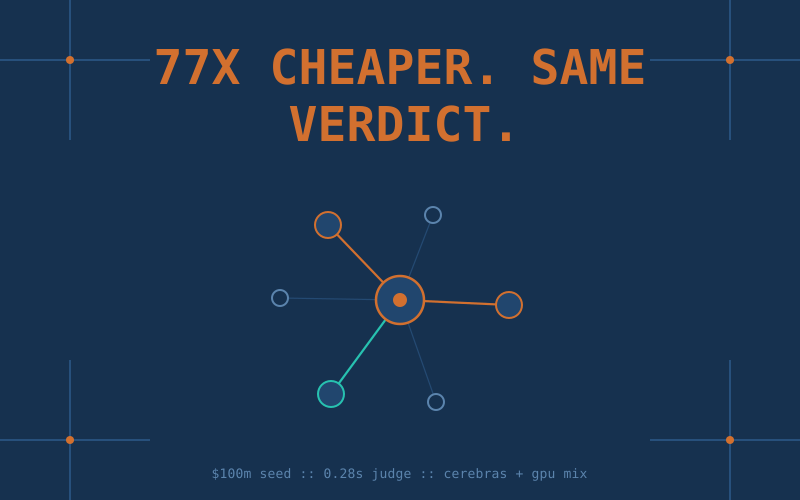
- Cost-optimised, post hoc: $0.08 per 1,000 traces, which they put at 77x cheaper than the monolithic judge.
- Latency-optimised, real time: a verdict in 0.28 seconds on Cerebras wafer-scale, 10x faster than the real-time baseline at less than half the price.
- Balanced: 0.53 seconds for $0.34 per 1,000 traces, using early access to TypeSafe AI's frontier model, 5.2x faster and 26x cheaper than that same baseline.
The point is not any single row. It is that a closed frontier model gives you one fixed point, and the decomposed version gives you a menu you pick from per deployment.
Beating frontier agents by not being one
The more interesting benchmark is agentic code search: find the relevant thing in a large codebase. Callosum searched over programs, models and silicon, and reports three solutions that all beat single-agent frontier baselines on F1, the harmonic mean of recall and precision.
Against the cheapest and fastest frontier agent, GPT-5.6 Luna, the compiled programs come in 3.5x cheaper, 3.7x faster and 16.9 F1 points higher. Against the quality leaders, Opus 5, Sonnet 5 and GPT-5.6 Sol, the company reports an order-of-magnitude gap on both cost and duration while still leading on F1.
Holding the program fixed and varying only the hardware, the best cost-latency balance was heterogeneous. A Cerebras-only assignment optimised for speed. A GPU-only assignment optimised for cost. The winner used both.
Two other customers are named. Round Treasury reports mean document extraction falling from 15.9 seconds to 2.1, an average of 7.5x, with the hardest cases improving up to 20x. Deliverance AI reports a four-agent workflow going from 64 seconds to 6.5.
The state is on the cap table
Callosum is the first-ever equity investment by the UK's £500M Sovereign AI Fund. That was announced on 16 April 2026, alongside compute access for Prima Mente, Cosine, Cursive, Doubleword, Twig Bio and Odyssey, at up to a million GPU hours each. What is new this week is the round the stake sits inside.
It fits the policy line neatly. The UK's AI Hardware Plan, published 8 June 2026, commits over £1.1 billion, including a £750m "heterogeneous AI supercomputer" and a £400m procurement for specialised chips. A government that has decided to buy a mixed fleet has an obvious interest in someone selling software that makes a mixed fleet usable. Whether that is industrial strategy or a very well-timed pitch deck depends on how the benchmarks hold up.
What to hold back on
Every number in this post is published by Callosum. There is no third-party benchmark, no public harness, no released code, and no way for you to run the agentic code search comparison yourself today. The baselines differ per case study, so the multipliers are not comparable to each other.
The Sovereign AI Fund's cheque size and equity stake are undisclosed, so the share of the $100M that is public money is unknown.
And decomposition is not free. Splitting a task into blocks means owning a graph, per-block evals, and a router that can regress. The reason most teams ship one model call is that one model call is one thing to debug. Callosum is betting that the cost gap gets wide enough that you will accept the graph anyway.
Key Takeaways
- $100M seed, Atomico led, with Plural, DCVC and the UK Sovereign AI Fund. One of the largest seed rounds ever raised by a UK company.
- Tailored Inference is live, a family of APIs that decompose a task into blocks and assign each block its own model and its own chip.
- The headline claim is 77x: $0.08 per 1,000 agent traces for post hoc leak detection, versus a closed-source monolithic judge, at what Callosum says is comparable detection quality.
- Real-time agent monitoring becomes affordable at 0.28s per verdict on Cerebras, or 0.53s for $0.34 per 1,000 traces on a balanced mix.
- Heterogeneous beat homogeneous: with the program held fixed, Cerebras-only won on speed, GPU-only won on cost, and the mixed assignment won overall.
- Nothing is replicated. Treat every multiplier as a vendor claim until someone outside the cap table runs it.
Sources: Callosum: $100M Seed to Redefine How Humanity Computes, Callosum: Pushing the Efficiency Frontier with Tailored Inference, Callosum: Making Heterogeneity Programmable, GOV.UK: first backing through the UK's Sovereign AI, GOV.UK: UK AI Hardware Plan, Electronics Weekly, Tech Startups, FinSMEs