AI Made 94% of China's 550,000 Micro-Dramas, and 98.7% Lose Money
On this page 8 sections
TL;DR
China ran the content-industry overflow test this year, at national scale. Cao Shumin, who heads the National Radio and Television Administration, told an industry conference on Nov 4 that nearly 550,000 micro-dramas went online in the first ten months of 2026, about 17 times the whole of 2025, and that more than 94% of them were made with AI, per Caixin. A Nov 13 Xinhua analysis fills in the rest of the market: at least 600 million viewers, an AI short-drama market DataEye puts above 22 billion yuan (roughly $3 billion) for the first five months, and a breakout show with four billion cumulative views made by a team of six. By DataEye's count, only 1.3% of AI short dramas clear the 50-million-view breakeven benchmark.
Read the big number with its caveats
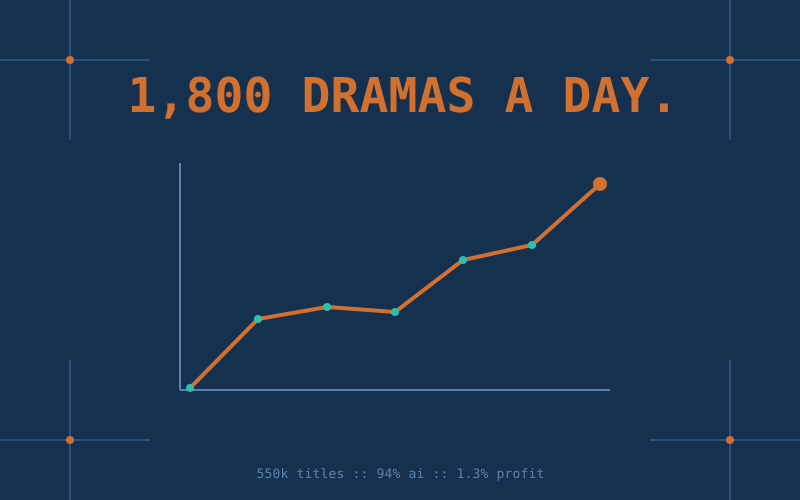
Cao's figures came at a Nov 4 conference and were reported by Caixin on Nov 5; Xinhua repeated them in its Nov 13 analysis. Nearly 550,000 titles in ten months works out to about 1,800 new shows a day, more television than any human could index, let alone watch.
The counts wobble when you look closely, and the wobble is instructive. The China Netcasting Services Association counted 367,000 titles in the first half with AI above 74%. Caixin's quarterly breakdown has AI at 95% of new titles in the first quarter and 64% in the second. The regulator then said more than 90% through August. Nobody has published a definition of what counts as an AI title, and animated comic dramas probably explain much of the spread. The direction of travel is not in dispute.
Volume is not attention
The association's first-quarter guide, as China AI Dispatch relays it, had AI titles above 95% of everything released but drawing about 4% of core plays. The term is undefined anywhere public, so treat that as an order of magnitude rather than a fact. In the Spring Festival window, DataEye counted live-action titles at one-fiftieth the number of AI ones, drawing 25 times the total plays.
Everyone in this market was handed a free printing press. The reading public did not get a second set of eyes.
Douyin's first-half intake tells you what a flood pays. Of 221,900 new AI and comic dramas, 1,055 passed 100 million plays, or 0.47%. DataEye uses 50 million views as the working breakeven line, and Xinhua's framing of the same data is blunt: 1.3% of AI short dramas turn a profit, 98.7% operate at a loss.
The front of the queue still pays
The hits are real, and they are made by tiny crews. Armed into the Song Dynasty, a time-travel military serial that premiered Aug 22, has reached 10 seasons and 1,000 episodes of under two minutes each, with cumulative views above four billion and millions of viewers pre-ordering seasons. The team is six people, including a former ride-hailing driver, a delivery worker and an ex-office employee. Lead planner Zhang Hansheng, 54, started teaching himself AI video generation in March. They ship up to 100 episodes a week.
Further down, the unit economics are extreme. Sci-fi title Guixu launched in May, hit 100 million views on roughly 200,000 yuan (about $30,000), and was made by one person with no film training, at about 2,000 yuan in compute per finished minute. Xinhua puts a comparable live-action production at up to 100 times the cost, and says a 100-episode AI series can wrap in three days, with premium AI dramas in Q1 running about one-tenth the cost of live-action equivalents.
The money lands on tools and feeds
The people reliably earning in this market sell shovels or own the mine mouth. Kling AI, Kuaishou's video model, generated more than 650 million yuan (about $91 million) in revenue in Q1 alone, up more than 300% year on year per Kuaishou's results announcement, passed 100 million global users by June, and has gone from version 1.0 to 3.0 Omni in two years. Huxiu columns put ByteDance's Seedance at about 95% penetration among short-drama producers, and Volcano Engine cut Seedance 2.5 Flash generation prices by about 34% on Nov 12, so the floor keeps moving down.
Distribution is the other winner. ByteDance's Hongguo app, the free-drama funnel that feeds this content, hit 168 million daily active users in July, up 107% year on year, and 430 million total users by September, per QuestMobile. Those figures cover all short-drama consumption, not only AI titles; the platform monetizes the flood either way. Tencent rolled out its own AI short-drama streaming platform in September. DataEye told Xinhua the AI short-drama market passed 22 billion yuan in the first five months of 2026 and forecasts 40 billion yuan (about $5.6 billion) for the year.
Beijing has picked a side
The same conference produced the official line, reported by The Paper: support live-action dramas, regulate AI ones. Live action gets backing in funding, algorithms and awards. For AI dramas the phrase was hold the volume steady and raise the quality.
The guardrails are already biting. Labeling rules took effect Sept 1. By mid-September, platforms had taken down 68,000 titles, equal to 16% of everything released through August, and more than 90% of what was removed was AI. The new rule is that every title gets a human review before it airs, on a flow of roughly 2,000 shows a day. Somewhere there is a person whose entire Tuesday is episode 407 of a time-travel battalion serial. In November the NRTA opened a two-month campaign against shoddy, vulgar and formulaic micro-dramas.
What this predicts for everyone else
China is running ahead of the rest of the world on cheap generative video, and the results are legible from anywhere. When the marginal cost of an episode collapses toward the cost of the tokens, title count stops being an interesting metric. Supply multiplied 17 times and the audience did not grow a second set of eyes, so the surplus flows to whoever owns verification, ranking and distribution, and to whoever sells the generation itself.
If you build content tools, this is your demand proof: a six-person show with four billion views, one solo creator at 100 million views on $30,000, and a model vendor pulling $91 million in a quarter off the long tail's token bills. If you make content, read the loss rate before the gross views, and note that the state's answer to oversupply was not better recommendation engines but mandatory review. When video generation gets this cheap in your market, expect the volume first, the losses second, and the rules third.
Key Takeaways
- Nearly 550,000 micro-dramas went online in China in the first ten months of 2026, about 17 times all of 2025, and more than 94% were AI-made, per NRTA head Cao Shumin via Caixin and Xinhua.
- Volume is not attention: AI titles topped 95% of Q1 releases but drew roughly 4% of core plays, and in the Spring Festival window live-action drew 25x the plays on one-fiftieth the titles.
- Only 1.3% of AI short dramas clear DataEye's 50-million-view breakeven line; 98.7% operate at a loss. Of Douyin's 221,900 new AI and comic dramas in H1, 0.47% passed 100 million plays.
- The hits are tiny crews: Armed into the Song Dynasty has 10 seasons, 1,000 episodes and 4 billion cumulative views from a six-person team; solo-made Guixu hit 100 million views on about $30,000.
- Reliable money sits in tools and distribution: Kling AI made 650 million yuan in Q1, up 300%+, and Hongguo reached 168 million daily users; DataEye sizes the AI short-drama market at 22 billion yuan for the first five months, forecasting 40 billion for the year.
- Beijing's line is now support live-action, regulate AI: labels since Sept 1, 68,000 titles removed by mid-September, and human review required for every title before it airs.
Sources: Xinhua analysis, Nov 13, 2026, Caixin Global, Nov 5, 2026, China AI Dispatch, Nov 5, 2026, 36kr on Armed into the Song Dynasty, Kuaishou Q1 2026 results announcement (HKEX), Eastmoney on Seedance 2.5 Flash, Nov 13, 2026, The Paper on the micro-drama forum, South China Morning Post on Kling revenue