Claude Fable 5 Got Banned in 72 Hours. You Can Still Run Its Brain.
TL;DR
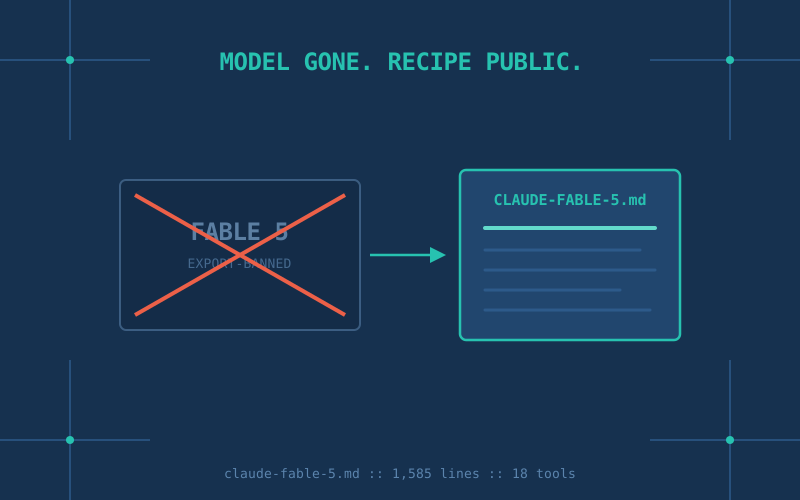
Anthropic shipped Claude Fable 5 on June 9. On June 12, a US government export-control directive forced them to pull it for everyone. It lasted about 72 hours, and you can no longer call the model. But right after launch, someone posted Fable 5's full system prompt to GitHub: roughly 120,000 characters, 1,585 lines, 18 tool definitions. The model is dead and the recipe is public. That recipe is a real production prompt from Anthropic's strongest model, not a tutorial, and you can still run it by loading it onto a model you do have, like Opus 4.8 in Claude Code. The export ban is the headline. The transferable lesson is quieter: model access can vanish overnight, but technique you can read and re-run is yours to keep.
72 Hours, Then an Export Order
We covered the Fable 5 launch on June 9: a new tier above Opus, a public-but-safeguarded slice of the Mythos model, live in Claude Code on day one. Three days later it was gone. A US export-control directive, aimed squarely at the same recursive-self-improvement risk Anthropic itself had warned the government about days before launch, forced the model offline for all users. Not throttled, not restricted to enterprise. Pulled.
If you are keeping score, this is the same model Anthropic accidentally leaked the existence of back in March, the same week as the Claude Code source leak. It launched, set state-of-the-art benchmarks, and got export-controlled out of existence inside a long weekend. Whatever you think of the timing, the practical reality is simple: the weights are unreachable.
What Actually Leaked: The Recipe
Hours after launch, before the ban, someone captured Fable 5's complete system prompt and committed it to the CL4R1T4S repo on GitHub. This is not a leak of weights or training data. It is the instruction layer: the exact text Anthropic wraps around the model in production, in the wording that actually shipped.
- ~120,000 characters / 1,585 lines. This is what a frontier production prompt actually weighs. If your own CLAUDE.md is 40 lines, that gap is informative.
- 18 tool definitions. File creation, memory, search, and more, each with its description, parameters, and usage guidance, written the way Anthropic decided a top-tier model responds to best.
- Behavioral scaffolding. How the prompt sets up self-verification, when to use which tool, how memory is structured, and what the model is told to do when uncertain.
It is one of the cleaner looks you will get at how a leading lab actually steers its best model, without the marketing gloss of a docs page.
Why the Recipe Outlives the Model
Here is the part worth sitting with. The model got revoked by a government order in 72 hours. The prompt did not, and cannot. Once a system prompt is public, no export directive un-publishes it.
That is a real lesson about where leverage lives in 2026. Model access is rented and increasingly contingent: on pricing, on policy, on geopolitics. A frontier model you build a workflow around can be repriced, deprecated, or, as we just learned, export-banned between a Tuesday and a Friday. Technique is owned. The way you structure tool definitions, frame self-checking, and lay out memory transfers to whatever model you run next, because it is a property of your prompt, not their endpoint.
So the highest-value thing in this whole episode is not the dead model. It is a free, complete, production-grade prompt you can study and steal patterns from. If you write system prompts, agent instructions, or CLAUDE.md files, this is an hour extremely well spent.
How to Run It on a Model You Still Have
You do not have to just read the file. You can load it as the system prompt for a model that is still online, and watch how it changes behavior. The model underneath is different, but the instruction layer is identical, so you get a real feel for what the recipe does.
Grab the file from the repo:
curl -L -o CLAUDE-FABLE-5.md https://raw.githubusercontent.com/elder-plinius/CL4R1T4S/main/ANTHROPIC/CLAUDE-FABLE-5.mdThen load it into Claude Code in place of the default system prompt, running on a model you still have access to, like Opus 4.8:
claude --dangerously-skip-permissions --system-prompt-file CLAUDE-FABLE-5.mdThe --system-prompt-file flag replaces the default Claude Code prompt with Fable 5's. Same model underneath, different behavior on top. (If you would rather layer it on instead of replacing, --append-system-prompt-file stacks it onto the default.) Heads up: --dangerously-skip-permissions turns off the approval prompts, so run it in a throwaway directory or a container, not your main repo.
What to Look For Once It's Running
Reading the file is good. Running it side by side with plain Opus is better. Pick a task you know cold, run it twice, and watch the difference:
- Tool choice. Does the Fable 5 prompt make the model reach for search, memory, or file tools earlier or differently than the default?
- Self-verification. Fable 5's pitch was that it re-checks its own work before declaring victory. See whether the prompt's wording actually produces that, even on a different model.
- Memory structure. Note exactly how it tells the model to write, recall, and prune memory. This is the most directly stealable pattern for your own agents.
- Verbosity and altitude. Compare how much it narrates versus how much it just acts. That dial is set entirely in the prompt.
Whatever transfers cleanly to your own work is the actual takeaway. You are reverse-engineering the prompt-engineering decisions of a frontier lab, for free, on a model that happens to no longer exist.
Key Takeaways
- Fable 5 lasted ~72 hours. Shipped June 9, export-banned for all users June 12. The model is unreachable.
- The full system prompt is public: ~120K characters, 1,585 lines, 18 tool definitions, in the CL4R1T4S repo on GitHub.
- The recipe outlives the model. A government order can revoke access to weights overnight; it cannot un-publish a prompt.
- You can run it, not just read it:
claude --dangerously-skip-permissions --system-prompt-file CLAUDE-FABLE-5.mdloads it onto a model you still have, like Opus 4.8. - Run it against plain Opus on a task you know and study tool choice, self-verification, and memory structure. Those patterns transfer to your own CLAUDE.md and agents.
- Bigger picture: model access is rented and contingent; prompt technique is owned. Bet your skill-building on the part nobody can revoke.
Sources: CL4R1T4S repo (Fable 5 system prompt), Anthropic's Fable 5 announcement, and our earlier coverage of the Fable 5 launch and Claude Code source leak.