Claude Fable 5 Is Here: Anthropic's Mythos-Class Model Hits Claude Code
TL;DR
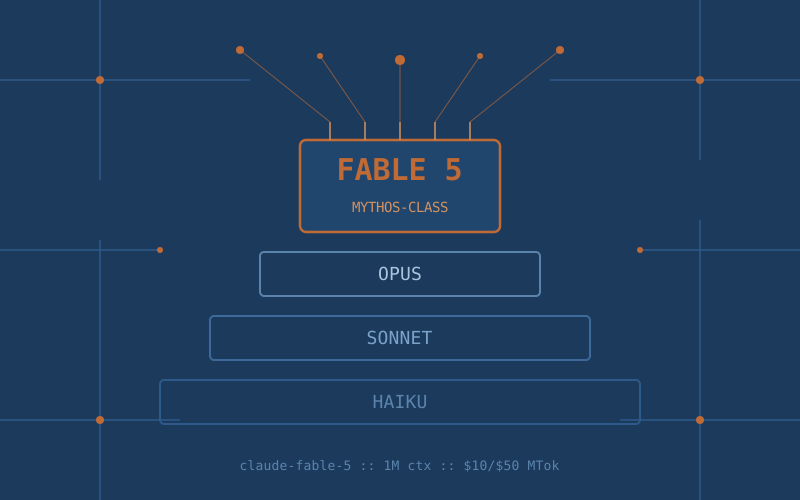
On June 9, 2026, Anthropic released Claude Fable 5: the first publicly available version of its Mythos-class model technology, previously restricted to vetted infrastructure partners. It's a brand-new tier above Opus, priced at $10/$50 per million tokens (double Opus 4.8), with a 1M-token context window and 128K max output. It's state-of-the-art on nearly every benchmark Anthropic tested, it's available in Claude Code right now, and it's included free on Pro, Max, Team, and Enterprise plans until June 22. The catch: classifier-based safeguards silently route high-risk queries to Opus 4.8, and all Fable/Mythos traffic now carries a 30-day retention requirement.
A New Tier Above Opus
For years the Claude lineup was a clean three-tier story: Haiku (fast/cheap), Sonnet (balanced), Opus (most capable). Fable 5 breaks that pattern. It doesn't replace Opus 4.8. It sits on top of it as a fourth tier, the same way Opus sits above Sonnet.
The lineage matters here. Fable 5 isn't a bigger Opus. It's a constrained public release of Mythos, the model Anthropic had been quietly deploying to enterprise partners managing critical infrastructure across 15 countries, the same technology the company referenced when it warned the US government about recursive self-improvement risks just days before this launch. Anthropic accidentally leaked Mythos's existence back in March (the same week as the Claude Code source leak we covered), describing it internally as a "step change" in capabilities. Now you can call it from an API.
Per Anthropic's announcement, Fable 5 is state-of-the-art on nearly all tested benchmarks: software engineering, knowledge work, vision, and scientific research. The pattern across evaluations is consistent: the longer and more complex the task, the larger Fable 5's lead over Opus 4.8. Highlights:
- Top score on Cognition's FrontierCode evaluation, at medium effort, not even max
- Stripe migrated a 50-million-line Ruby codebase, reporting Fable 5 "compressed months of engineering into days"
- Completed Pokémon FireRed using a vision-only interface, a long-horizon agentic benchmark that has humbled every previous model
- 3x improvement in Slay the Spire performance with persistent file-based memory versus Opus 4.8
- Top marks on Hebbia's Finance Benchmark for senior-level reasoning
It's in Claude Code Today
For most readers of this blog, the practical question is: what does this mean for my coding agent? Fable 5 is live in Claude Code now: switch with /model or set claude-fable-5 via the API. Boris Cherny (Claude Code lead at Anthropic, last seen confirming the npm leak was "plain developer error") called it "the best model I have used for coding, by a wide margin," citing fewer prompts and steers, more efficient token use, better tool use, smarter self-verification, and longer-running autonomous sessions.
That last point is the real story. Anthropic's whole pitch is that Fable 5's advantage compounds with task length. Opus 4.8 was already strong at overnight autonomous runs; Fable 5 is built for exactly that workload: give it the full task spec up front, set effort to high, and let it run. One early tester noted that "at the highest effort, Claude Fable 5 reflects on and validates its own work," the model re-checks its output before declaring victory, which is precisely what you want from an agent you're not babysitting.
API Details Developers Should Know
- Model ID:
claude-fable-5: available on the Claude API, Claude Platform on AWS, Amazon Bedrock, Vertex AI, and Microsoft Foundry from day one (GitHub Copilot too) - Context window: 1M tokens, 128K max output
- Same API surface as Opus 4.7/4.8: adaptive thinking only; sampling parameters (temperature, top_p, top_k) are removed and will 400
- One new breaking change: explicitly sending a disabled thinking config returns a 400 on Fable 5 (it was accepted on Opus 4.8). If you don't want thinking, omit the parameter entirely
- Effort parameter: supports the full range up to max. Effort matters more on Fable 5 than any prior model, so re-tune per workload rather than copying your Opus settings
The Safeguard Architecture Is Genuinely New
This is the part that makes Fable 5 different from every previous frontier release. Instead of refusing risky queries, Fable 5 runs three classifier-based safety systems, covering cybersecurity, biology/chemistry, and anti-distillation, and when one trips, your request is silently answered by Claude Opus 4.8 instead. Ask it how to make ricin and you don't get a refusal; you get a safe answer from the weaker model.
Anthropic says the classifiers are tuned conservatively enough that over 95% of sessions run entirely on Fable 5, and external red-teamers found zero universal jailbreaks across 1,000+ hours of testing. The anti-distillation classifier is aimed at preventing capability extraction to train competing models, consistent with the fake-tool-injection machinery we saw in the leaked Claude Code source.
The trade-off: all Fable/Mythos traffic carries a mandatory 30-day retention requirement, which Anthropic frames as necessary for "defending against complex and novel attacks." Data is used only for safety purposes and then deleted, per the announcement, but if your org has zero-retention agreements, check with your account team before routing production traffic through Fable 5.
For the small set of organizations that need the unrestricted version, Claude Mythos 5 (the identical underlying model with safeguards selectively lifted) is rolling out to cyberdefenders and infrastructure providers through Project Glasswing, a collaboration with the US government, plus select biomedical researchers in a trusted-access program. Early Mythos 5 results are wild: protein design tasks accelerated ~10x, and autonomous genomics research matching Science-published models.
The Money Question: Is 2x Opus Worth It?
At $10/$50 per MTok, Fable 5 costs exactly double Opus 4.8 ($5/$25). Whether that math works depends entirely on your workload shape:
- Long-horizon agentic work: probably yes. If Fable 5 finishes a migration in one run that took Opus three attempts plus your review time, the per-token premium disappears. Higher capability up front often means fewer turns and lower total cost. Anthropic's own guidance has made this point since Opus 4.7.
- Interactive coding sessions: try it free first. Fable 5 is included on Pro, Max, Team, and seat-based Enterprise plans at no extra cost until June 22, after which it requires usage credits. That's a two-week window to benchmark it on your real work before committing money.
- High-volume simple tasks: no. Classification, extraction, summarization. Nothing about Fable 5 changes the calculus for tasks Sonnet and Haiku already nail at a fraction of the cost.
Worth noting: $10/$50 is less than half what Mythos Preview customers were paying. Anthropic is cutting the price of its frontier tier while moving it downmarket, a pattern worth remembering next time a "too dangerous to release" model is announced.
The Timing Is… Interesting
Anthropic released its most powerful public model days after warning that AI capabilities are advancing dangerously fast and calling for coordinated industry brakes. TechCrunch didn't miss the irony, and neither should you. The launch also lands squarely in the middle of Anthropic's IPO preparations, alongside OpenAI and SpaceX.
The charitable read: the safeguard-plus-fallback architecture is the coordinated brake: ship the capability, classifier-gate the dangerous parts, retain traffic to catch novel attacks. The cynical read: nothing concentrates a safety lab's risk tolerance like an upcoming public offering. Both can be true.
Key Takeaways
- Fable 5 is a new fourth tier above Opus, a public, safeguarded version of the Mythos model previously limited to vetted infrastructure partners
- $10/$50 per MTok, 1M context, 128K output: double Opus 4.8's price, less than half of Mythos Preview's
- Live in Claude Code now via /model or
claude-fable-5; also on Bedrock, Vertex AI, Foundry, and GitHub Copilot - Free on paid Claude plans until June 22: benchmark it on real work now, before it starts costing usage credits
- Safeguards route flagged queries to Opus 4.8 instead of refusing, less than 5% of sessions affected; zero universal jailbreaks in 1,000+ red-team hours
- 30-day traffic retention is mandatory on all Fable/Mythos usage: check your compliance requirements
- API surface matches Opus 4.8 with one new gotcha: an explicit thinking-disabled config now 400s: omit the parameter instead
- Biggest gains on the longest tasks: if you're not running long agentic workloads, Sonnet and Haiku are still your value plays
Sources: Anthropic, TechCrunch, CNBC, NBC News, AWS, GitHub Changelog, Boris Cherny