CodeRabbit Hits $100M ARR Reviewing the Code AI Agents Write
On this page 9 sections
TL;DR
CodeRabbit, the AI code reviewer, says it grew from $10 million to $100 million in annual recurring revenue in just over a year, announcing the milestone on Nov 12. More than 20,000 customers now push over 3 million pull requests a week through it, and the company behind them runs on 35-40 engineers. The part worth studying if you sell into the agentic coding stack: the revenue is plain seat-based SaaS at $24-72 per developer a month, gross margin sits near 50%, and the acquisition engine was three years of giving the product away free to open source at a cost of $7-8 million.
The number, and what backs it up
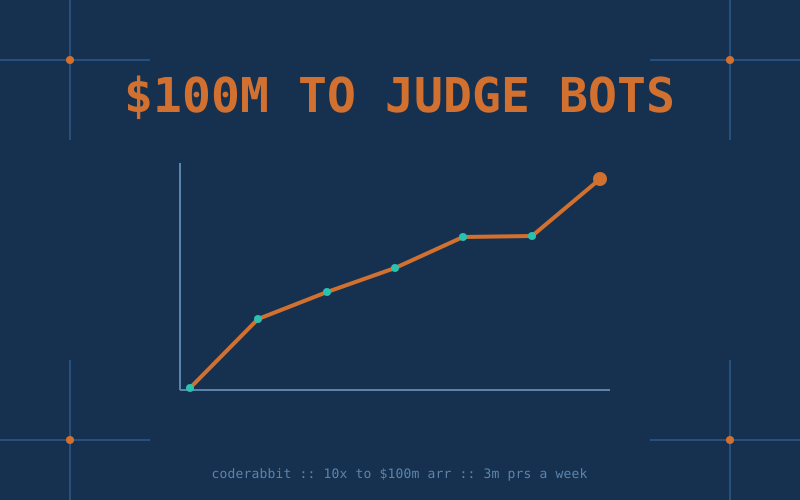
The figure is company-reported, published in a blog post and a Business Wire release on Nov 12, so treat it as vendor math until an outside auditor gets a look. Two independent anchors make the curve plausible. TechCrunch reported in September 2025 that CodeRabbit was past $15 million in ARR with 8,000-plus customers and 20% monthly growth. A month ago, on The Neon Show podcast, co-founder and CEO Harjot Gill said the company was "north of 60 to 65 million" and growing 15-20% a month. Four weeks of that rate puts $100 million within easy reach.
Customer count has gone from 8,000-plus to more than 20,000, with 400,000 monthly active users and 120,000 daily actives. Teams route more than 3 million pull requests through the reviewer every week, it has surfaced more than 100 million issues to date, and it connects to 8.5 million repositories across 300,000-plus open-source projects. Named customers quoted in the announcement include Dialpad, whose CTO Brian Peterson drew the line at letting "the model that wrote the code decide whether it is fit to ship," and Questrade, a Canadian financial institution with more than $100 billion CAD under administration. CodeRabbit's own growth chart, built on ICONIQ's State of Scaling 2026 data, puts the $1 million to $100 million run at roughly nine quarters.
Why the money sits in checking, not writing
The demand side is documented outside CodeRabbit. A Pragmatic Engineer analysis of a tracked cohort found weekly pull requests up 128% year over year, and agent-written PRs are now large enough that humans often cannot read them line by line. A June 2026 New Relic survey found 62% of tech leaders saying their teams often ship AI-generated code to production without line-by-line review. The company's one-line version: "Code generation got cheap. Judgment didn't."
Gill's market thesis, from the same podcast: senior developers spent 25-30% of their time reviewing code even before generative AI, so if code generation becomes a $1 trillion market, validation and explainability could be a $250 billion slice of it. That is a founder extrapolating, not a measured market. The mechanism underneath is simpler. When Claude Code opens a PR on GitHub, someone still has to say yes before it merges, and the blog puts the independence requirement plainly: the validating layer "can't be the agent that wrote the code." The agent that wrote the exam does not grade it.
In practice the two sides argue until one gives in. Gill describes what he calls loop engineering: the coding agent trades findings with CodeRabbit across several commits until the review passes the organization's guardrails, and the human arrives at a PR that has already survived an adversarial pass. Developers shift toward triage, deciding which of a hundred agent-opened PRs gets finished first.
The unit economics
Pricing is deliberately dull. Plans run $24, $48 and $72 per developer per month billed annually, at $30, $60 and $90 monthly, and only developers who open PRs are charged. Past the included hourly review allowance, usage pricing kicks in at $0.25 per reviewed file, and the cloud coding agent bills at $0.40 a minute.
Margins are the number investors keep asking about. Gill says the business runs at roughly 50% gross margin and is on a path to 50-80%, and that falling model prices have not widened it, because cheaper tokens just buy more subagents and deeper reviews per PR. One internal metric traces the trade: review-comment acceptance went from 30-35% a year ago to 65-70% now, which the company credits to spending more compute per review, not less.
Headcount is the other half of the story. Gill puts the team at 35-40 engineers, which at $100 million ARR works out to roughly $2.5-2.9 million per engineer, and says agents have doubled to tripled the team's own velocity in the past three months. In trial surveys, 80-85% of developers say they cannot go back to reviewing without it, and churn is, in his words, super low.
An $8 million coupon called free open source
CodeRabbit has been free forever on public repositories since launch, and that decision is the whole acquisition engine. It started when GPT-4 cost about $40 per million tokens, by Gill's account, and reviews on 300,000-plus open-source projects were real money: he says the company has spent $7-8 million on AI costs supporting open source over three years. What that bought is distribution ads cannot buy. Open-source maintainers install the reviewer, like it, and take it to their day jobs; Gill claims more GitHub app installs than any other AI product, and the go-to-market is word of mouth with no paid ads. The company's own marketing now ships through pull requests: it deploys Google ads by opening a PR. No word on whether the rabbit reviews those.
The funding history reads like a growth ladder. Bootstrapped to roughly $1 million ARR, then a Series A led by CRV, a $60 million Series B at a $550 million valuation in September 2025 led by Scale Venture Partners with Nvidia's NVentures participating, and a $143 million Series C at $1.5 billion in August 2026, which Gill confirmed on the podcast.
The newer distribution move is selling next to the agents themselves: listed in Anthropic's Claude Marketplace since May, an anchor partner in the OpenAI Marketplace since September, an authorized partner in the SpaceX Super Intelligence Partner Network and the Grok Build Plugin Marketplace since October, and in the Google Antigravity Plugin Marketplace the same week as the announcement, where Antigravity writes the code, CodeRabbit reviews it, and Antigravity fixes the findings in the same loop. The Claude and OpenAI listings let customers apply existing spend commitments on a single invoice.
Security is the second product
In October the company joined the OpenAI Daybreak Defense Network and put OpenAI's GPT Cyber models into CodeRabbit Secure, alongside a $1 million commitment to fund free Deep Scans for any organization. The first ten days of that program: 2,700-plus organizations ran more than 13,000 scans, which surfaced 43,000-plus critical or high-severity findings, and one in three scanned repositories carried at least one. Nearly 10,000 of those vulnerabilities have been fixed already. A continuous posture management add-on followed in mid-October, per the podcast.
Read the ledger with care
The caveats are the usual ones for a vendor milestone, plus a few specific to this market. Every growth and usage figure above comes from CodeRabbit. The quarters-to-$100M comparison is the company's own chart built on ICONIQ data. The competition is not standing still: Graphite raised a $52 million Series B led by Accel, Greptile has been in talks with Benchmark, and Gill himself names rivals he meets in enterprise deals. The bigger risk is bundling: Claude Code, Codex and every other harness ship some review capability for free. Gill's counter is that review is an org-wide install with central guardrails, and that the pipeline is model-agnostic, with NVIDIA's Nemotron open models added in January alongside the frontier ones.
His view of the benchmark noise around code review is also on the record: "we never did a benchmark because we don't think we'll be able to do a fair job."
What to steal
- Ride a wave instead of inventing one. Gill's previous startup, an observability company, went nowhere for years; CodeRabbit began as a weekend project inside it, productized by co-founder Gur Singh. Gill's summary: "You cannot really create a wave, it's easier to ride a wave."
- Free-for-open-source is paid acquisition with a receipt. It cost $7-8 million over three years and bought the GitHub install base. Budget it like marketing, because it is marketing.
- Sell the seat, meter the overage. Predictable per-developer pricing with generous limits keeps invoices boring; usage pricing catches power users at $0.25 a file.
- Sit next to the thing you check. Marketplaces for Claude, OpenAI, Grok and Antigravity put the reviewer where the agents already live, paid from existing commitments.
- Stay model-agnostic. When labs cut prices, you choose whether to pocket the difference or spend it on thoroughness. CodeRabbit spends it, and its acceptance rates are the evidence.
Key Takeaways
- CodeRabbit says it passed $100 million ARR on Nov 12, up from $10 million a year earlier. Independent anchors: TechCrunch had it above $15 million ARR with 8,000+ customers in September 2025; Gill said $60-65 million on a mid-October podcast.
- Usage at the milestone: 20,000+ customers, 400,000 monthly actives, 3 million+ PRs a week, 100 million+ findings surfaced to date, 8.5 million connected repos, 300,000+ open-source projects.
- Economics: seats at $24-72 per developer a month billed annually, $0.25 per reviewed file past the allowance, $0.40 per cloud agent minute, gross margin around 50% per the CEO, and 35-40 engineers, about $2.5-2.9 million ARR each.
- The growth engine was free open source: $7-8 million in AI costs over three years, word-of-mouth PLG with no paid ads, and marketplace listings inside the Claude, OpenAI, Grok, SpaceX and Google Antigravity ecosystems.
- Demand is real and externally documented: weekly PRs up 128% year over year in a Pragmatic Engineer cohort, and 62% of tech leaders in a New Relic survey say teams ship AI code without line-by-line review.
- All growth figures are self-reported; rivals like Graphite and Greptile, plus review features bundled into the coding agents themselves, are the standing risks to the category.
Sources: CodeRabbit, Passes $100 million in ARR, Nov 12, 2026, CodeRabbit newsroom release, Nov 12, 2026, The Neon Show podcast with Harjot Gill, Oct 15, 2026, TechCrunch, Sept 16, 2025, New Relic 2026 AI Code Report, The Pragmatic Engineer, CodeRabbit pricing.