Elvis Estate Sues Suno Under the ELVIS Act; Eminem's Publisher Wants $41M
TL;DR
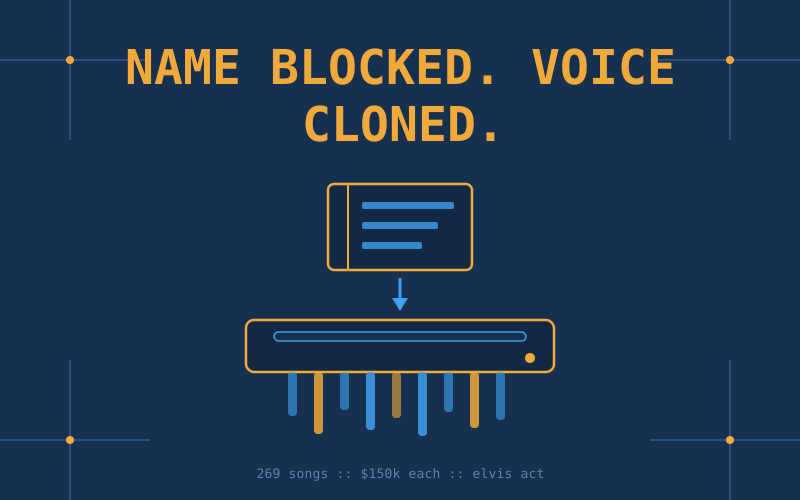
Suno picked up two new federal lawsuits on Friday, November 6, both filed in San Francisco by the same four attorneys. Elvis Presley Enterprises, the Authentic Brands Group unit that controls Elvis's catalog, name, image, and likeness, accuses Suno of cloning the King's voice, in a case Billboard calls one of the first major tests of Tennessee's 2024 ELVIS Act. In the second case, Eight Mile Style, the publisher behind 269 Eminem songs, demands roughly $41 million: the $150,000 statutory maximum for willful infringement on each song, plus $672,000 for allegedly stripping copyright metadata. Suno says it blocks artist names in prompts and screens uploads with third-party providers. Both complaints argue the blocklist is a sieve.
Two filings, one law firm
Richard Busch of Adams & Reese, working with Mark Block, David Niemierzycki, and Andrew Davis, filed both complaints, alongside Raleigh Music Publishing and other rightsholders on the Presley side. The Presley filing runs 51 pages in the Northern District of California and stacks three theories: copyright infringement over songs like "Don't Be Cruel," "All Shook Up," and "Return to Sender," exploitation of Presley's identity, and violation of the ELVIS Act for letting users generate tracks in his "rich vocal timbre."
"All of the humanity, history, despair, and triumph that constitutes Elvis' identity was stolen and is stored on servers and harnessed by Suno to make massive amounts of money," Busch writes. The exhibits are links to videos of Suno outputs that sound like Presley, and the complaint says there are "hundreds to thousands more like it." It also claims that as recently as last month, Suno generated a Presley-styled vocal from lyrics that merely contained his name, and it calls Suno's insistence that its models cannot mimic real voices "unequivocally false."
The Eight Mile Style filing runs 32 pages and covers "Lose Yourself," "Without Me," "The Real Slim Shady," "Till I Collapse," and "Stan," among others. Eminem is not a party. Exhibits include a track titled "Slim Shady x Rosefalls" with an AI-generated Eminem on the cover art, plus outputs the publisher says quote "Lose Yourself," "The Real Slim Shady," and "Houdini" verbatim or near-verbatim. The Detroit Free Press also reports on leaked Suno source code that appears to show the service scraping Eminem music and lyrics from YouTube and Genius.
Suno has said in earlier litigation that it trained on essentially all music files of reasonable quality accessible on the open internet. The new filing quotes that position back at the company and notes that anyone "capable of paying $10 per month" can make complete songs.
The statute is the new weapon
Tennessee passed the ELVIS Act, short for Ensuring Likeness Voice and Image Security, in 2024, the country's first law aimed at AI voice and image cloning. Older right-of-publicity law usually required a commercial use, say a fake endorsement ad, before anyone could sue. The ELVIS Act dropped that requirement and added liability for companies whose tools enable the cloning in the first place. The old law fined the counterfeit poster; this one walks upstream to the print shop.
The complaint leans into the fit: "Suno is the embodiment of why the ELVIS Act was so essentially required." Tennessee wrote a statute named after the man, and two years later his estate is its marquee plaintiff. A ruling either way writes the first page of the law's case law, and every AI audio vendor that lets users describe a voice sits downstream of it.
The name filter meets the style prompt
Suno's defense, in a statement, is its guardrails: "Suno exists to help people create new, original music, not to trade on anyone's name or likeness, and we prohibit any unauthorized use of an artist's work. To protect against this, we do not allow prompts for specific artists' names and songs and work with third party providers to screen uploaded audio files and lyrics for potential misuse."
In the Jason Isbell class action, Suno's lawyers argued that artist names in prompts work as "shorthand for the genre they perform in." The Eight Mile Style complaint answers with a prompt string it says still produces a Slim Shady-style track: "aggressive rap, rapid-fire flow, dark humor, male rapper, horrorcore." Blocking the string "Eminem" while serving a model trained on his catalog guards the front door and leaves the loading dock open.
The docket keeps growing
Suno has faced the three major labels since June 2024. Warner Music Group settled in 2025 and licensed, as did BMG and Believe, and that licensed pipeline produced September's v6 model, which drew a fresh Universal and Sony suit calling it "the fruit of the same poisoned tree." The Isbell class action is pending, and publishers Round Hill Music and Reservoir have their own cases. None of it has dented the valuation: Suno raised $400 million in June at $5.4 billion.
The same lawyers are running this playbook against other AI firms. The Presley group sued Anthropic last month over 274 songs, demanding $48.6 million. Eight Mile Style sued Meta in June for roughly $110 million over 243 recordings, a case a Michigan judge allowed into discovery.
What to steal
- A prompt blocklist is a mitigation, and a complaint is a list of prompts that beat it. If your safety story rests on filtering names, your real exposure is whatever the model does with the other 10,000 ways to describe a voice.
- Treat voices as licensed inputs. Under the ELVIS Act and the state laws copying it, a voice is property with a statute behind it, and tool providers can be on the hook for enabling unlicensed clones. Paper your reference and training audio.
- Keep copyright metadata intact when you ingest data at scale. Stripping it is a separate claim with its own damages line, priced at $672,000 in this complaint.
- Run your worst-case math as works times $150,000. Courts rarely award the ceiling, but a catalog-scale complaint can be existential for a startup even at a discount.
- If you publish AI music in anything monetized, keep your prompt history and download dates. The exhibits in these cases are user-made tracks, and the ones that sound like a named artist are the pile that ends up quoted in filings.
Caveats
- Everything above except the docket history is allegation. Suno denies wrongdoing and has not yet answered either new complaint.
- A demand is an opening bid, not a forecast. Statutory ceilings exist to be negotiated down from.
- The ELVIS Act has no track record. Being one of its first major cases means no precedent for either side to lean on.
- Eminem is not a plaintiff, and the Anthropic and Meta cases involve different defendants and different claims.
- The $41 million breakdown comes from the complaint as reported by the Detroit Free Press and summarized by Mubert. The Free Press article is paywalled.
Key Takeaways
- On November 6, Elvis Presley Enterprises sued Suno in the Northern District of California in a 51-page complaint alleging copyright infringement, identity exploitation, and violation of Tennessee's 2024 ELVIS Act.
- Billboard calls it one of the first major cases under the ELVIS Act, the first state statute to drop the commercial-use requirement and extend liability to tools that enable voice cloning.
- The same day, Eight Mile Style sued over 269 Eminem songs, demanding the $150,000 statutory maximum per work plus $672,000 over stripped copyright metadata, about $41 million total.
- Both complaints attack Suno's guardrail story: the filing says the style prompt "aggressive rap, rapid-fire flow, dark humor, male rapper, horrorcore" still yields a Slim Shady-style track, and lyrics containing Elvis's name alone triggered a clone last month.
- Suno says it blocks artist names and songs in prompts and screens uploads with third-party providers, and it raised $400 million at a $5.4 billion valuation in June despite the litigation.
- The same attorneys already sued Anthropic for $48.6 million over 274 Presley songs and Meta for roughly $110 million over 243 Eminem recordings.
Sources: Billboard, Variety, Detroit Free Press, Mubert