Emergent Is a Unicorn Now. 70% of Its Builders Have Never Written Code.
TL;DR
Emergent, a platform where you build software by describing it in plain English, raised $130 million in a Series C at a $1.5 billion valuation, roughly a year after its public launch. It got there on sheer volume: more than 12 million apps built, most of them by people who have never written a line of code. The round, led by Creaegis, roughly quintuples the valuation Emergent held in January. The more interesting part for builders is not the money. It is what the company is selling next: agents that do not just write your app, they run your operations.
What just happened
A year ago, "vibe coding" was mostly a punchline. It is now a balance sheet. Emergent, backed by Y Combinator, Khosla Ventures, SoftBank Vision Fund 2, Lightspeed, and Google's AI Futures Fund, closed a $130 million Series C led by Creaegis and became a unicorn about twelve months after opening to the public. That brings total funding to roughly $230 million.
The trajectory is the headline. In January the company raised a $70 million Series B at a $300 million valuation. Six months later it is worth $1.5 billion. Whatever you think of the category, capital is not treating it as a toy.
Who is actually building here
Emergent is a prompt-to-app platform: you type what you want in plain language, an agent scaffolds, writes, and deploys it, and you iterate by talking to it. That puts it in the same lane as Lovable and Replit, tools racing to make shipping software feel like ordering lunch.
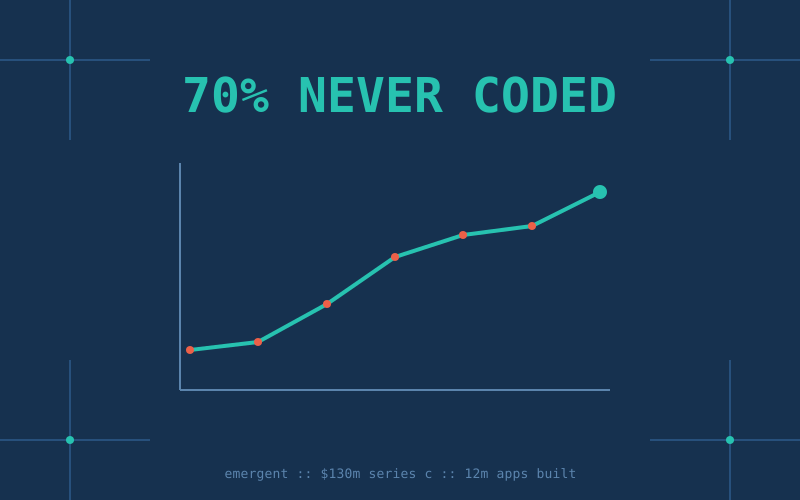
The number that should stop you is the customer profile. The company says 70% of its builders have never coded before, and more than 12 million apps have been made on the platform. This is not a developer tool that also welcomes beginners. It is a beginner tool that happens to output real software, and the developers are the minority.
CEO and co-founder Mukund Jha framed the bet plainly:
The real impact of the AI revolution will be a complete democratization of who gets to build what software, at a fraction of the cost.
The pivot from building to running
Here is the strategic tell. Back in April, Emergent shipped Wingman, an autonomous agent that lives inside WhatsApp and Telegram and runs tasks across your email, calendar, and workplace tools. You assign work in a chat and it executes in the background. The Series C narrative leans on it hard.
That is the move up the value chain. Building an app is a one-time event. Running the operations of a business is a subscription you renew forever. Emergent is trying to walk its non-coder audience from "make me a booking site" to "handle my follow-ups and scheduling," which is a much stickier place to sell from.
The part builders should actually watch
The traction is real. Emergent said it crossed a $100 million annual run rate within eight months of launch, and reporting since pegs revenue near $12 million a month. Those are not vanity numbers.
But the durability question is the one worth asking, and it is a familiar one. A prompt-to-app platform sits on top of frontier models it does not own. Think of a packed restaurant that does not own the kitchen: business is booming, but the landlord sets the rent and could open a competing place next door on a whim. When the model providers ship their own coding agents, and they keep doing exactly that, the wrapper has to prove it owns something the model does not: the distribution, the non-coder onboarding, the operational glue that Wingman is reaching for.
The gross-margin math matters too. If every generated app burns tokens you are reselling, revenue growth and cost growth are joined at the hip. A $100 million run rate is a great slide; the interesting number is what is left after inference. That is the debate quietly attached to this raise, and it is the one no funding press release answers.
For indie hackers the signal cuts two ways. The barrier to shipping software has functionally collapsed, which is either your new superpower or twelve million new competitors, depending on the day. And the frontier is no longer "can a non-coder build an app." It clearly can. The frontier is whether a non-coder can run a business on autopilot, and that is now a funded, contested race rather than a demo.
Key Takeaways
- The raise: Emergent closed a $130M Series C led by Creaegis at a $1.5B valuation, up from $300M in January. Total funding is around $230M.
- The audience: 70% of its builders have never coded, across more than 12 million apps. It is a beginner tool that outputs real software.
- The pivot: Wingman, launched in April, pushes past app-building into running operations via WhatsApp and Telegram. Recurring beats one-off.
- The traction: The company claims a $100M annual run rate within eight months, with revenue reported near $12M a month.
- The risk: Prompt-to-app platforms resell frontier-model tokens they do not own. Defensibility and margins after inference are the open questions.
- The signal for builders: Shipping software is no longer the moat. The contest has moved to autonomous operations.
Sources: IndianWeb2, TechFundingNews, Emergent (Wingman announcement), TechCrunch, BusinessWire