Google's New SDLC Paper: Your Agent Is 10% Model and 90% Harness
TL;DR
Google released The New SDLC With Vibe Coding, a roughly 50-page paper by Addy Osmani, Shubham Saboo, and Sokratis Kartakis (part of a 5-day AI Agents course). It maps the spectrum from casual "vibe coding" to disciplined "agentic engineering" and reframes the whole software lifecycle around one shift: from writing code to expressing intent. The line that should stick with builders is the equation Agent = Model + Harness, and the claim that the harness, not the model, is where most of your results come from. The paper cites the data: by early 2026, 85% of professional developers use AI coding agents, 51% daily, and an estimated 41% of all new code is AI-generated.
Vibe coding is a spectrum, not an insult
Andrej Karpathy coined "vibe coding" in early 2025 to describe fully giving in to the vibes: describe what you want, accept what comes back, paste the error in when it breaks. By early 2026 he admitted the framing was too narrow and added "agentic engineering" for the disciplined end. Google's paper runs with that and makes the key point sharp: the difference between the two ends is not whether you use AI. It is how the output gets verified. Tests cover the deterministic parts (this input, that output). Evals cover the parts that are not deterministic (did the agent take the right trajectory, choose the right tools, hit the quality bar). Without both, you are vibe coding no matter how clever your prompts are.
That distinction has teeth. Telling a CTO your team vibe-codes the payment system should set off alarms. Telling them you practice agentic engineering, with AI implementing under human-designed constraints while test coverage ensures correctness, is a different conversation entirely.
The real skill is context engineering
The paper argues the quality of AI output depends less on clever prompts and more on the quality of context. It names six types every agent needs (instructions, knowledge, memory, examples, tools, guardrails) and splits them into static context (always loaded, expensive, every token present every turn) versus dynamic context (loaded on demand, you pay only when needed). The most powerful pattern for managing dynamic context is Agent Skills: portable packages of procedural knowledge loaded only when a task calls for them, via progressive disclosure. The agent stays a lightweight generalist that flexes into a specialist on demand, carrying dozens of capabilities while paying the token cost of only the one in use.
Agent = Model + Harness
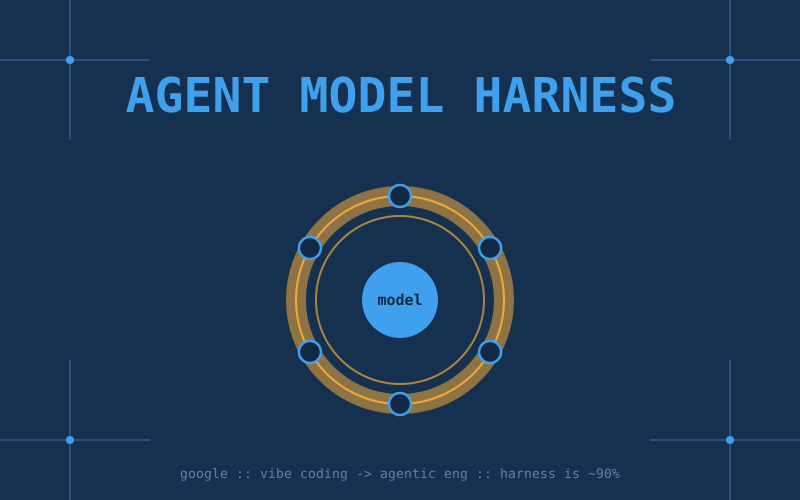
This is the paper's best idea, and the one most teams get wrong. When an agent misbehaves, the instinct is to blame the model. But the model is just the engine. Everything else, the prompts, tools, context policies, hooks, sandboxes, sub-agents, and observability, is the harness: the scaffolding that lets the model actually finish something. The behavior you feel using Claude Code, Cursor, Codex, or Gemini Code Assist is dominated by the harness, not the model underneath.
The numbers are concrete. On Terminal Bench 2.0, the paper reports one team moved a coding agent from outside the Top 30 into the Top 5 by changing only the harness, no model change at all. A separate LangChain experiment raised a coding agent's score on the same benchmark by 13.7 points by tweaking only the system prompt, tools, and middleware around a fixed model. The everyday version: when an agent does something wrong, the failure usually traces to a missing tool, a vague rule, an absent guardrail, or a context window stuffed with noise. Most agent failures are configuration failures.
The new lifecycle, and the factory model
AI compresses the SDLC unevenly. Implementation that took weeks now takes hours, while requirements, architecture, and verification stay stubbornly human-paced. So the shape changes: specification quality becomes the new bottleneck, architecture decisions get amplified at scale, and the iteration loop drops from weeks to minutes. The paper is honest that this is not a pure win. It cites a METR study where experienced developers were actually 19% slower on certain tasks, because the time saved typing got spent verifying, debugging, and correcting AI output. Headline surveys claim 25 to 39% productivity gains, but the picture is messier than the slogans.
The mental model that ties it together is the factory model: the developer's real output is no longer code, it is the system that produces code, specs, agents, tests, feedback loops, and guardrails. A factory manager does not assemble each widget by hand; they design the line and own quality control. Which leads to the paper's other warning, the 80% problem: agents rapidly produce about 80% of a feature, but the last 20% (edge cases, error handling, integration points, subtle correctness) needs deep context current models lack, and those failures are dangerous precisely because the code looks right and may pass basic tests.
Conductor or orchestrator
The developer's role splits into two modes the paper says you move between fluidly. The conductor works real-time and synchronous, in the IDE, keystroke-level control, guiding an AI pair-programmer (Copilot, Gemini Code Assist, Cursor, Windsurf). Good for exploration and unfamiliar code, but it caps your throughput because you are directing every move. The orchestrator works async and high-level, defining goals and delegating to agents working in parallel in sandboxes, then reviewing output (Jules, Copilot agent mode, Cursor background agents, Claude Code). It demands different skills: specification, decomposition, evaluation, and system design rather than syntax fluency.
The economics: who pays, and when
The part engineering leaders should read twice is the money. Vibe coding looks free (a monthly subscription, a few prompts) but hides a compounding operational bill: token burn from dumping unstructured files into the context and asking the model to fix its own unverified mistakes, a maintenance tax when someone reverse-engineers ad-hoc "spaghetti" six months later, and security remediation that is exponentially more expensive in production than at design time. Agentic engineering flips it: high upfront investment (specs, test suites, structured context) for a low marginal cost per feature thereafter.
Two levers cut the operational cost. Context engineering is one: passing a 100,000-token repo into every prompt is financially unviable, so you feed the model a dense, high-signal payload (a precise AGENTS.md, architectural guardrails) and raise first-pass success. Intelligent model routing is the other: use large frontier models for hard work (requirements, architecture) and route deterministic, low-complexity tasks (test generation, code review, CI monitoring) to smaller, cheaper, faster models instead of paying premium token prices to fix a typo.
Where to start
The paper's advice is refreshingly concrete. For an individual: set up an AGENTS.md (start with ten lines: stack, conventions, hard rules, workflow, and add a rule every time the agent does something it should not), install a set of skills, turn one repetitive workflow into your first agent, write the tests and evals before the code, and review every line that ships. For leaders: make context engineering a first-class practice (treat AGENTS.md, prompts, eval suites, and skill libraries as versioned, reviewed code), set the bar at the eval not the demo, reshape code review for AI-generated code, and adopt open standards like Model Context Protocol (MCP) for tools and Agent2Agent for cross-agent delegation.
The honest caveats
This is a Google paper, and it is selling a worldview (one that conveniently runs on Google's tooling and Gemini). The productivity numbers it cites are a grab bag of industry surveys, and it admits as much by quoting the METR result that cuts the other way. The harness-effect benchmarks (Terminal Bench, LangChain) are single data points, not laws. And the whole "agentic engineering" frame is, at bottom, a restatement of old software discipline: write specs, write tests, review code, version your config. The value is not novelty. It is that a major vendor is now saying out loud that AI does not let you skip the engineering, it raises the cost of skipping it.
Key Takeaways
- Google's paper frames AI development as a spectrum from vibe coding to agentic engineering, where the real differentiator is verification (tests plus evals), not whether you use AI.
- Agent = Model + Harness. The harness (prompts, tools, sandboxes, orchestration, guardrails, observability) drives most of the behavior; a harness-only change moved an agent from outside the Top 30 to the Top 5 on Terminal Bench 2.0.
- Most agent failures are configuration failures, not model failures.
- The economics favor agentic engineering at scale: high upfront CapEx, low marginal OpEx, with context engineering and model routing as the cost levers. Vibe coding is low CapEx but high, compounding OpEx.
- The durable shift is from writing code to exercising judgment. Generation is solved; verification, judgment, and direction are the new craft.
Sources: The New SDLC With Vibe Coding (Osmani, Saboo, Kartakis, Google), Model Context Protocol, Agent2Agent (A2A)