Human Security Projects 150x Cyber Week AI Agent Traffic, Meta's Muse Near 70%
On this page 7 sections
TL;DR
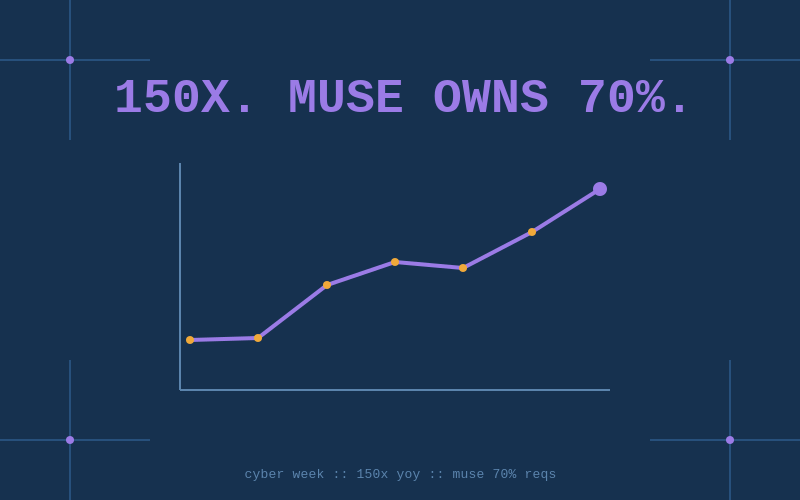
Human Security, the bot-defense firm whose monthly State of Agentic Traffic benchmark measures AI agents across the sites it protects, projects agent traffic during Cyber Week, November 26 to 30, at 150 times last year's level. Per Adweek, the firm's current data puts Meta's Muse at nearly 70 percent of agent-led site requests. October's verified numbers already showed the wave forming: agent traffic up 157.5 percent in a month, Meta and OpenAI carrying about 90 percent of it, checkout requests roughly doubling. If you run a store, this week's decision is whether agents get to buy, and your bot-protection settings are where that decision gets made.
The forecast for this week
Cyber Week starts today and runs through November 30, with Black Friday on the 27th. Human Security expects agentic traffic during the window to come in at about 150 times what it measured during last year's Cyber Week, and retail agent traffic to more than double from pre-holiday levels into the Black Friday peak, mirroring last year's 145 percent jump. The firm also expects block rates to dip, on the logic that a growing share of agent traffic is legitimate shopping rather than scraping.
Muse's share of agent-led requests has climbed from 59 percent in October to nearly 70 percent now, per Adweek's summary of the firm's data. Google's agents are a footnote in volume, under 5 percent, but they account for nearly 20 percent of agent requests to checkout pages.
"First real season." John Searby, chief strategy officer at Human Security, describing what Cyber Week means for agentic commerce after last year's test run.
October set the table
The October edition of the benchmark, published November 9, is the last full month of primary data before the holiday. Agentic traffic rose 157.5 percent from September and about eightfold from August. Muse, which launched September 8 in the US and just went live in the UK this week, went from new entrant to 59 percent of all agent requests in two months, sending 3.7 times the requests of the next-largest agent. Meta said on its October 21 earnings call that more than 10 million people in the US and Canada had set up Muse agents, about a quarter of them active on any given day.
The rest of the top ten reshuffled around Muse. Comet, the standalone agentic browser that led with 41 percent of agent traffic in August, is down to 3.6 percent. In Human's reading, consumers are settling into agents embedded in platforms they already use, while developer-facing tools like OpenAI's Codex Browser nearly tripled traffic. By sector, ecommerce took 59.9 percent of agent requests, travel 19.3 (passing media for the first time), and SaaS is the fastest grower at roughly four times September's volume, from a 1.2 percent base.
Browsing is the volume, checkout is the signal
Agents still mostly read. In October, 85.2 percent of agent requests hit product and search pages, up from 81 percent in September. Checkout and payment drew 1.9 percent of requests, a shrinking share of a fast-growing pie: Human says checkout volume grew 117 percent month over month.
Request counts undersell the buying, though, and the unit of measurement matters. Human counts requests; Microsoft Clarity counts sessions, and in late October Clarity found checkout steps in 25 percent of AI agent sessions against 15 percent for human ones. Requests are footsteps, sessions are whole trips: one agent errand is thirty product-page footsteps and a single stop at the till, so both numbers can be true at once.
Every independent measurement points the same direction. Shopify reported that orders arriving from AI searches grew 3.3 times year over year in the third quarter. And Cequence's first Agentic AI Security Index, published November 23, found the share of agent visits that sign in, book, buy, or pay rising from 1.4 percent to 13 percent over six months. During the early-holiday deal window of November 5 to 15, the share of agent visits ending in a purchase went from a 0.2 percent baseline to 3.0 percent, and agent purchases ran about 1,600 percent above Amazon Prime Day in June. Muse acted on 51 percent of its visits in its first 30 days; Amazon's own agent acted on 1 percent, making it the most cautious shopper in its own store.
Serve, block, or verify
Amazon cut Muse off from Amazon.com on September 20, citing unauthorized access. Walmart went the other way, letting agents complete purchases within customer-set spending limits like 50 or 100 dollars. An audit by Blend found 29 of 200 retailers refused its shopping agent outright.
Human's own holiday history suggests blocking loosens when money shows up. During Black Friday week 2025, more agent requests were blocked in absolute terms than any other week, yet the block rate, 4.7 percent, was the lowest of the nine-week window, down from 5.3 percent the week before. Human expects the same dip this year.
Impostors ride the same trend. Cequence logged bots posing as AI agents to probe for credentials and admin consoles up 2,600 percent since May, and 63 percent of visits claiming the Perplexity name were probes. Human's data puts account-takeover attempts at 23 percent of login attempts on the day before Black Friday 2025. An agent's name in a request header is a costume, not an ID.
Caveats
- Vendor data, vendor incentives. Human sells AgenticTrust and Cequence sells agent governance; both benchmarks cover their own protected customers, skew toward ecommerce, and have not been independently audited.
- The 150x is a projection against a small year-ago base, published via Adweek's summary of new Human data. The underlying November report, with Black Friday and Cyber Monday measured, lands after this week.
- Requests are not people. Every figure from Human is a request count; one shopping task generates dozens of product-page loads. Session-based tools like Clarity answer a different question.
- Some math is fuzzy. PPC Land found Human's claimed 117 percent checkout-volume growth does not quite follow from the published shares; the direction is confirmed, the exact multiple is not.
- The near-70 percent Muse share comes from Adweek's key takeaways on current Human data; the last primary monthly figure is 59 percent for October.
- Cequence's window closes November 15, before the Black Friday peak it is being used to preview.
Key Takeaways
- Human Security projects Cyber Week agent traffic at 150 times last year's, with retail agent traffic more than doubling into the Black Friday peak; Adweek reports Muse now near 70 percent of agent site requests, up from 59 percent in October.
- October agent traffic rose 157.5 percent month over month and about eightfold since August; Meta and OpenAI together carry roughly 90 percent, while Perplexity's Comet collapsed from 41 percent in August to 3.6 percent.
- Agents still browse far more than they buy: 85.2 percent of requests hit product and search pages and 1.9 percent reach checkout, but checkout volume roughly doubled in October.
- Independent signals agree the buying is real: Clarity sees checkout steps in 25 percent of agent sessions versus 15 percent for humans, Shopify's AI-search orders grew 3.3 times year over year, and Cequence measured purchases in 3.0 percent of agent visits during early holiday deals, up from a 0.2 percent baseline.
- Retailers are split: Amazon blocks Muse, Walmart allows capped agent purchases, and 29 of 200 retailers refused Blend's shopping agent; Human expects block rates to dip as legitimate agent shopping rises.
- The security flip side grows with the opportunity: fake-agent probing is up 2,600 percent since May, and account-takeover attempts hit 23 percent of logins the day before Black Friday 2025. Verify agents by behavior and identity, never by the name they claim.
Sources: Adweek, Nov 25, 2026, Human Security, State of Agentic Traffic, Oct 2026, Human Security, Black Friday 2026 Predictions, Cequence Agentic AI Security Index, Nov 23, 2026, PPC Land, Nov 13, 2026, PPC Land on Microsoft Clarity, Oct 29, 2026, Meta, Introducing Muse in the UK