Linux 7.4's Merge Window Takes 18,591 Changesets in Two Weeks, Nearly a Whole 7.3 Cycle
TL;DR
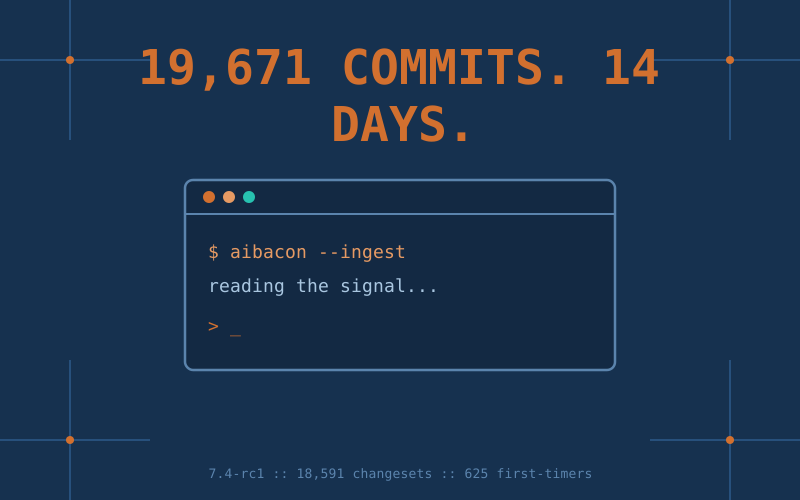
Linux 7.4-rc1 is out. Linus Torvalds tagged it on November 1 at 21:26 UTC, closing the biggest merge window the kernel has ever had. LWN counts 18,591 non-merge changesets in two weeks, within 174 of the 18,765 that the entire nine-week 7.3 cycle produced. Phoronix, counting every Git commit including merges, gets 19,671 against a 15-year norm of roughly 13,000 to 14,000. Torvalds says the cause is "the by now obvious one" and that he is "*much* happier" seeing AI-triggered work land in the merge window than as a flood of fixes during the -rc period. So far 2,678 developers have contributed to 7.4, and 625 of them are first-time kernel contributors.
The window that ate a cycle
Michael Larabel at Phoronix pulled Git commit counts for every merge window back to Linux 3.1 in 2011. The long-standing record was 6.7's 16,203. Linux 7.3 edged past it two months ago with 16,267. Linux 7.4 then cleared both by a wide margin at 19,671, about 21% more than 7.3 and 40% to 50% above the typical window of 13,000 to 14,000 commits.
LWN's count excludes merge commits, which is why its figure is about 1,080 lower, and it tells the same story. Its tallies at each rc1 run 11,588 for 7.0, 12,996 for 7.1, 13,412 for 7.2, 15,267 for 7.3, and now 18,591 for 7.4. The jump from 7.3 to 7.4 is 22%, the largest step in the series.
LWN's 7.3 statistics put that release at 18,765 non-merge commits over 63 days, a cycle that "broke just about every record imaginable." Linux 7.4 came within 174 commits of that in 14 days. On Phoronix's all-commits basis, 7.3 was the first cycle ever past 20,000 (20,260 from the v7.2 tag to v7.3). The 7.4 merge window alone landed 19,671.
What Torvalds said
Torvalds named the cause in the rc1 announcement:
"This is a *BIG* merge window. I think the reason is the by now obvious one, but I'm actually taking it as a good sign: I'm *much* happier with the flood of AI triggered work going into the merge window than it showing up mainly as extra fixes during the -rc period. So I'm hoping that this merge window being larger than usual is a sign that the AI fixes are becoming more part of the "normal development" than a flood of fixes that go into the whole stabilization phase. I think that's a much healthier model. But we'll see how the -rc's look."
The merge window is the two weeks in which the kernel accepts new work. The seven or eight weekly -rc releases that follow are for fixing what came in. Think of a restaurant that takes deliveries before service: boxes arriving at the back door during dinner is how plates get dropped. That, by Torvalds' account, is where the AI-found fixes had been arriving. He reads a fat merge window and, he hopes, thin -rc releases as the deliveries finally moving to the morning.
He adds a second cause that has nothing to do with language models. "A small part of the 'this is a big merge window' may also be that people are expecting 7.4 to be the next LTS release, which is another independent reason why some releases tend larger than others. So it may not *just* be the flood of AI patches." Developers like to get work into the kernel that distributions will carry for years.
On the raw size: "it's huge both in commits - almost 20k commits vs the more common ~15k - and as a diff." The shortlog alone is 24,000 lines and 1.2 MB. The diff, though, is inflated by an old friend. "A full third of the patch is just AMD GPU register offsets and bit masks. We've been here before, and I'm sure we'll see it many times again in the future. Just ignore the noise." The kernel's most prolific author remains AMD's header generator, which has never needed an LLM. Per the full announcement, once you ignore those headers about half the change is drivers, with the rest spread across architecture updates, filesystems, tooling (mainly perf and selftests) and core work in networking, Rust, BPF and memory management. Two pull requests were still sitting in his inbox and may show up in rc2.
Who showed up
LWN counts 2,678 developers in 7.4 so far, 625 of them contributing to the kernel for the first time. For scale, the entire 7.3 cycle had 3,021 developers and 807 first-timers, both records, with LWN noting that "well over a quarter" of 7.3's contributors were new. Two weeks of 7.4 have already reached 89% of 7.3's nine-week developer count.
The 7.3 statistics also show where the volume comes from. "Automated systems are the source of nearly half of the credited bug reports," LWN wrote. The Sashiko review tool accounted for 304 Reported-by credits (19.4%), ahead of syzbot at 239 (15.3%) and the kernel test robot at 89. Kylinsoft alone fielded 92 developers, most with a handful of commits each, who "appear to be working through lists of LLM-identified bugs."
You will not get a cleaner number for 7.4. The docs pull that removed the Assisted-by tag was merged on October 21, inside this merge window, after only about 10% of 7.3's commits carried it. The instruments left are commit counts and Torvalds' nose.
Half a million lines of code in two weeks
Larabel also ran cloc over the tree. The v7.3 tag measured 41,019,555 lines, of which 30,962,306 were code. The tree just before rc1 measured 41,605,120 lines, with 31,417,938 of code. That is 455,632 new lines of code in two weeks, before counting 75,056 lines of comments and 54,877 blank lines. Phoronix expects the tree to pass 42 million lines during the 7.5 cycle early next year.
What is actually in 7.4
Phoronix's rc1 write-up lists the headline changes. A new AMD PerfOpt feature for Radeon integrated GPUs targets AI and LLM workloads. AMD Zen 6 enablement is largely complete ahead of the client CPUs. AMDGPU turns on HDMI 2.1 by default. Intel IPU8 support arrives for upcoming Nova Lake laptops, alongside more Qualcomm Snapdragon X2 laptop enablement. EXT4 gains optional buffered iomap support. Basic Apple M4 bring-up lands, though it is not ready for end users. Google's Tensor G5 and the Pixel 10 get mainline support, and kernel build times are faster.
If the cycle holds to the normal schedule, Phoronix expects the final 7.4 on December 20, which would make it this year's long-term support kernel. Torvalds had warned in the 7.3 announcement that his holidays might stretch this merge window by a week. He kept up anyway.
What to watch
Torvalds' own caveat is the right one: "we'll see how the -rc's look." If rc2 through rc7 come in at ordinary sizes, the fixes really did move forward into the window and his healthier model holds. If they fill with the kind of fix flood he describes, the volume simply arrived twice.
PostgreSQL faced the same pressure and made the opposite call. PostgreSQL 19 slipped its release because committers could not clear the backlog of LLM-found bugs in time. The kernel runs a time-based release and does not slip; it absorbs. One project traded its date for its review bar, the other is betting that the merge window can hold the flood while the -rc period stays calm. Both are experiments, and the kernel's reads out in about seven weeks.
Two measurement notes if you plan to quote these figures. LWN's 18,591 and Phoronix's 19,671 both describe the same window; the gap is merge commits, which LWN excludes. And the diff size says little about AI, because a third of it is machine-generated AMD register headers that predate the language-model era by a decade.
Key Takeaways
- Linux 7.4-rc1, tagged November 1, closes the largest merge window on record: 18,591 non-merge changesets (LWN) or 19,671 total commits (Phoronix), versus a long-run norm of 13,000 to 14,000.
- Two weeks of 7.4 intake came within 174 commits of the entire 63-day 7.3 cycle, which itself broke most kernel records.
- Torvalds attributes the size mainly to AI-triggered work and calls it a good sign, because he would rather see it in the merge window than as -rc fixes. LTS expectations are a secondary cause.
- 2,678 developers have contributed so far, 625 for the first time; 7.3's automated reporters produced nearly half of its credited bug reports.
- The tree grew by 455,632 lines of code to 31.4 million, but a third of the diff is AMD register headers, so line counts are a weak AI proxy.
- The verdict lands in the -rc releases: quiet rcs vindicate Torvalds' model, fat ones mean the fixes just arrived twice.
Sources: LWN: Kernel prepatch 7.4-rc1, Phoronix: Linux 7.4-rc1 Released, Phoronix: The Linux 7.4 Merge Window Is Easily The Largest In Kernel History, Phoronix: Linux 7.4 Merge Window Saw Nearly 20k Commits, LWN: Development statistics for the 7.3 kernel, LWN: The rest of the 7.3 merge window, LWN: The rest of the 7.2 merge window, LWN: The rest of the 7.1 merge window, LWN: The second half of the 7.0 merge window, Tux Machines: Linus 7.4-rc1, torvalds/linux v7.4-rc1 tag, kernel.org