Lovable Doubled to $13.3B. Its Multiple Actually Shrank.
TL;DR
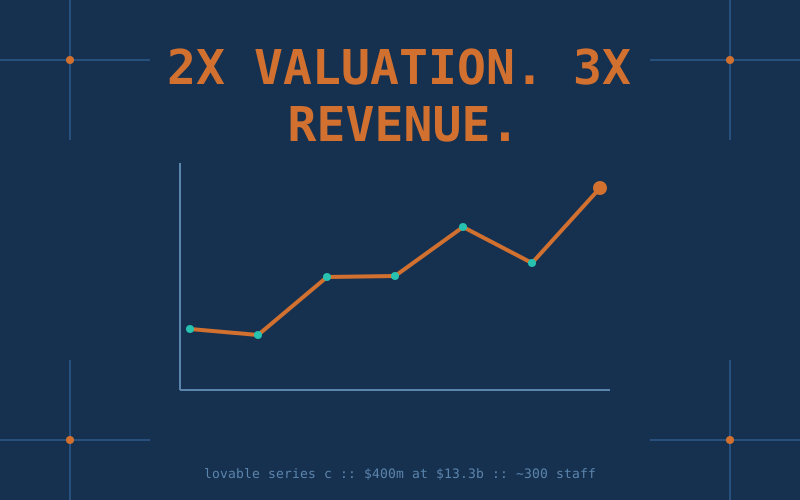
On August 12, Lovable announced a $400 million Series C at a $13.3 billion valuation, co-led by Menlo Ventures and the Scaleup Europe Fund managed by EQT. That is exactly double the $6.6 billion it carried in December. The number worth noticing is not the valuation, though. It is the ratio. The price went up 2x while annual recurring revenue went up roughly 3x, from about $200 million to a run rate Reuters reports is tracking toward $600 million by the end of August. In a year when AI multiples mostly went one direction, Lovable's went the other.
The round
Menlo Ventures and the EQT-managed Scaleup Europe Fund co-led. New money came from Tencent, Balderton Capital, Carmignac, Kaszek Ventures, LTS Growth, World Innovation Lab, and Regent. Returning investors include Accel, Antler, CapitalG, DST Global, Evantic Capital, HubSpot Ventures, and Salesforce Ventures. It is a long list, which is what happens when a European company posts American growth numbers.
The ladder, for context:
- February 2025, Series A: $200 million at $1.8 billion, led by Accel.
- December 2025, Series B: $330 million at $6.6 billion, co-led by CapitalG and Menlo Ventures.
- August 2026, Series C: $400 million at $13.3 billion.
The multiple went the wrong way, and that is the story
Do the division. In December, $6.6 billion against the $200 million ARR Lovable had reported that November is 33x revenue. Today, $13.3 billion against the roughly $600 million run rate it is tracking toward is about 22x. Even if you refuse the forward number and use the $500 million annualized run rate TechCrunch reports for June, you land near 27x. Every honest way to cut it comes out below 33x.
A revenue multiple is really just the market's patience with a price tag on it. At 33x, the cheque equals thirty-three years of revenue at the run rate of the day, and nobody is planning to wait thirty-three years. You are paying for the slope, not the level. What changed between December and August is that a chunk of the slope stopped being a projection and turned up in the bank, so the same optimism now costs eleven fewer years of revenue. Investors did not mark Lovable down per dollar because they lost their nerve. They did it because the dollars arrived faster than the story required.
Who is actually paying
Lovable says it reached employees at half the Fortune 500 within its first year, and that the figure is now "nearly two-thirds." Reuters names Nvidia, Deutsche Telekom, and Adidas as customers; TechRepublic adds Hearst and Zendesk. Note the careful phrasing in the company's own wording: employees at those companies, which is bottom-up seat sprawl, not signed enterprise agreements. Both are real revenue. They are not the same revenue.
The survey number Lovable published is more interesting than the logo wall. It says nearly 8 in 10 users are building a business or side project they hope to monetize, and "more than one-third of those are already earning revenue." Read that twice: it means close to two-thirds of the monetization-minded builders have not earned a cent yet. That is either a very large untapped conversion pool or a very large pile of abandoned side projects, and the announcement understandably declines to say which.
The volume numbers
More than 60 million projects created since the November 2024 launch, and over 900 million monthly visits to Lovable-built apps. Both are worth comparing against the company's own figures from ten weeks earlier: in the June 3 Google Cloud announcement, Lovable cited 600 million monthly visits and over a million new projects a week. Traffic to the output, not just the tool, grew by half in a quarter.
The part builders should actually read
Buried under the funding headline is the model strategy, and it is the most load-bearing paragraph in the whole announcement. Lovable says it will "continue to draw on the strengths of multiple models, matching each part of the work to the model best suited to handle it," and, separately, that it will "continue post-training promising open-source models."
That is a company at a $13.3 billion valuation telling you its cost of goods sold is somebody else's inference bill, and that it intends to do something about it. A router that sends the cheap steps to cheap models plus a post-trained open-weight model for the high-volume paths is the only margin lever a prompt-to-app company has that does not involve raising prices. Every serious player in this lane, Replit and Cursor included, is running some version of the same play.
The infrastructure side is already committed. The June Google Cloud deal is multiyear, puts Google Cloud in as a primary technology partner, wires Gemini models into the workflow, adds Wiz vulnerability scanning, and lists Lovable Agent in the Gemini Enterprise Agent Gallery. Hiring follows the same shape: roughly 450 people this year, weighted toward machine learning, product, infrastructure, and security.
There is a nice symmetry in the founder path here. CEO Anton Osika shipped gpt-engineer as an open-source CLI experiment in 2023, and it went on to collect north of 55,000 stars. Three years later the commercial descendant is worth $13.3 billion and is going back to post-training open weights to defend its gross margin.
The caveats, stated plainly
- ARR is self-reported and is a run rate, not audited GAAP revenue. Nobody outside the cap table has checked it.
- No churn, no net revenue retention, no profitability disclosed. For a product with a large prosumer base, retention is the number that decides whether 22x was cheap or generous.
- Headcount is thinly sourced. TechRepublic puts current staff near 300, which pencils to roughly $2 million of run-rate revenue per employee. At the stated 450 target, that falls toward $1.3 million unless revenue keeps climbing.
- Valuation figures are not specified as pre or post-money in any of the reporting, so the $6.6 billion to $13.3 billion comparison assumes both are quoted the same way.
- Disclosure worth repeating: TechCrunch noted that Regent, one of the Series C investors, owns TechCrunch's parent company.
Key Takeaways
- Lovable raised $400 million at a $13.3 billion valuation on August 12, co-led by Menlo Ventures and EQT's Scaleup Europe Fund, exactly double its December mark.
- The valuation grew 2x while ARR grew roughly 3x off a $200 million base, compressing the revenue multiple from about 33x to about 22x. On June's confirmed $500 million run rate it is still only about 27x.
- Traction is real and independently restated: 60 million projects since the November 2024 launch, 900 million monthly visits to Lovable-built apps, up from 600 million just ten weeks earlier.
- Lovable says it will keep post-training open-source models alongside multi-model routing, which is the margin play for anyone whose COGS is a frontier lab's API bill.
- The soft spot is durability: no churn, no retention, no profitability, and by the company's own survey nearly two-thirds of would-be monetizers have not made money yet.
Sources: Lovable Series C announcement, TechCrunch, Reuters, TechRepublic, Google Cloud press corner, Wikipedia funding history