Third Circuit Rules ROSS's AI Training on Westlaw Headnotes Was Not Fair Use
TL;DR
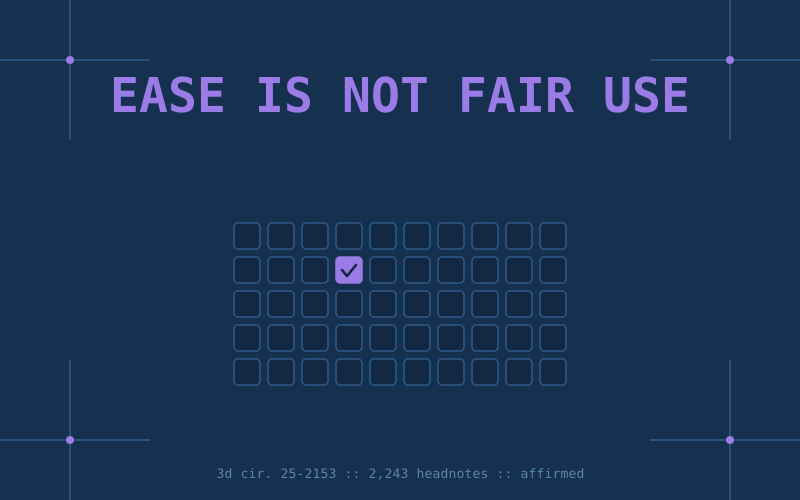
The US Court of Appeals for the Third Circuit has affirmed that Westlaw headnotes are copyrightable and that ROSS Intelligence's use of them to train an AI legal search engine was not fair use. The panel ruled on September 29 under seal, and the opinion went public on September 30. Judge Tamika Montgomery-Reeves calls it "no more than an ordinary copyright case": ROSS built a direct Westlaw competitor out of Westlaw's own editorial work, when free judicial opinions were sitting right there. The opinion also goes out of its way to say the result does not automatically carry over to generative models like the ones in Bartz v. Anthropic or the OpenAI litigation.
What the court decided
The case is Thomson Reuters Enterprise Centre GmbH v. ROSS Intelligence Inc., No. 25-2153, an interlocutory appeal from Judge Stephanos Bibas's February 2025 ruling in Delaware. The panel was Judges L. Felipe Restrepo, Tamika Montgomery-Reeves, and Emil Bove. It heard argument on June 11, 2026.
Two questions were certified for appeal: are the headnotes original enough to copyright, and was ROSS's use fair? The answer is yes and no. As LawSites and Copyright Lately both note, this is the first federal appellate ruling on fair use in AI training. For roughly a day, the only public document was a one-page judgment that said "AFFIRMED."
How ROSS built its training set
ROSS, founded by three University of Toronto students out of an IBM Watson competition, wanted a search engine that answered plain-English legal questions with passages from judicial opinions. The opinion is explicit that this was not generative AI: ROSS "would only return text passages from preexisting judicial opinions," drawn from a bank of roughly ten million uncopyrighted opinions.
To teach the model which passages answer which questions, ROSS hired LegalEase Solutions to write about 25,000 training memos. Each memo posed a legal question and labeled four to six opinion passages as great, good, topical, or irrelevant. The memo writers built their questions from Westlaw headnotes because the headnotes offered, in the record's words, "an easy way [to] fram[e] questions." The "great" passages were most often the exact passages Westlaw linked to the headnote.
ROSS never hid the goal. It ran ads comparing itself directly to Westlaw at prices "in line with" Westlaw, and some law firms switched. That fact ends up deciding most of the case.
Headnotes are copyrightable
The originality bar under Feist is "extremely low," and the court says all 2,243 headnotes clear it. Editors decide which points of law matter and how to phrase them so each headnote stands alone in about 800 characters. The court leans on 19th-century Supreme Court precedent (Callaghan v. Myers) and on Georgia v. Public.Resource.Org, which both treat a private reporter's headnotes as protectable.
ROSS argued this would give Thomson Reuters "a monopoly over the law." The panel's reply is two sentences long: "Headnotes are not law; judicial opinions are." The merger doctrine fails too, illustrated with a Third Circuit precedent about a banana costume, because there are many ways to summarize a point of law. Two questions stay open: whether headnotes that quote an opinion verbatim are protectable, and the Key Number System, which ROSS never briefed.
The fair-use scorecard
Fair use turns on four statutory factors. ROSS won one, and only barely.
Factor 1: same purpose, so barely transformative
Under the Supreme Court's Andy Warhol Foundation v. Goldsmith test, the question is whether the copier has a distinct purpose. Thomson Reuters uses headnotes to help researchers find relevant opinions. ROSS used them to train a system that helps researchers find relevant opinions. The training step "arguably presents a slight degree of difference," but both companies were building "a legal-research platform that helps users find responsive legal material." Verdict: "minimally transformative, at best," and commercial.
ROSS's best precedents were the intermediate-copying cases: Sega v. Accolade, Sony v. Connectix, and Google v. Oracle. The court says copying was allowed there because it was the only way to reach the unprotected functional parts of the code. ROSS had the unprotected material, the opinions themselves, and skipped it. The opinion's sharpest line: "Unlike necessity, ease is not a justification for copying."
Think of the interoperability cases as picking a lock because it is the only door into the building. ROSS had the front door open and climbed in through the neighbor's window because it was closer.
A footnote adds bad faith on top. According to the record, ROSS tried to access Westlaw with a law-firm investor's credentials, an employee asked about an account "under the guise of a solo practitioner," and another used a student account. That is the legal-research equivalent of showing up in a fake mustache.
Factor 3: 0.08% is still too much
ROSS argued it took a rounding error: 0.08% of Thomson Reuters's 28 million headnotes. The court did not accept it. Each headnote is its own copyrighted work, so for each one ROSS copied the whole thing. And because the purpose was not transformative and the public opinions were available, it "took more than necessary."
Factor 4: the AI training-data market is real
This is the part every AI company should read. ROSS argued there is no market for headnotes as a standalone product. The court said the statute protects the work's value, not just a narrowly defined market, and headnotes are a reason people buy Westlaw. ROSS's copying weakened that.
The court then accepted a derivative market for licensing headnotes as AI training data, which it describes as "rapidly developing." Thomson Reuters had never licensed headnotes to anyone for training, and the court said that does not matter: "That Thomson Reuters did not license its headnotes to others does not disprove that a market exists to do so." ROSS also argued that AI development and national security justified the copying. Neither came with evidence, and AI does not give anyone "carte blanche to violate copyright law merely because it incorporates AI."
The generative AI carve-out
Footnote 7 is the paragraph labs will quote. The court addresses the DOJ's September 1 statement of interest in the OpenAI copyright litigation, which relied on Bartz v. Anthropic to argue that training a model that can "generate original responses" is transformative. The panel says those concerns "do not apply here," because "ROSS's AI platform cannot generate original expression" and ROSS "trained its AI for the purpose of creating a commercial substitute for Westlaw." It also notes, a little pointedly, that the DOJ knows how to weigh in on these cases "but the DOJ notably did not do so here."
So the ruling does not decide whether training GPT-class models on books or news is fair use. It does say that training is not automatically transformative, that a competing substitute loses factor one, and that a training-data licensing market counts under factor four. Plaintiffs in the generative cases will cite all three.
What it means if you build with AI
- Provenance matters more than volume. ROSS lost over 2,243 summaries, not a scraped internet. A small, curated, copyrighted dataset can sink you if your product competes with its owner.
- Use the public source if one exists. The court's main point is that ROSS could have trained on public-domain opinions and chose a shortcut. If the raw material is free, labeling someone else's derivative work is the risky option.
- Read the Terms of Service. Borrowed credentials and disguised accounts turned up as bad-faith evidence. Your growth hack can end up in a footnote.
- Licensing is the expected path. Once a court recognizes a training-data market, every unlicensed use can be framed as lost licensing revenue.
Limits: this is a Third Circuit ruling, so it is binding in Delaware, New Jersey, Pennsylvania, and the Virgin Islands and only persuasive elsewhere. It reviewed a partial summary judgment, so the remaining claims return to the district court. ROSS has already shut down, which makes this a precedent fight more than a damages fight.
Key Takeaways
- The Third Circuit affirmed that 2,243 Westlaw headnotes are copyrightable and that ROSS's use of them to train a competing AI search engine was not fair use (No. 25-2153, filed September 29, unsealed September 30).
- Factors one, three, and four went against ROSS. Only factor two favored it, and only slightly.
- "Unlike necessity, ease is not a justification for copying": skipping free public opinions for convenient copyrighted summaries defeated the intermediate-copying defense.
- The court recognized a "rapidly developing" market for licensing content as AI training data, even though Thomson Reuters had never licensed headnotes to anyone.
- The panel explicitly separated ROSS's non-generative, substitutive tool from generative models in Bartz and the OpenAI cases, so the big LLM fair-use question remains open.
Sources: Third Circuit opinion, No. 25-2153 (PDF), Courthouse News, Bloomberg Law, LawSites, Copyright Lately, Musicologize