Menlo Ventures Finds Enterprise AI Spend Up 5.4x to $177B, With 69% to Three Labs
TL;DR
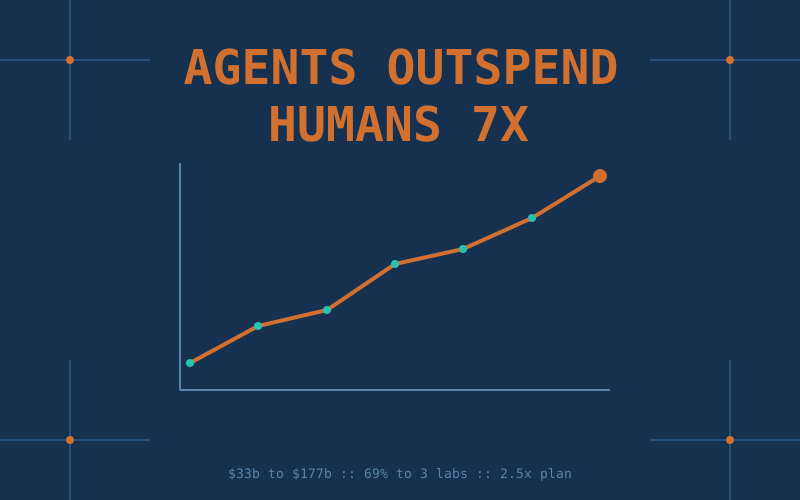
Menlo Ventures' 2026 State of Enterprise AI puts enterprise AI deployment spend at $176.8B as of September 2026, up 5.4x from $33B a year earlier. The engine is agents: on OpenRouter they now generate 80% of all tokens, roughly 7x human traffic, and the average enterprise spent 2.5x its AI plan because the work, and the billing, continued after people logged off. Anthropic, OpenAI and Google captured $122.7B of it, 69% of all deployment dollars.
How the number was counted
This is Menlo's fourth annual enterprise AI report. It draws on a survey of nearly 400 US enterprise decision-makers responsible for more than $4B in AI spending, fielded by Morning Consult from September 8 to 26, 2026. The market figures are Menlo's own bottoms-up estimates built from that survey, public filings and third-party data, shown as annualized run rate. Informed estimates from a firm with a stake in them; the stake is itemized in the caveats.
The trajectory: $1.7B in 2023, $8.5B in 2024, $33B in 2025, $176.8B now. Deployment spend is more than 30% of public cloud revenue, up from 6% a year ago. For every dollar going into building models, $1.70 goes into using them: $102.5B on training compute, data and services, against $176.8B on inference, infrastructure and apps.
Agents are the customer now
Menlo's causal story is that agents changed the shape of consumption. Agent traffic on OpenRouter tripled the week after Opus 4.5 shipped in November 2025, passed human traffic in early February after the Opus 4.6 and GPT-5.3-Codex launches, and has grown 37x since, against 5x for humans. Agents now account for 130.9T tokens a week, 80% of the platform's total. OpenRouter is one channel and its users skew toward developers and startups, a bias Menlo flags itself.
The budget data tells the same story from the buyer side. Enterprises planned to spend 1.9x last year's AI budget on average and reported 4.7x, about 2.5x plan. The median enterprise landed at 2.2x against a 1.8x plan, so a fat head of power users drives the average; most buyers sit closer to their plan than the headline suggests. Adoption rose only from 55% to 65% while spend per enterprise nearly quintupled.
The mechanism is plain arithmetic. Seat software bills like a gym membership; an agent fleet bills like a cab with the meter left running, one ride per task, all night. Spend scales with work performed instead of headcount.
Sixty-nine cents of every deployment dollar went to three labs
Anthropic, OpenAI and Google command $122.7B of enterprise spend, 69% of deployment dollars, up from 50% a year ago. Their spend grew 7.5x year over year while everyone else's grew 3.3x. In the API market specifically, Anthropic went from 40% to 55%, OpenAI from 27% to 31%, and Google fell from 21% to 9%. The top two now hold 86% of enterprise LLM API spend, up from 67%.
Buyers also traded up. A year ago the most popular models were Claude Sonnet 4.5 at $3/$15 per million tokens and GPT-5 at $1.25/$10. Today they are Claude Opus 5.5 at $4/$20 and GPT-6 Astra at $10/$60, and the mix shift kept most of the value with the most capable models.
The labs take the app layer too. Claude Code and Codex together account for $24.0B, 70% of all coding spend, up from about $1B a year ago. Enterprise Claude, ChatGPT and Gemini subscriptions make up $15.5B, 62% of chatbot and productivity spend.
The software-budget war is the small table
Where did the incremental money come from? Menlo asked. Net-new budgets funded 55% of it, software budgets 22%, labor and other lines the remaining 23%. Inside the software slice, 13 points stayed with incumbents converting their own licenses, think Microsoft Office to Copilot, and 9 points, $12.6B, moved to AI-native vendors. That 9-point shift is what Menlo prices as roughly a 2-point growth headwind for the $600B+ application SaaS market, which grew about 11% this year instead of 13%.
The report also found little evidence of enterprises ripping out systems of record like Salesforce, Workday or NetSuite. SaaS is growing more slowly, and it is not being replaced.
SaaStr's read is the sharpest one on this table: a product priced like the seat product it replaces is competing for the 22%. A product that charges 2x that and still gets bought is being paid out of the other 78%.
Two categories are 76% of the app market
The application market is $77.3B. Coding is $34.0B of it, up 7.7x, and enterprise chatbots are $25.0B, up 3.0x. Together: 76%. Healthcare, one of the largest industries on earth, ranks third at $3.7B. Menlo's explanation is that agents thrive where they get systems to act in, complete context to learn from, and results anyone can verify, and coding plus chat tick all three boxes. Support does too, and customer-success spend grew 4.3x to $2.7B; HR, where judgment is subjective, grew 2.5x to $0.9B.
Independents still grew behind the labs. The rest of the coding market, outside Claude Code and Codex, grew 2.9x to $10.1B across Cursor, Cognition, Factory and Lovable. Lovable alone adds more repos per month, +32M, than all of GitHub at +24M, and Menlo says enterprise code activity overall is up 5x. AI-native vendors hold 77% of application-layer spend and 90% of infrastructure spend. Incumbents keep the categories where they own the system of record: ServiceNow has 91% of AI spend in IT, and Workday 68% in HR.
Open source runs a fifth of the tokens for a twenty-fifth of the money
Open-source models went from 11% to 19% of tokens, and their share of spend fell from 6% to 4%. Volume rose 22.5x to an estimated 2.9 quadrillion tokens a month, while the average open token price dropped 3.3x to $0.13 per million, against $0.70 blended for closed models. Popularity is up, revenue share is down; the units got cheap faster than they got used.
Chinese models take 89% of open-source spend: Kimi 61%, DeepSeek 15%, GLM 11%, Qwen 3%. Meta's Llama is the most popular Western open model at 7%.
One more pricing detail matters if you bill by the token. Cache reads can make up 95%-plus of an agent's tokens, and Opus 5.5 charges $0.20 per million for them against $4 fresh input and $20 output. At a mix of 3% fresh input and 2% output, an agent session costs about $0.70 per million tokens. As agents take over usage, blended prices fall on their own.
What to steal
- Price against work, not seats. The customers who blew 2.5x past plan are the ones a per-seat price caps hardest. Consumption, resolution and outcome pricing follow what agents actually do at 3 a.m.
- Pick your budget line. If your product has to win the software line, you are fighting incumbents for the smallest pool. Net-new and labor budgets are several times bigger and buy 2x-priced products happily.
- Ride the agent infrastructure curve. Code sandboxes went from 11% to 40% of builders this year, agent search from 5% to 30%, browser infrastructure from 4% to 14%. 74% of builders now run agents and 32% run more than one. Infrastructure that assumes human-paced usage is being rebuilt for machine-paced usage.
- Expect cache economics. If agents are your users, most of your token volume is cache reads at a fraction of list price. Model your margins on the $0.70 blended session, not the $20 output sticker.
Caveats
- Menlo is an investor in many companies the report covers, including Anthropic, OpenRouter, Fireworks, Modal, Mercor, Fleet, Legora and Lovable. The report says so itself.
- The dollar figures are Menlo's bottoms-up estimates, not audited numbers. Revenue is annualized run rate, and prior years were reclassified under this year's taxonomy, so growth rates are not strictly like-for-like.
- The average overspend comes from a fat head of power users; the median enterprise spent 2.2x last year against a 1.8x plan. Most buyers look nothing like the 4.7x average.
- The OpenRouter agent share comes from one gateway whose users skew toward developers and startups. Menlo flags this too.
- The survey covers nearly 400 US decision-makers only. Europe and Asia are extrapolation at best.
Key Takeaways
- Menlo Ventures estimates enterprise AI deployment spend hit $176.8B by September 2026, up 5.4x from $33B, and now exceeds 30% of public cloud revenue. Using AI now costs $1.70 for every $1 spent building it.
- Agents drive the curve: 80% of OpenRouter tokens, 130.9T a week, 37x growth since passing human traffic in February. The average enterprise spent 2.5x its AI plan; the median spent about 1.2x its plan.
- Anthropic, OpenAI and Google captured $122.7B, 69% of deployment dollars. In API spend, Anthropic rose to 55%, OpenAI to 31%, Google fell to 9%, and the top two hold 86%.
- Only 22% of incremental AI spend came from software budgets, and 13 of those points stayed with incumbents; AI cut app SaaS growth about 2 points, from 13% to 11%. No evidence of systems of record being replaced.
- Coding ($34.0B) and chatbots ($25.0B) are 76% of the $77.3B app market. Claude Code and Codex alone are $24.0B of it. Independents still grew 2.9x to $10.1B.
- Open-source models handle 19% of tokens for 4% of spend, with Chinese models at 89% of open-source spend and Kimi alone at 61%.
Sources: Menlo Ventures, 2026: The State of Enterprise AI, Menlo report PDF, SaaStr analysis, GlobeNewswire release