220% More Code, 36% More Product. Zuckerberg Blinked.
TL;DR
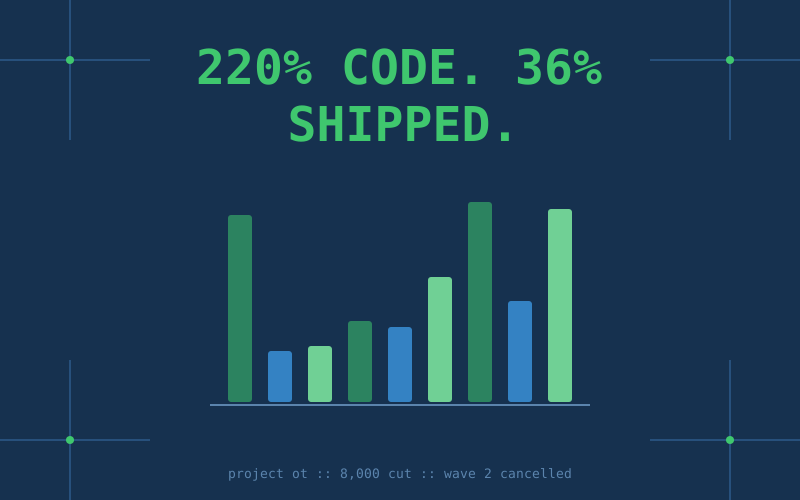
In January, Meta's leadership went to Mark Zuckerberg's Hawaii compound and came back with Project OT, short for Organization Transformation: replace most of the daily work of thousands of employees with AI agents, supervised by small "talent-dense" pods of humans. A Reuters special report published August 26, built on internal documents, posts, recordings and more than 20 sources, lays out what happened next. By early June the internal telemetry read: code changes to Meta's platforms and infrastructure up 220% year over year, new or improved features actually reaching users up 36%, major technical and security incidents up 40%, and time spent firefighting up 70%. The November layoff wave was called off the night of May 19, hours before the May 20 wave went ahead.
The plan was not a metaphor
Plenty of executives say "AI-native" and mean a slide. Project OT had an org chart. According to Reuters, an internal AI-Native Playbook proposed replacing traditional product teams of 10 to 20 specialists with pods of roughly three to five people, with engineers, designers and product managers collapsing into a general-purpose "builder" role. Unit heads, called Org Leads, would carry 30 to 50 people. Pod Leads would run day-to-day work with no formal authority, which is either a flat organization or a management theory with the seatbelts removed, depending on where you sit.
Early pilots under VP of Product Management Ime Archibong stood up five small technology pods, each two to three engineers plus a designer. Scenario planning explored cutting some individual teams by as much as 60%. Meta told Reuters that never meant cutting 60% of the company, which is true, and is also what you call a number after you decide not to use it.
The number that killed it
Look at the top bar and the bottom bar together. A 220% rise in code changes against a 36% rise in features reaching users is not a productivity win with a lag. It is a queue forming somewhere between the diff and the user, and the 40% incident spike plus the 70% jump in firefighting time tells you roughly where.
Think of a restaurant that installs six more stoves and hires nobody else. Plates leave the range faster than ever, then pile up under the heat lamp because there is still one expediter, one pass, and one person who checks that the order is actually right. Meta bought stoves. Review, integration, on-call and quality control were the pass, and they did not get bigger. They got smaller, because engineering units were shrinking by as much as 30% by the end of May.
This is the part worth carrying into your own team. Generation capacity is now cheap and close to unbounded. Verification capacity is not. Every hour of agent output that lands in a repository still needs review, integration, rollout and someone paged at 2am when it misbehaves, and none of those got 220% cheaper this year. Reuters reports that Meta's agents also produced what internal material described as large-scale, disruptive actions that humans are unlikely to execute, which is the polite version of a class of incident your on-call rotation has never seen before.
How the reversal actually ran
The sequence matters, because it is unusually well documented for a story about an internal reorg.
The May 20 cut itself is public record and was covered at the time: roughly 8,000 people, about 10% of staff, alongside a memo in which Zuckerberg wrote that success isn't a given and called AI the most consequential technology of our lifetimes. CNBC and Fortune reported the same day that Meta was also redirecting about 7,000 employees into AI roles and cancelling roughly 6,000 open positions. What nobody outside the building knew until this week is that a second, larger wave had been sitting in the calendar and was deleted the night before.
By July, per Engadget's summary of the Reuters reporting, Zuckerberg told a town hall that "the trajectory of the agentic development over at least the last four months hasn't really accelerated in the way that we expected." That is a CEO revising a capability forecast in public, roughly six months after betting an org chart on it.
The staff read the plan before the plan was ready
Project OT also failed in the ordinary way large reorgs fail. Reuters first reported on March 13 that Meta was preparing cuts that could hit 20% or more of the workforce, before many vice presidents had been briefed. Employees therefore learned the shape of their own restructuring from the news, concluded correctly that the AI initiatives were partly about replacing them, and stopped cooperating with them.
The half-year Pulse survey landed at 55% favorable, down from 74%. A keystroke-tracking program intended to measure how people worked was paused after backlash. An Applied AI Engineering unit meant to make employees produce training data got described internally as rote and boring work. It is difficult to get people to enthusiastically generate the corpus that automates them, and it turns out that resistance has a survey score.
What holds up, and what to discount
The internal figures come from a single outlet's reporting on documents it reviewed, and Meta has not published them. Treat the 220 / 36 / 40 / 70 set as Reuters' characterization of Meta's own early-June read, not as an audited metric. The public scaffolding around it is independently confirmed: the May 20 layoff size and memo, the AI role reassignments, and Zuckerberg's assurance on Workplace that he did not expect other company-wide layoffs this year.
Two more caveats. First, none of this says agents do not work. It says Meta's throughput ceiling was not where its leadership thought it was, at a company whose review, launch and incident processes are among the heaviest in the industry. Your five-person startup has a different bottleneck. Second, the spending did not reverse: Meta still planned at least $130 billion in AI chips and infrastructure for the year. The headcount thesis got walked back. The capex thesis did not.
The useful comparison is that this is now the second large, independent dataset in a month pointing the same direction. The Linear data report found teams shipping roughly three times the pull requests without recovering the time, and Meta found triple the code changes with a third more product. Different companies, different instrumentation, same shape: the constraint moved downstream of writing code, and nobody staffed the new constraint.
Key Takeaways
- Meta's Project OT, hatched at a January leadership retreat, aimed to replace much of the daily work of thousands of employees with AI agents supervised by pods of three to five people, with scenario planning that explored cutting some teams by as much as 60%.
- Per Reuters, the early-June internal read showed code changes up 220% year over year against features reaching users up 36%, major incidents up 40%, and firefighting time up 70%.
- Zuckerberg cancelled the planned November layoff wave on the night of May 19, hours before the May 20 wave cut roughly 8,000 people, or about 10% of staff.
- Employee sentiment fell from 74% to 55% favorable, a keystroke-tracking program was paused after backlash, and staff learned of the restructuring's scale from a March 13 news report before many VPs were briefed.
- By July, Zuckerberg told a town hall that agentic development had not accelerated the way the company expected, while Meta's planned AI infrastructure spend for the year stayed above $130 billion.
- The builder takeaway: generation capacity got cheap, verification capacity did not. Staff review, integration and on-call before you staff down.
Sources: Reuters, "Mark Zuckerberg had a bold plan to replace Meta staff with AI. Here's how it imploded" (August 26, 2026), The Globe and Mail syndication of the Reuters report, TimesLIVE syndication, Engadget, IBTimes, CNBC on the May 20 layoffs and memo, Fortune, NBC News, Linear, The Data Report