A 33B Video Model Fits on a 3060. Five Seconds Takes Nine Minutes.
TL;DR
MiniMax has published the weights for H3, its omni-modal video model, days after saying it would. It generates up to 15 seconds of video at up to 2K with native 32 kHz stereo audio, it is a 33B dense transformer, and it is a real download rather than an API key. ComfyUI shipped support the same day and got it running on a 12GB RTX 3060. The catch is not the hardware. It is the license, which defines its own territory as the world minus the United States, the European Union, the United Kingdom, and South Korea.
What actually landed
The weights live at MiniMaxAI/MiniMax-H3 on Hugging Face, in safetensors, as two task-specific checkpoints:
FL2VA, first-and-last-frame to video plus audio. This is your text-to-video and image-to-video path.Ref2VA, reference to video plus audio. Feed it reference images, clips, and audio, and it generates something consistent with all of them.
Output is 4 to 15 seconds at 24 fps, 32 kHz stereo, on a native canvas with a 768px short edge that regenerates up to 2K. Durations snap to a 17-frame block grid, so you do not get arbitrary lengths. The official announcement describes four pieces: a rebuilt tokenizer called H3-VAE claiming a 4x gain in effective sequence length, an Omni Transformer that splits understanding from generation work for roughly 30% more training throughput, a language-based representation that bridges the modalities, and in-context regeneration that upscales by having the base model redo its own output instead of bolting on a separate super-resolution stage.
One detail worth noting for anyone budgeting disk: the text encoder is Qwen3-VL 32B. MiniMax's video model runs on Alibaba's language model, which is either a nice illustration of a healthy open ecosystem or a slightly awkward family photo, depending on your mood.
The audio is the interesting part
Dialogue, sound effects, music, and room tone are generated in the same pass as the frames, not stitched on afterward by a second model. That is the difference between a tool that hands you footage and one that hands you a clip.
Think of it as a band recording live in one room versus overdubbing each instrument separately and praying the timing lines up in the mix. The overdub approach can sound fine, but every sync problem is something you fix later. Joint generation makes the model own the alignment up front, which is why a footstep lands on the frame where the foot lands.
What "runs on a 3060" actually costs you
ComfyUI's day-zero writeup is where the local-inference story gets real. Roughly 40% of H3's parameters sit in modulation branches, which they replaced with lookup tables, then applied int8 convolution quantization and custom kernels to cut peak VRAM. Full precision is 123.6 GB. The optimized build is 42.5 GB, a 66% cut, and with dynamic VRAM offloading it fits on consumer hardware.
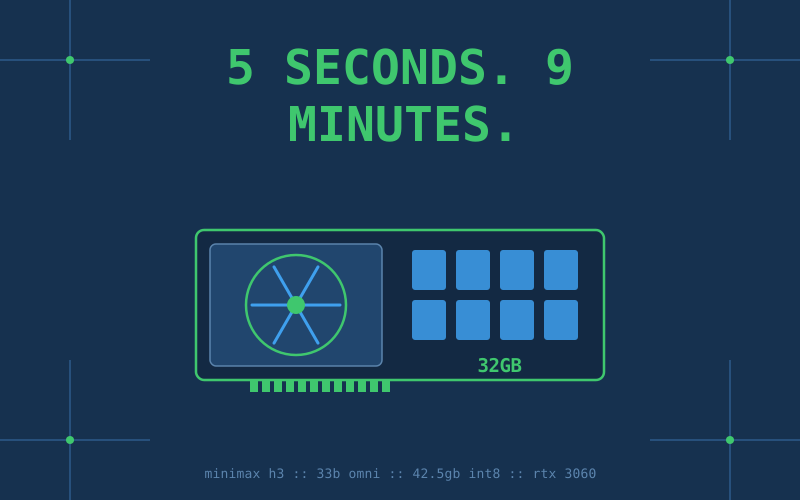
Now the part the headline numbers leave out. ComfyUI's own test on a 3060 was not 2K. It was 832x480, 124 frames (about five seconds), 20 steps, with 8-bit weights, 32 GB of system RAM, and an NVMe SSD, and it took a bit under nine minutes end to end. The NVMe is not a suggestion. On a model this size, offloading through a SATA drive turns a GPU-bound job into an I/O-bound one, and you will watch your GPU idle while the disk thinks about it.
So calibrate. This is not a card that iterates on prompts at conversational speed, and 480p is not the 2K in the marketing copy. What it is: the whole model, on your machine, with no per-second meter running. Put the kettle on.
Running it needs ComfyUI 0.30.0 or later, with prepackaged quantizations mirrored at Comfy-Org/MiniMax-H3 in bf16, int8, and pruned int8, plus an NVFP4 AWQ text encoder for the truly memory-constrained.
Where it actually ranks, and what it costs
MiniMax published no benchmarks of its own. The one third-party read comes from Artificial Analysis, which puts H3 first in video editing, second in text-to-video behind Google's Gemini Omni Flash, and third in image-to-video behind both Gemini and ByteDance's Seedance 2.0. Good, not dominant, and one leaderboard run is not a peer-reviewed verdict.
The price is the sharper weapon. API access runs $0.13 per second at 2K, about $1.95 for a full 15-second clip, which is roughly a third of what the closed 1080p competition charges per finished minute.
Read the license before you build on it
This is where "open weights" needs an asterisk, and it is a big one. The MiniMax H3 Community License Agreement defines Applicable Territory as "worldwide, excluding the Excluded Territories," and names those as the European Union, the United Kingdom, the Republic of Korea, and the United States of America. Section V.4 is explicit: you may not use, reproduce, modify, distribute, or display the works or their outputs outside the Applicable Territory.
Read plainly, an American developer is not licensed to run these weights or publish what comes out of them. Neither is a British, Korean, or EU one. That is most of the audience that has spent two years arguing about the importance of open weights, now standing outside the terms of one.
Two more clauses matter if you clear that hurdle:
- Revenue above $20 million a year requires separate prior written authorization from MiniMax.
- You must prominently display "MiniMax H3" in the UI of any commercial product built on it.
These are the same shape of restrictions we saw on Huawei's openPangu release two days ago. Two geo-fenced "open" licenses in one week is no longer a coincidence, it is a trend, and the word open is doing less work every time.
What is still closed
- Training code. There is no open-source training repository.
- Training data. Undisclosed, and the provenance question is not hypothetical: Disney, Universal, and Warner Bros. Discovery sued MiniMax in the Central District of California over its Hailuo service, and the court has since denied the motion to dismiss the copyright claims and found the defendants subject to US jurisdiction. Worth weighing before you build a commercial pipeline on the outputs.
- The technical report. Promised, not published, so the architecture claims above are the vendor's own.
- Evaluation methodology. The only numbers are a third party's.
The honest summary: you get the weights and the right to run them in some of the world. You do not get the recipe.
Key Takeaways
- MiniMax H3's weights are live on Hugging Face as of August 3, 2026: a 33B dense omni-transformer producing 4 to 15 second clips at up to 2K, 24 fps, with native 32 kHz stereo audio generated in the same pass as the frames.
- ComfyUI shipped day-zero support and cut the footprint from 123.6 GB to 42.5 GB using lookup tables for modulation weights plus int8 convolution quantization.
- It runs on a 12GB RTX 3060, but the tested configuration was 832x480 and 124 frames in just under nine minutes, not 2K. You also need 32 GB of RAM and an NVMe drive.
- Artificial Analysis ranks it first in video editing, second in text-to-video, and third in image-to-video. MiniMax published no benchmarks itself.
- The license excludes the US, EU, UK, and South Korea from its Applicable Territory outright, and adds a $20M revenue authorization gate plus a mandatory attribution badge.
- Code, training data, evaluation methodology, and the technical report all remain closed.
Sources: MiniMaxAI/MiniMax-H3 on Hugging Face, MiniMax H3 Community License, MiniMax official announcement, ComfyUI day-0 support writeup, ComfyUI H3 workflow docs, Comfy-Org/MiniMax-H3, South China Morning Post, MarkTechPost, Artificial Analysis