Mito Details the 5,130-Asset Pipeline Behind Movistar's 95%-AI World Cup Spot
TL;DR
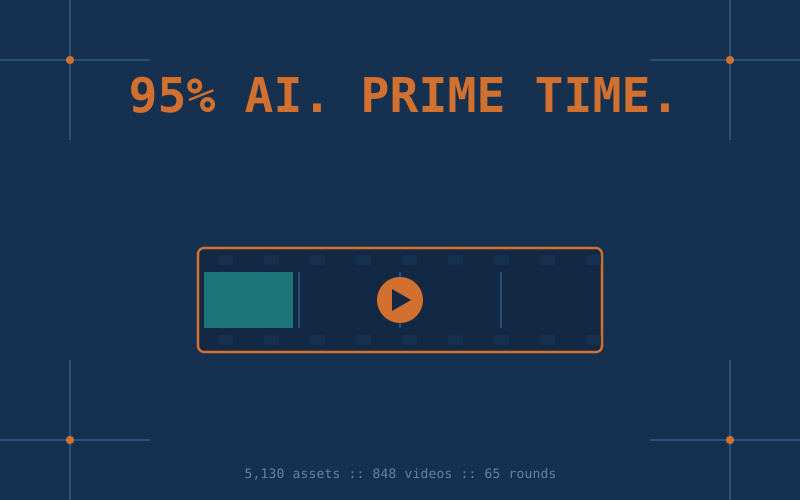
Mito, the startup behind the AI video canvas of the same name, has published a full teardown of Batido, the 120-second Movistar Plus+ World Cup spot its production team describes as 95% AI-generated, which ran on Spanish television through the tournament. Writing on the Google Cloud blog on November 6, Mito's CEO Iñaki Berenguer and head of engineering Keyvan Akbary give the real numbers: 5,130 generated assets, 848 of them videos, 55 to 65 rounds of iteration, 1,441 assets wired into the final canvas. The workflow is the useful part: validate everything in stills because video costs 5 to 10 times more per iteration, cap shot references at six variables, and put a Gemini judge between your agent and production.
What went on air
The client was Movistar Plus+, part of Telefónica, in its sponsorship of the Spanish national team and the Royal Spanish Football Federation at the World Cup. The spot was directed by Oriol Villar and produced by production company Roma together with Mito AI, with more than 140 human specialists and Havas Media buying TV, cinema, outdoor, press and digital, as Spanish trade press reported at the May launch. Mito says the film ran in prime time on every major television channel in Spain.
The plot is built around AI on purpose. Tommy, a 17-year-old student, is making a school video project when the model misreads the brief and has Spain's coach Luis de la Fuente deliver the closing line as "In the same milkshake", drink in hand. Tommy corrects the prompt on screen, the video recalibrates, and the line lands as "In the same heartbeat." The team leaned into what they call an imperfect aesthetic, to the point of weighing extra fingers as a deliberate glitch so the machine would read as a machine. For once, an extra finger was on the shot list.
The iceberg, in numbers
Mito's own case study puts the cost of 120 seconds in plain view. The final canvas held 1,441 connected assets. The recycle bin held most of the work: 5,130 generated assets in all, roughly 4,085 images, 848 videos and 189 documentation files such as scripts, storyboards and style guides, produced over about a month and between 55 and 65 rounds of iteration. Character likeness had to hold across 29 scenes, and one shot, integrating journalist Mónica Marchante through a mirror, took more than 25 iterations on its own.
Mito calls generative projects an iceberg. About 28 percent of everything generated ended up on the final canvas; budget a campaign by the length of the final cut and you have budgeted the tip.
Three rules that made it survivable
Narrative before generation. The script is written against what the model does well and what breaks it. In Mito's words, if the text does not fix an authorial tone, the model defaults to the average of the internet.
The Rule of 6. Each shot is described with at most six variables: World, Camera, Light, Texture, Actions, Character. Cross six references in a group and the model averages them, which reads as mush on screen. Ask six designers for one poster and you get the overlap of all six, not the best one.
Stills first, video second. The team validates art direction in key frames before any animation budget is spent, because video inherits every flaw of its base image. Iterating in photography is 5 to 10 times cheaper and more effective, on Mito's own accounting.
The plumbing
The Google Cloud post covers the engineering, and it reads like any other high-throughput pipeline. The canvas frontend talks to Java services on Cloud Run; long video renders are published to Pub/Sub and picked up by background workers, so a four-to-five-minute render never freezes the UI. Assets land in Cloud Storage behind a CDN with expiring key signatures, which keeps pre-release client material private. The generative models, including Veo, Omni and Nano Banana, are called through Vertex AI.
Two details deserve copying. First, a virtual queue with bounded retries sits between Mito and the public model APIs, because pay-as-you-go rate limits bite hardest exactly when a campaign team peaks; every job gets a definite outcome instead of a hang. Second, the AI Director, the copilot that holds the brief and the references as project memory, has its own regression net: a harness powered by Gemini replays Director outputs against the original user intent and runs alongside standard tests whenever a high-impact Director change lands. Creative output resists unit tests, so they hired a model to grade the model.
Routing is multi-model by design. The Director coordinates Sonnet, Gemini and ElevenLabs for audio across tasks, and treats the spatial canvas like a live code repository to infer context from neighboring shots.
Likenesses and the law
The film features real public figures: players Lamine Yamal and Marc Cucurella, chef Ferran Adrià, journalists Juanma Castaño and Mónica Marchante, swimmer Teresa Perales. Two constraints shaped those shots. The model kept rendering Adrià bald, so holding his white hair needed explicit instruction. And the trophy he pours molten gold into had to evoke the World Cup trophy without copying a design protected by copyright. Likeness came from dedicated casting sheets, one per face, maintained alongside the 29-scene continuity.
What to steal
- Order your modalities by cost. Settle art direction in stills, animate only what survived. Mito prices the difference at 5 to 10 times per iteration.
- Cap references per shot. Six variables across World, Camera, Light, Texture, Actions, Character; past six, the model returns the average.
- Queue your model calls. A bounded-retry queue between you and rate-limited APIs turns a traffic spike into a wait instead of an outage.
- Grade your agent in CI. A Gemini-powered harness replays Director outputs against intent for high-impact changes, a real regression net for a creative agent.
- Budget the discard pile. 5,130 generated assets for 1,441 finalists is the honest ratio at this quality bar.
- Write the narrative against the model's failure modes instead of hiding them. The milkshake glitch became the spot's most quotable beat.
Caveats
- Every production number here is self-reported by Mito, in its own case study and a Google Cloud customer post. Spanish trade press corroborates the campaign, the client and the 140-plus crew, not the asset counts.
- The 95% figure is the production team's description of its own work; no independent audit exists of what share of the final film is generated.
- Mito is a hosted, proprietary platform with a free tier. You can adopt the workflow, not the infrastructure behind it.
- No production cost or model spend was disclosed, so the 5-10x stills figure is a ratio, not a price.
- The campaign launched in May and ran through the tournament; the news here is the engineering teardown published November 6. The spot itself is months old.
Key Takeaways
- Mito published a teardown of Batido, the 120-second Movistar Plus+ World Cup spot its team calls 95% AI-generated: 5,130 generated assets (about 4,085 images, 848 videos, 189 docs) over a month and 55 to 65 iteration rounds, with 1,441 assets on the final canvas.
- The workflow rules: write the narrative against the model's strengths, cap shot references at six variables (World, Camera, Light, Texture, Actions, Character), and validate art direction in stills at 5 to 10 times lower cost than video.
- The stack is ordinary event-driven engineering: Java services on Cloud Run, Pub/Sub for render jobs, background workers, CDN-signed asset delivery, and models including Veo, Omni and Nano Banana through Vertex AI.
- A Gemini-powered eval harness grades AI Director outputs against original intent and runs with standard tests on high-impact changes; a bounded-retry virtual queue absorbs public API rate limits.
- The spot was produced with Roma and director Oriol Villar, with more than 140 human specialists and Havas Media placing it across Spanish TV, cinema, outdoor, press and digital.
- Real-public-figure shots added legal and technical constraints: a trophy designed to evoke a copyrighted original without copying it, and per-face casting sheets to keep likeness stable across 29 scenes.
Sources: Google Cloud, The Blueprint: Orchestrating 5,000+ AI assets for a World Cup TV spot, Mito, Crafted Stories: Movistar World Cup, MarketingNews on the Batido campaign, Mito product site