The Model Scored 30%. Nvidia's Harness Scored 100.
TL;DR
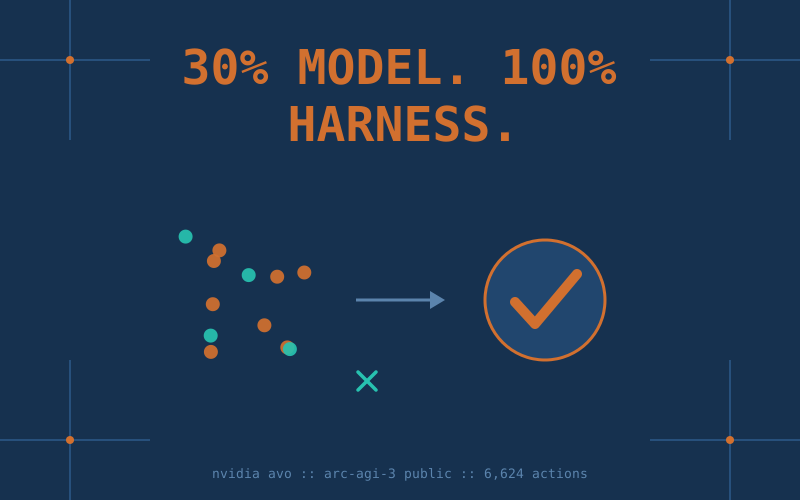
On August 21, Nvidia published a result showing AVO, its agent system, scoring 100.00 RHAE on the public set of ARC-AGI-3: all 183 levels across 25 environments, in 6,624 environment actions. The model doing the thinking was Claude Opus 5, which scores 30.2% on the same benchmark when you hand it the games directly. Nobody retrained anything. The difference is the software wrapped around the model, and that is the entire point of the paper.
What actually ran
AVO stands for Agentic Variation Operators. It is a general-purpose coding agent system built at Nvidia, and per the announcement it brings three things to a task: persistent memory that carries prior implementations, evaluation results, compiler and profiler output and accumulated reasoning across the whole run; a supervision component that can redirect the main agent toward a different strategy; and environment-specific tools with their own execution loops.
ARC-AGI-3 is not a question-and-answer eval. It is a set of interactive 2D games with rules the agent has to discover by playing, described in the benchmark paper as a test of whether an agent can explore, adapt and act in a dynamic environment rather than pattern-match a static prompt. Scoring uses RHAE, Relative Human Action Efficiency, which folds task completion together with how many actions each level took relative to a first-time human player. Think of it as a speedrun leaderboard rather than a pass/fail exam: finishing is table stakes, and the button presses are the score.
The delta is the story, not the 100
Claude Opus 5 at high reasoning effort was verified by ARC Prize at 30.2% on ARC-AGI-3 in late July, which was itself state of the art at the time, roughly four times the 7.8% that GPT-5.6 Sol Max had held. Same weights, same benchmark, wrapped in AVO: 100.00 RHAE.
Before you file this under solved, note that Nvidia is not the first to clear the public set. VISTA, published on August 5 by a group at MIT, took Claude Opus 5 to a mean score of 100.00 on all 25 public games, with 25 perfect scores, in 7,542 actions against a human baseline of 17,135. With GPT-5.6 Sol driving it instead, VISTA reports 98.27 and 22 perfect scores in 10,063 actions.
So the competitive claim is narrower than the headline number suggests: AVO used about 12% fewer environment actions than VISTA to reach the same ceiling. Nvidia says so plainly, and also says the comparison is not controlled. VISTA feeds its model rendered 512x512 PNG images. AVO feeds it text-only 64x64 grids. The memory implementations and context management differ too. That is at least three uncontrolled variables in a 12% gap.
What is actually inside the wrapper
Strip the branding and the harness is doing two unglamorous jobs. It keeps a durable record of what has already been tried and what happened, so the agent stops rediscovering its own dead ends every few thousand tokens. And it runs a second agent whose only job is to watch the first one and say "this approach is not working, try something else."
That supervisor is the part worth stealing. It is the coworker who taps you on the shoulder after you have spent forty minutes rewriting the same regex, which is a role no amount of extra reasoning effort inside a single forward pass can fill, because the stuck agent is exactly the wrong entity to notice that it is stuck.
AVO was not built for video games
This is the part that makes the generality claim interesting rather than boring. AVO started life as an evolutionary search system for GPU kernels. The original paper, posted in March, replaces the fixed mutation and crossover operators of classical evolutionary search with autonomous coding agents, and reports kernels that beat cuDNN by up to 3.5% and FlashAttention-4 by up to 10.5%. Nvidia's August post says the same system explored more than 500 optimization directions on DGX B200 to get there.
Nobody told it that it was also supposed to be bad at 2D puzzle games. The same memory-plus-supervisor loop that hill-climbs a matmul apparently transfers to learning the rules of an unfamiliar environment by poking at it, which is either a strong argument for general agent architecture or a strong argument that both tasks are the same task wearing different hats.
The caveats, in full
- Public set only. 25 environments, 183 levels, all of them published. The semi-private and private ARC-AGI-3 splits are untouched, and a benchmark's whole reason for having hidden splits is that public numbers drift.
- No ablation. Nvidia explicitly says the 30.2% comparison does not isolate the harness contribution. Reasoning effort, observation format and context handling all move at once.
- The VISTA comparison is uncontrolled, by Nvidia's own admission. Different observation modality, different memory, different context management, 12% gap.
- GPT-5.6 Sol results are preliminary and cover only a subset of games.
- No code, no weights. There is a blog post and a March kernel paper. There is not a repository you can clone and point at your own environment.
What to do with this
If you are shipping a long-horizon agent, the practical read is that your next capability jump is probably not a model upgrade. It is a memory layer that survives compaction and a second process that is allowed to interrupt the first one. Both are ordinary engineering, both are cheap next to a fine-tune, and two independent groups just demonstrated a three-times swing on the same weights within sixteen days of each other.
The uncomfortable corollary: benchmark numbers attached to a model name are becoming close to meaningless for agentic work. "Opus 5 gets 30.2% on ARC-AGI-3" and "Opus 5 gets 100.00 on ARC-AGI-3" are both true statements published within a month, and the only thing separating them is code somebody wrote around the API call.
Key Takeaways
- Nvidia's AVO harness cleared all 183 levels of the ARC-AGI-3 public set at 100.00 RHAE in 6,624 actions, driving Claude Opus 5.
- The same model scores 30.2% unwrapped, an ARC Prize verified figure from late July that was state of the art at the time.
- MIT's VISTA got the identical 100.00 on August 5 in 7,542 actions, so AVO's real claim is 12% better action efficiency, on an admittedly uncontrolled comparison.
- The harness is persistent memory plus a supervisor agent plus environment tools. No retraining is involved anywhere.
- AVO was originally a GPU kernel search system that beat FlashAttention-4 by up to 10.5%, which is the strongest evidence here for architectural generality.
- Public set only, no ablation, no code release. Treat 100.00 as a ceiling on a known set, not as a solved benchmark.
Sources: Nvidia Technical Blog, AVO: Agentic Variation Operators for Autonomous Evolutionary Search (arXiv), VISTA (MIT), ARC Prize: Claude Opus 5 results, ARC-AGI-3: A New Challenge for Frontier Agentic Intelligence (arXiv), ARC-AGI-3