Inside OpenAI, Nobody 'Chats' With AI Anymore. They Delegate.
TL;DR
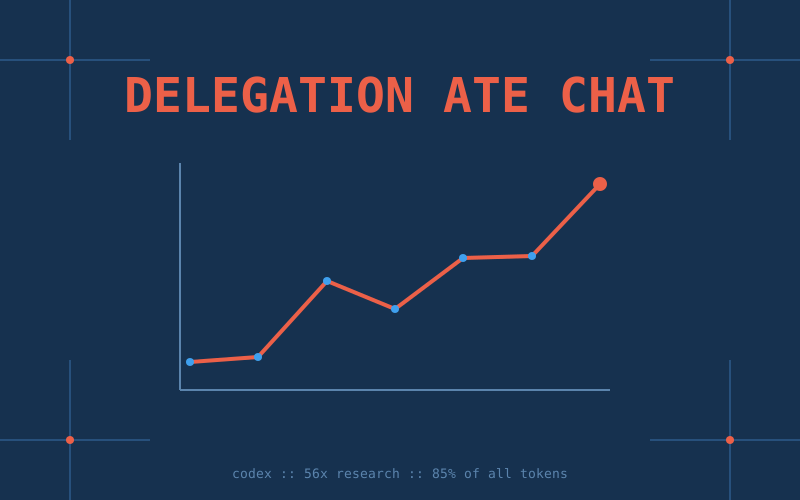
OpenAI published a report, How agents are transforming work, with an accompanying paper, The Shift to Agentic AI: Evidence from Codex, arguing that the basic unit of AI knowledge work is changing from chat (ask a question, get an answer) to delegation (hand off a long, multi-step task and walk away). The evidence is its own dogfooding of Codex: between November 2025 and June 2026, median output tokens per worker rose 56x in Research, 32x in Customer Support, 27x in Engineering, and 13x in Legal. The average OpenAI employee now generates more than 85% of their output tokens through an agent, not a chatbot. It is a real signal about where agentic coding is going. It is also, every single number of it, measured by the company selling the agent.
What "chat to delegation" actually means
The framing is the whole point, so it is worth being precise. A chat interaction is one turn: you ask, the model answers, you read it. Delegation is a handoff: you describe an outcome, the agent plans, edits files, runs commands, fixes its own mistakes, and comes back later with a result you review. Same underlying model, completely different shape of work.
The difference shows up brutally in token counts, and here is the intuition for why. A chat reply is a postcard: a few hundred tokens, written once. An agent grinding on an eight-hour task is mailing you a novel it wrote while you were at lunch, plus every draft, every tool call, and every retry along the way. So when OpenAI says output tokens jumped 56x, that is not 56x more questions asked. It is the unit of work getting an order of magnitude longer.
The kicker is who is doing it. ChatGPT, the product that defined the chatbot era, is now mostly a fallback inside the company that built it. Through August 2025 the average OpenAI worker spent less than 10% of their tokens on Codex; employee adoption sat around 40%. By June 2026, adoption is reported at nearly 98%, and Codex accounts for the large majority of output tokens for the typical worker. Even the lawyers and recruiters are running coding agents for automation, data analysis, and debugging.
How far the handoffs go
The more telling metric is not volume, it is the length of task people are willing to walk away from. By May 2026, among sampled individual Codex users, 81% had handed it at least one task estimated to take an experienced human more than 30 minutes, 70% gave it work over an hour, and 26% assigned something that would take a person more than eight hours. The share submitting those eight-hour-plus jobs has grown roughly tenfold.
Sophistication is climbing too: the paper says more than 10% of users now run three or more Codex agents at once, and 26.6% use skills, reusable instruction bundles for repeated workflows. Running a fleet of agents in parallel is a different job than typing into a box, and it is becoming normal.
Inside the building vs. outside it
The most useful slice for builders is the gap between OpenAI and everyone else. Measured as Codex's share of output tokens, the report puts OpenAI employees at 99.8%, outside organizations on Business and Enterprise plans at 63.3%, and individual users at 16.5%. Active users overall grew more than fivefold in the first half of 2026, with most of that growth happening outside the original software-developer audience.
Read that gradient as a trajectory, not a verdict. OpenAI is the most agent-saturated workplace on earth and treats itself as the leading edge of a curve everyone else is climbing. Maybe. Or maybe a company that pays its staff to build the product is not a neutral readout of organic demand. Both can be true, which is exactly why the next section matters.
Why builders should care
Strip out the corporate self-portrait and there are real, portable lessons here.
- Design for handoffs, not chats. If the unit of work is becoming a delegated task, your tooling, prompts, and review process should assume a long-running agent that returns a diff, not a conversation. Optimize for clear task specs and good verification, because the bottleneck moves from generation to checking.
- Budget for the token bill. A 56x jump in output tokens is a 56x jump in spend on that work. Agentic delegation is powerful and expensive. If you are pricing an internal rollout off your chatbot-era usage, the real number is going to surprise you.
- Parallel agents are a skill, not a toggle. Ten percent of users running three or more agents at once is a preview of the workflow. Managing a swarm, splitting work, and merging results is its own competence, and it is worth learning before it is table stakes.
- Non-developers are in scope. The fastest relative growth was in Legal and Support, not Engineering. Coding agents are quietly becoming general automation tools, which widens both your potential users and your potential blast radius.
The honest caveats
Every figure in this report comes from OpenAI, a company with a direct financial interest in the conclusion that everyone should be delegating to its agent, published while it is widely reported to be courting investors. No independent third party has verified the usage numbers. The paper does not address whether OpenAI incentivizes or mandates internal Codex use, and near-universal adoption inside the company that sells the product is not the same thing as organic demand.
There is also a measurement trap worth naming: more output tokens is not the same as more value delivered. Faster code generation does not automatically become proportional productivity, because verification, testing, and cleanup can expand to swallow the speed you gained. Treat this as a credible signal of where OpenAI believes the market is heading, and a useful prompt to test delegation on your own workflow, but not as settled proof that an agent doing eight hours of token-generation equals eight hours of finished work.
Key Takeaways
- OpenAI's new report argues knowledge work is shifting from chat to delegation, citing internal Codex output-token growth of 56x (Research), 32x (Support), 27x (Engineering), and 13x (Legal) from Nov 2025 to Jun 2026.
- The average OpenAI worker now produces 85%+ of output tokens through an agent; reported employee adoption rose from about 40% to nearly 98%.
- By May 2026, 81% of sampled users had delegated a 30-minute-plus task, 70% over an hour, and 26% over eight hours, with the eight-hour share up roughly tenfold.
- Codex's share of output tokens is 99.8% inside OpenAI, 63.3% for outside organizations, and 16.5% for individuals, a gradient OpenAI frames as a curve everyone else is climbing.
- Every number is OpenAI's own, unverified by outsiders, and more tokens does not automatically mean more delivered value. Treat it as a direction, not a proof.
Sources: OpenAI: How agents are transforming work, arXiv: The Shift to Agentic AI: Evidence from Codex, Axios, The Next Web