OpenAI Hit a $40B Run Rate. ChatGPT Users Aren't the Majority.
TL;DR
At a closed-door investor meeting on August 14, OpenAI CFO Sarah Friar told the room that business revenue has overtaken ChatGPT consumer subscriptions for the first time. The company is running at a $40 billion annualized pace, and the crossover arrived roughly two quarters before OpenAI's own internal forecast said it would. Her line to investors, per CNBC: "We entered the year at 60-40, but enterprise has accelerated much faster than expected and those lines have now crossed." The company that got famous on a consumer chatbot now makes most of its money selling to your employer.
The number, and the number behind the number
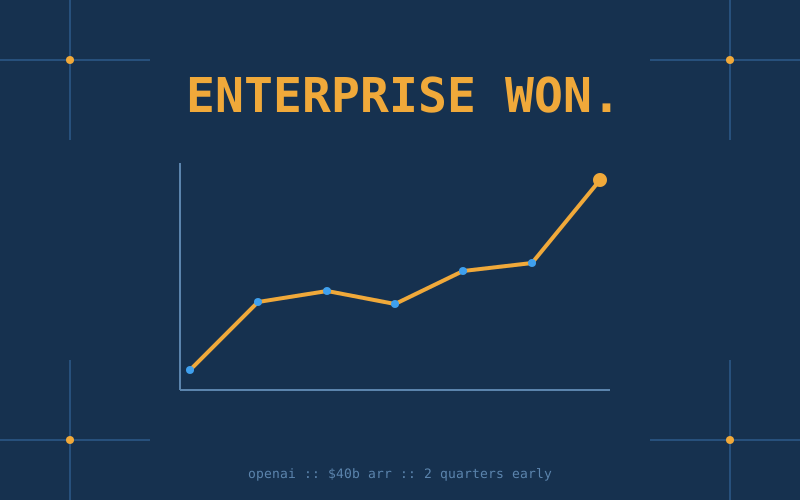
The $40 billion figure was first reported by Bloomberg on August 13, a day before Friar's investor session put a shape on it. Set against the run-rate history Friar herself has disclosed over the past three years, the curve is the whole story.
Friar also gave investors the monthly texture, which matters more than the headline. In July, total revenue grew 20% month over month. Business customer revenue grew 32% in the same stretch. Enterprise is not merely bigger now, it is compounding faster, which means the gap widens from here rather than settling into a stable split.
There is a third pillar forming underneath both. Friar said advertising, which OpenAI began testing inside ChatGPT in February 2026, is approaching a $1 billion annualized run rate. At OpenAI's scale that is a rounding error. At almost anyone else's it would be a very good Series F.
What actually changes when the buyer changes
If you build on the API, a revenue-mix flip is not gossip. It is a roadmap leak.
Consumer revenue rewards engagement: retention, daily actives, a model that feels good to talk to. Enterprise revenue rewards something close to the opposite: predictable latency, auditable logs, permission boundaries, contractual uptime, and a per-task cost you can put in a spreadsheet. When the majority of the money moves to the second column, the second column starts winning internal arguments about what gets built.
Expect that to show up in concrete places. Deprecation policy gets more conservative, because enterprise contracts hate surprise migrations. Compliance surface expands. And pricing pressure shifts from cost per token toward cost per completed task, because a buyer measuring an agent against a contractor's hourly rate does not care how many tokens the agent burned getting there.
The other half of the read is competitive. Anthropic has been running the enterprise-first playbook since well before it was the consensus, and its own IPO chatter is priced on exactly that. OpenAI just confirmed the same terrain from the other direction. Two of the largest labs are now fighting over the same procurement committees, which historically is very good news for the people signing the contracts.
The week the org chart went sideways
The timing is the part nobody at OpenAI chose. The revenue chart went vertical in the same seven-day window that two senior leaders walked.
Brad Lightcap ended an eight-year run on August 11 to "start something new." Two days later, chief revenue officer Denise Dresser resigned after eight months in the job, having arrived from Salesforce and Slack. CNBC counts roughly a dozen leaders departing across 2026, including AGI-deployment CEO Fidji Simo last month, and has reported the churn as a potential red flag ahead of the IPO. Dali Rajic, previously operating chief at Wiz, takes the revenue seat.
The uncomfortable juxtaposition: the executive who owned enterprise revenue left one day before the company announced that enterprise revenue had become the majority of the business. Either she left on the highest possible note, or the enterprise machine matters more than any single person running it. Both readings are available.
The caveats, stated plainly
- Run rate is not revenue. A $40 billion annualized run rate is one strong month multiplied by twelve. It is the marathon equivalent of clocking a runner's pace at mile three and printing the finish time. Directionally useful, not audited, and not a year of collected cash.
- This was a private room, not a filing. The numbers come from a closed-door investor meeting reported secondhand. OpenAI has a confidential S-1 registration on file with the SEC as of June 2026, and executives declined to discuss IPO timing for that reason. Nothing here has been through an auditor.
- The exact split is undisclosed. "The majority of our revenue is now enterprise" is the entire disclosure. Whether that is 51% or 65% is not public, and the difference matters a great deal.
- Definitions do work here. "Enterprise" appears to fold together ChatGPT business seats and API consumption, two very different businesses with very different margins. A seat-heavy mix and a token-heavy mix imply different futures for the API pricing you actually pay.
Key Takeaways
- OpenAI's enterprise revenue passed ChatGPT consumer revenue for the first time, disclosed by CFO Sarah Friar at an August 14 investor meeting, roughly two quarters ahead of the company's internal forecast.
- The company is at a $40 billion annualized run rate, up from a disclosed $20 billion-plus at the end of 2025.
- July growth: 20% month over month overall, 32% for business customers. The faster-growing half is now also the bigger half.
- Advertising is emerging as a third pillar at roughly a $1 billion annualized pace, from a standing start in February 2026.
- For builders, the mix flip predicts the roadmap: slower deprecations, more compliance surface, and pricing framed around cost per completed task rather than cost per token.
- Treat the figures as unaudited investor-meeting numbers. The precise enterprise-to-consumer split was not disclosed, and a run rate is a pace, not a result.
Sources: CNBC: OpenAI CFO Friar tells investors that enterprise business now bigger than consumer, Bloomberg: OpenAI's Revenue Run Rate Tops $40 Billion Ahead of IPO, Unite.AI: OpenAI Tells Investors Enterprise Revenue Has Overtaken Its ChatGPT Consumer Business, CNBC: Longtime OpenAI executive Brad Lightcap leaves, CNBC: OpenAI loses revenue chief Denise Dresser, CNBC: OpenAI talent exodus raises 'huge red flag' ahead of IPO