OpenAI Chief Scientist Publishes Internal Perplexity Numbers, Proposes Shared Limits
On this page 7 sections
TL;DR
OpenAI chief scientist Jakub Pachocki published Perplexity and Intelligence on November 22, and it contains two things the industry has never had from a frontier lab: OpenAI's internal log-perplexity curve going back to GPT-3.5, and a proposal for cross-lab "common limits" on development that hold until safety monitoring reaches a concrete milestone. The argument in one line: pretraining loss is the only number that has tracked every capability jump from small talk to cybersecurity to this month's mathematics results, so it is the number labs should pace themselves by. No relation to the search company with the same name.
You should care even if you will never pretrain anything. If the idea catches on, frontier releases acquire a shared and visible governor, and your planning gets a number to watch instead of launch events.
What OpenAI put on the table
The framing is old-school in the best way: a language model is a compressor. Predicting the next token well and compressing the corpus well are the same thing, by Shannon's source coding theorem. Everything built on top, the prompting, finetuning and reinforcement learning, is elicitation of capabilities the compressor already contains. Pachocki made this argument before in September's An Alien Mind; the new part is the receipts.
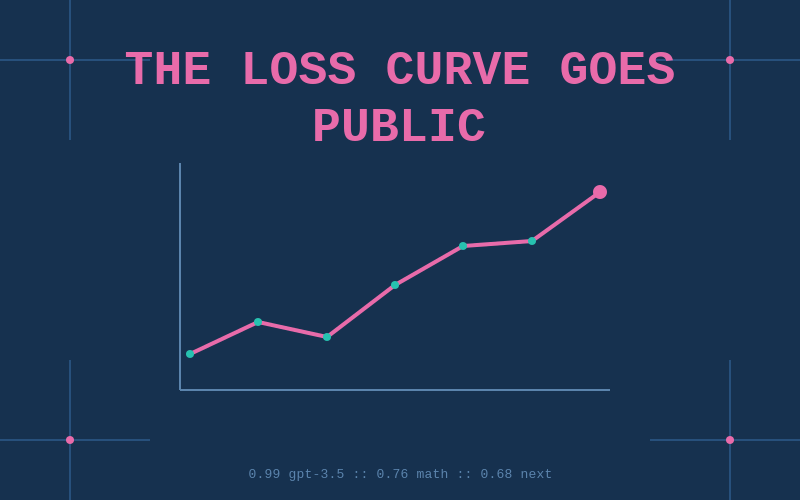
Perplexity is the odometer on that compressor: one boring number that ticks down while the vehicle keeps changing shape. OpenAI has tracked it on held-out data since the GPT-3.5 days, and the essay publishes that curve for the first time, from 0.99 down to the sub-0.8 losses of its current models.
One footnote does heavy lifting: since GPT-3.5, the main held-out set is drawn from OpenAI's own internal codebase, frozen as a fixed snapshot. These numbers compare OpenAI against OpenAI. That is honest, and it is also the exact comparability gap the proposal asks the industry to close.
One dial, four surprises
The milestones, as Pachocki tells it:
- 0.99: GPT-3.5, fluent conversation, the engine of the original ChatGPT.
- 0.91: GPT-4, where chain-of-thought reasoning started paying off, which led to the reasoning models in daily use now.
- below 0.8: current models, and what Pachocki calls transformative capabilities in cybersecurity and mathematics.
- about 0.76: the upgrade that started producing what he describes as groundbreaking results on open math problems: "resolutions to questions we've long thought about coming out of the model one after another in a single Slack thread."
His emphasis is that nobody predicted which capability would appear at which threshold. They emerged as the loss came down, which is his argument for watching the loss instead of the benchmark carousel.
Extrapolating the curve, he expects further transformative capabilities in the 0.68-0.7 window, and says plainly that we may not be testing for whatever they are.
A red line with a tripwire
The proposal is the part aimed at other labs. Pachocki wants developers to agree on common limits, based on perplexity and other measurements, that they commit to not crossing until the ability to understand and monitor model behavior reaches a concrete milestone, such as a successor to today's chain-of-thought monitors. Alongside it: shared transparency standards, and joint norms for evaluating and red-teaming new models before first use.
This lands two months after Anthropic CEO Dario Amodei's We Must Pace the Frontier essay calling for exactly this kind of coordination, and a week after OpenAI agreed to embed external safety assessors in its frontier training runs. The new essay supplies the missing piece: a number the limits could be written against.
Why a monitoring milestone as the release condition? OpenAI's own November 10 study on chain-of-thought monitorability found that lower base-model perplexity tracks rising no-CoT capability, that RL training increases CoT controllability, and that GPT-6 Astra already degraded on CoT monitorability relative to prior models. METR's Q4 capability update reaches the same place from outside: capability time horizons doubling every 3.6 months while evaluation methods trail behind.
There is a price tag, which Pachocki acknowledges: publishing the curve "gives competitors a clearer picture of where we stand." Showing the table your hole cards so everyone can agree on when to stop raising is an expensive conversation starter. He argues the urgency outweighs it.
The fine print he wrote himself
The essay lists its own objections, which is refreshing:
Two footnotes deserve wider circulation. The 2026 stretch of the curve is steeply accelerated, which OpenAI attributes mostly to long-term research and compute investments, and only in smaller part to automation, per its research acceleration writeup. And Pachocki thinks AI participating in pretraining research itself could bring "an avalanche of fundamental pretraining advancements" as soon as 2027, by analogy with what the 0.76 model did to open math problems.
The unknown floor cuts both ways. Nobody knows the inherent entropy of the data, so as models approach it, the dial will look like it is slowing while each tick represents a bigger leap. Anyone who has re-zipped a zip file knows the last few percent refuse to come out; for language, nobody has measured where that floor sits.
Why it matters at your desk
If a shared dial gets adopted, frontier releases acquire a threshold the public can argue about instead of a launch date, procurement teams get a question worth asking vendors, and safety cases become comparable between labs. None of that is true today.
If it fails, the essay still demonstrated the method worth copying. Track one boring, held-out number for years, write the caveats yourself, and publish it. Your eval dashboard is almost certainly worse than their loss chart.
Key Takeaways
- OpenAI published its internal log-perplexity curve for the first time on November 22: GPT-3.5 at about 0.99, GPT-4 at about 0.91, current models below 0.8, measured on a frozen held-out snapshot of its own codebase.
- Pachocki ties capability milestones to the dial: conversation at 0.99, productive chain-of-thought at 0.91, cybersecurity and mathematics below 0.8, groundbreaking math results at about 0.76, and further surprises expected in the 0.68-0.7 window.
- The proposal: cross-lab common limits based on perplexity and other measurements, held until monitoring reaches a concrete milestone such as a successor to today's CoT monitors.
- OpenAI's November 10 monitorability study and METR's Q4 update both supply the motive: capability is outrunning the methods used to audit it.
- The caveats are in the essay itself: the numbers are not yet comparable across labs, post-training gains do not reduce perplexity, and the entropy floor of the data is unknown.
- Watch whether Anthropic, Google or Meta answer with comparable curves; a second published curve is what would turn this metric into a standard.
Sources: OpenAI, "Perplexity and Intelligence" (Nov 22, 2026), OpenAI, "What affects chain-of-thought monitorability across the model lifecycle?" (Nov 10, 2026), Dario Amodei, "We Must Pace the Frontier" (September 2026), OpenAI, "Research acceleration: the jagged frontier", METR Q4 2026 capability update, Unite.AI coverage, Hacker News discussion