Pew: 54% of Americans Now Say Data Centers Hurt the Environment, Up From 39% in January
TL;DR
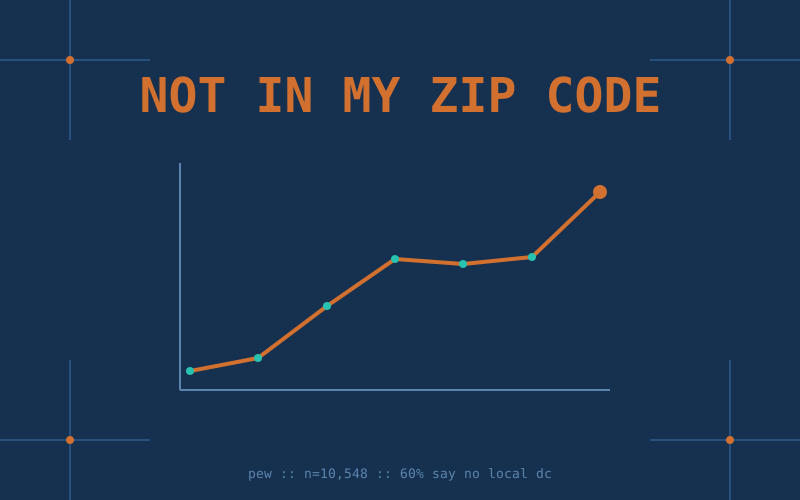
Pew Research Center re-ran its January data center survey in July and August, and the mood has soured fast. Among 10,548 U.S. adults, 54% now say data centers are mostly bad for the environment (from 39%), 50% say they are mostly bad for home energy costs (from 38%), and 49% say they are mostly bad for quality of life nearby (from 30%). Only 4% call them mostly good on any of those three. Six in ten would be uncomfortable with a new data center in their area. The shift shows up in every group Pew broke out, rural Republicans included. If your roadmap assumes cheap, fast, uncontested compute buildout, the permitting environment is now a product risk.
What Pew measured
This is a panel survey, not a vibes poll. Pew fielded it July 20 to August 9, 2026, on its American Trends Panel, and weighted it to represent all U.S. adults. The topline puts the margin of error at plus or minus 1.3 points.
The comparison point is Pew's January 20-26 wave, which asked the same questions. Pew defined a data center for respondents as a building "filled with computer equipment that powers streaming services, artificial intelligence (AI), online banking, and other things." So AI is named in the question itself, not bolted on afterward.
Respondents rated five local effects as mostly good, mostly bad, neither, or not sure. Every one moved toward "mostly bad."
The numbers that matter
- Environment: 54% mostly bad, up from 39%.
- Home energy costs: 50% mostly bad, up from 38%.
- Quality of life nearby: 49% mostly bad, up from 30%. That is a 19-point swing, the largest in the survey.
- Local jobs and tax revenue: still mixed, with 21% to 24% on each side, but "mostly bad" rose 9 points on both (jobs 15% to 24%, taxes 12% to 21%).
- The upside case: just 4% say data centers are mostly good for the environment, energy costs, or nearby quality of life.
One detail makes these numbers softer than the reality, not harder. Pew's headline shares are of all adults, including the 12% who have never heard of data centers. Among the 9,641 people who had heard at least a little, the topline shows 62% calling them mostly bad for the environment and 56% saying the same about quality of life nearby. The more people learn about data centers, the less they like them.
Awareness is also climbing. The share who have heard "a lot" about data centers rose from 25% to 35%, and the share who have heard nothing fell from 25% to 12%. A year ago a data center was a gray box nobody thought about. Now it is the gray box everybody's electric bill is blaming.
This is not a partisan story anymore
Democrats remain more negative than Republicans, but Pew found views worsened across every demographic and partisan group it tracked. Two numbers stand out.
Rural Americans moved the most on the environment. The share calling data centers mostly bad for it rose from 32% to 50%, an 18-point jump. Rural views on energy costs (32% to 46%) and quality of life nearby (28% to 45%) moved nearly as much. That matters because, as Pew reported in April, most new U.S. data centers being planned or built are going to rural areas. The people most likely to get a campus next door are souring fastest.
Republicans are turning too. 42% of Republicans and Republican leaners now say data centers are mostly bad for quality of life nearby, up from 24% in January. Pew notes this is happening while President Trump strongly backs data center construction, and after Texas Governor Greg Abbott, previously a supporter, ordered a statewide moratorium on new data centers in August. On the Democratic side, Pennsylvania Governor Josh Shapiro and Illinois Governor JB Pritzker have moved toward tighter rules and oversight.
The NIMBY number
The question most likely to predict a zoning fight is the one about proximity. Pew asked how comfortable people would be with a new data center operating in their local area.
60% said not too or not at all comfortable. 19% said somewhat comfortable, and only 7% said extremely or very comfortable. Majorities in urban, suburban, and rural areas all landed on the uncomfortable side. Republicans came in at 54% uncomfortable, Democrats at 68%, and liberal Democrats at 81%.
Put another way: for every American who would be genuinely happy to host a new data center, there are roughly eight who would not. That is the ratio a county commissioner hears at the public comment meeting.
Why builders should care
You probably do not site data centers. You do rent the output of them, by the token and by the GPU-hour, and your costs depend on how fast new capacity comes online. Public opinion is now a supply-side input.
Permitting is the new bottleneck
Chips and power have been the constraints everyone models. This survey points at a third one: local consent. The National Conference of State Legislatures now tracks states restricting data centers, and the National League of Cities keeps a running tracker of local actions. When 49% of adults think a facility makes life worse for its neighbors, moratoriums and tax-break rollbacks stop looking like fringe politics.
Energy cost is the sharpest wedge
Half of Americans now tie data centers to their own home energy bills. That is a pocketbook argument, and pocketbook arguments travel across party lines better than environmental ones do. Expect utility rate cases and "who pays for the grid upgrade" fights to feature AI demand by name.
The capacity map gets lumpier
If opposition hardens unevenly by state and county, capacity will cluster where permits still flow, and inference latency and regional pricing will follow the politics. For teams running self-hosted or colocated workloads, the jurisdiction question belongs in the planning doc next to the power contract.
Caveats
- This measures attitudes, not outcomes. Discomfort in a survey does not automatically become a blocked project.
- Large shares are still unsure: between 18% and 32% said they did not know how data centers affect each of the five areas.
- The trend line is two points, January and August 2026. A sharp move over eight months is real, but it is not yet a long series.
- Pew asked about data centers generally, which includes streaming and banking workloads, not only AI.
Key Takeaways
- Pew's survey of 10,548 U.S. adults (July 20 to August 9, 2026) found 54% now say data centers are mostly bad for the environment, up from 39% in January.
- The biggest swing was quality of life nearby: 49% mostly bad, up from 30%. Only 4% see data centers as mostly good for the environment, energy costs, or nearby residents.
- 60% would be uncomfortable with a new local data center, including 54% of Republicans and 68% of Democrats.
- Rural Americans, where most new builds are headed, shifted hardest: 50% now call data centers mostly bad for the environment, up from 32%.
- Local consent is becoming a real constraint on AI compute supply alongside chips and power, which makes it your problem even if you only buy tokens.
Sources: Pew Research Center: Americans' views of data centers have turned more negative, Pew topline (Wave 197), Pew methodology, Pew January 2026 data center survey, Pew: most new data centers are coming to rural areas, Fingerlakes1: Americans grow more wary of data centers, NCSL, NLC data center tracker