Reuters Institute Survey: 51% Use AI Weekly and 28% Daily
TL;DR
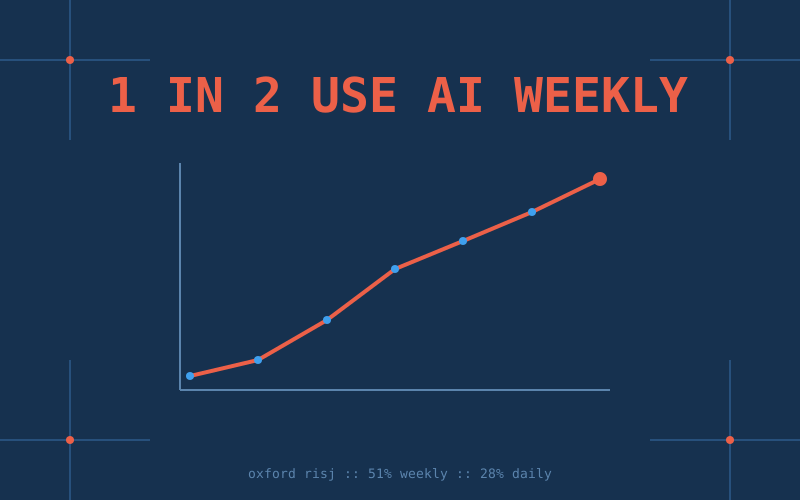
The Generative AI and News Report 2026, published October 29 by Oxford's Reuters Institute for the Study of Journalism, finds that 51% of people in its six tracked countries used a generative AI system in the last week, up from 34% a year earlier, and 28% now use one daily, four times the 2024 share. YouGov polled roughly 2,000 people per country across nine countries between August 14 and September 28. For people who publish or build: getting information (38%) now outranks creating media (31%), 57% met AI answers inside search engines without asking for them, and only 14% of the public has used an AI agent for a real task.
Half the public, every week
This is the third wave of an annual survey, with trend data for Argentina, Denmark, France, Japan, the UK and the USA, plus first-time reads on Australia, Finland and Norway. Weekly use in those six went from 34% to 51% in a year. Daily use nearly doubled for the second year running, from 7% in 2024 to 16% in 2025 to 28% now. Four years after ChatGPT launched, weekly use has crossed half the population faster than US smartphone adoption reached 50% (about five years) or internet use (about seven).
Uptake tracks your job title. 64% of people in professional occupations use generative AI weekly, against 52% of clerical support workers and 45% of people in elementary occupations. Norway, at 57%, is second only to Argentina; the UK brings up the rear at 42%, and French use jumped 21 points in a single year.
The leader grows; the challengers grow faster
ChatGPT is still the clear leader at 34% weekly use across the six countries, up from 22%. Gemini climbed from 11% to 24%, Copilot from 6% to 11%, and Claude from 1% to 7%, a sevenfold gain from a very small base. DeepSeek has stalled in both use and awareness after its 2025 moment. Weekly users now average two systems apiece.
Trust trails use at a distance: across nine countries, 37% trust ChatGPT, 27% Gemini, 18% Copilot and 13% Claude, with more trusters than distrusters for each. Among people who ask factual questions, 75% trust the answers. Ask users why and 64% say it is faster and easier, while just 21% say the information is more reliable than what they would find otherwise.
People ask more than they create
Getting information has grown from 11% of people in 2024 to 24% in 2025 to 38% now, ahead of creating media at 31%. Researching a topic leads at 24%, asking for advice reaches 20%, answering factual questions 18%. The advice number is the one to watch: a growing share of the public asks a model to help them decide things, and the model's answer arrives before your landing page does.
People who use AI for information report using search engines less since they started, a net 13 percentage points, and news sites a little less, a net 3 points. Self-reported behavior is soft evidence and the authors flag it as such. It points the same way as Chartbeat data cited in the report: Google search referrals to more than 2,500 news sites fell by roughly a third between November 2024 and November 2025, though the data cannot prove AI caused the drop.
The AI nobody opted into
57% of respondents saw AI answers, summaries or assistants in search engines in the last week, which the report says is more common than actively using a standalone AI system. Another 25% ran into AI on phones, tablets or computers, and 21% in social or messaging apps. Only 20% saw it nowhere. It is fluoride in the water supply at this point, present whether you asked for it or not.
News sites are becoming another delivery pipe: 49% noticed at least one AI feature on a news site or app, most often a label saying content was made with AI (24%), ahead of AI summaries (around a fifth), AI chatbots (14%) and AI audio or video versions (12%).
Agents are the reality check. 67% of people used no AI agent in the last week; 14% used one for a real task and 13% only to poke at one. Money splits the field: 39% of people with paid AI access used an agent, against 11% of people on free tiers, and half of daily users who pay used one. The agent economy, so far, is a paid, power-user economy.
AI for news: 3% to 9% in two years
Using AI to get news grew from 3% in 2024 to 9% now across the six countries. In the USA it is 12%, which the authors set against brand reach in their Digital News Report 2026: enough to rival the online reach of CNN and the New York Times, behind only Yahoo! and Fox News among the measured brands. Among AI news users, asking a follow-up question (49%) has passed getting the latest news (46%). And 17% of AI news users tried to use AI to read stories behind paywalls; the survey cannot say whether anyone got in, only that the handle was tried.
Attitudes have barely moved in three years of asking. 12% are comfortable with news made entirely by AI, 19% if a human oversees it, 45% for a human working with an AI assistant, and 67% for a story made entirely by a journalist. On expectations, people think AI will make news cheaper to make (net +34 points) and more current (+19), while making it less transparent (-10) and less trustworthy (-17).
Read it as a builder
- A third of the public (38%) now uses AI weekly to get information. If your funnel only counts browser sessions, your dashboard never sees the surface where a growing share of people first meet your name.
- The median user sits on a free tier. Paid access of any kind reaches 18% of people, the same share that pays for news. Design and price for free-model behavior first.
- Reliability is a minority motivation (21%) and convenience the majority one (64%). Machine-checkable facts and clean page structure are how you stay citable by the intermediary.
- The honesty gap is measured, not hypothetical: for all ten sectors polled, fewer people believe an organization is honest about its AI use than believe it means well. Label what is AI.
- Daily users (26% of the public) run on average 49 points more optimistic about AI's impact than people who have never used it (22%). Whichever group your roadmap assumes, the other is roughly a quarter of your market.
Caveats
- This is a self-reported online survey. Online panels under-represent older, less affluent and less formally educated groups, and the authors treat differences of 2 points or fewer as noise.
- Trend figures cover six countries; the nine-country numbers are single-year snapshots, so country comparisons mix two bases.
- The methodology discloses that the authors used ChatGPT 6, Claude Opus 5.5 and Claude Fable 5.1 for data analysis, copy-editing and suggested text, with all substantial writing by the authors and a line-by-line human review.
Key Takeaways
- Weekly generative AI use in the six tracked countries rose from 34% to 51% in one year; daily use went 7% (2024) to 16% (2025) to 28% (2026).
- ChatGPT leads at 34% weekly, but Gemini (11% to 24%), Copilot (6% to 11%) and Claude (1% to 7%) all grew faster in relative terms, and weekly users now average two systems.
- Getting information (38%) outgrew creating media (31%); advice-seeking (20%) nearly matches factual questions (18%), which turns chatbots into a decision layer for a large minority of the public.
- Incidental exposure beats intentional use: 57% saw AI in search engines last week, 25% on devices, 21% in social apps, and only 20% saw none.
- Agents stay niche: 67% used none last week, 14% used one for a real task, and paid access (39%) versus free tiers (11%) is the strongest divider.
- AI for news tripled since 2024 to 9%, and 12% in the USA rivals the online reach of CNN and the New York Times, while comfort with fully AI-made news is stuck at 12% against 67% for journalist-made news.
Sources: Reuters Institute, Generative AI and News Report 2026, report PDF, University of Oxford announcement, Journalism.co.uk coverage, Digital Watch summary