Sand AI's MAGI-2 Video Model Ties ByteDance's Seedance 2.5 at One-Seventh the Price
On this page 8 sections
TL;DR
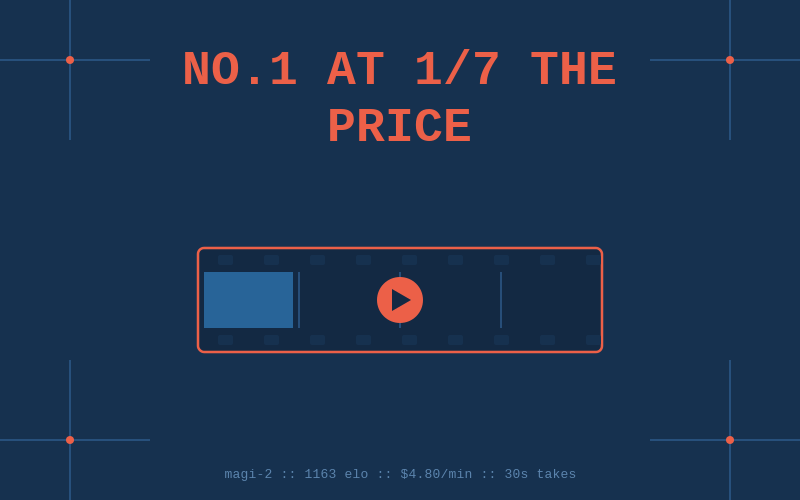
MAGI-2, the new flagship video model from Beijing startup Sand AI, shipped November 24. It generates up to 30 seconds of 1080p video with native audio in one take, and it enters the Artificial Analysis image-to-video board in first place at 1163 Elo, statistically tied with ByteDance's Dreamina Seedance 2.5 at 1158. The tie does not extend to the price column: $4.80 per minute against $34.12. Full 480B weights are promised, and the 114B MAGI-2 Preview is already downloadable under Apache 2.0.
What Sand AI shipped
MAGI-2 is a sparse mixture-of-experts: 480B total parameters, about 28B active per token, a 5.8% slice. That is more than 4x the August research release, MAGI-2 Preview, which had 114B total and 6B active. Pretraining ran on 4T tokens, roughly three times the Preview's data, drawn from about 1 billion samples that the pipeline annotated in three weeks.
Output is synchronized audio and video from a single backbone: dialogue with lip-sync, foley, ambient sound, and music, up to 30 seconds at 1080p and 25 fps across six aspect ratios. You also get timeline and shot-cut control, editing on existing footage, and omni-reference conditioning, up to 20 media items per request split as 10 images, 5 videos, and 5 audio clips.
The architecture is where the effort went. MAGI-2 keeps the single-stream transformer from Preview and scales the Multi-Head Latent MoE behind it. In a conventional MoE, each token gets routed to experts scattered across GPUs after the model reads it, so cross-device traffic fluctuates with every routing decision. Head Parallel, the trick here, splits each token into independent heads and exchanges fixed-size slices between GPUs before any routing happens. Picture a depot that swaps fixed-size pallets between trucks before reading a single shipping label: every GPU knows its load in advance. Under matched FLOPs at 480B, Sand measures about a 22% training speedup over the one-head variant, with MagiFSDP, MagiMoE, and a sharded Muon optimizer keeping multi-node throughput up.
On Artificial Analysis's Video Arena v2.1, the four-task average Elo went from 998.5 for Preview to 1150.3 for MAGI-2, a jump of 151.8 points in one generation.
One board says first, another says second
On Artificial Analysis's image-to-video board, the one that animates a still image with sound, MAGI-2 entered at 1163 Elo with a ±14 interval over 5,943 samples. Dreamina Seedance 2.5, the incumbent from ByteDance, sits at 1158 ±14 over 7,384 samples. The board places both models somewhere in ranks 1 to 3, which is the careful way of saying voters cannot tell them apart. The price column can: $4.80 per minute against $34.12.
Below the tie, the board reads like a clearance sale. Seedance 2.0 costs $22.45 a minute at 1140 Elo. Google's Veo 3.1 costs $24.00 a minute and sits at 951, thirty places down the board while charging five times MAGI-2's price. MiniMax H3 at 768p, itself open-weight, matches MAGI-2's $4.80 a minute at 1135 Elo.
Higgsfield, which says it has MAGI-2 exclusively, runs its own arena, and that panel disagrees about the ordering. Seedance 2.5 leads there at 1219, MAGI-2 follows at 1146 with a 60.5% overall win rate, and Seedance 2.5 won 61% of their direct matchups. MAGI-2 beat everyone else on that board: 71% against Seedance 2.0, 79% against Wan 3.0, and 83% against both Kling 4.0 and MiniMax H3.
Two blind-vote panels, two verdicts on first place. Neither disputes the price, and price is the part you can act on this week.
What 20 references buy you
The reference budget is the feature that matters for anyone making ads, comics, or short drama. Ten images, five videos, and five audio clips can ride along on one request, so character sheets, location plates, a previz camera move, and a voice clip all condition the same generation. Sand's own demo locks a character's face, wardrobe, and three flower environments from reference images, then walks one 30-second take through five classic paintings without a cut.
The Higgsfield announcement pushes the same idea to storyboard depth: a 30-second fight scene specified down to half-second beats, with the camera path taken from a reference video for the first 23 seconds and the assassin's face held back until 0:29.3. One generation, 745 frames, zero cuts.
A detail worth stealing: the 1080p upscaler re-injects the original reference images at the upscale stage. The base generation already anchors where faces and text move, so the upscaler goes back to the source images for fine detail instead of inventing it. Small faces and on-screen text stay legible across 30 seconds, which is usually where cheap video falls apart.
The pre-trained model reasons a little, and fine-tuning quiets it
Sand's most interesting finding sits in section five of the launch post. The 480B pre-trained checkpoint, with prompt enhancement switched off, solved 9x9 Sudoku probes in video, handled shape-marking and maze tasks, followed instructions across languages without an external LLM rewriting the script, and filled in unprompted camera direction when given only story beats.
After reinforcement learning on a few thousand curated clips, polish jumped and those behaviors got harder to elicit. Sand's working hypothesis reads like a video edition of the alignment tax: fine-tuning on a small, aesthetics-focused dataset narrows the output distribution toward cinematic polish at the expense of broader pre-training. The team now argues visual polish is the wrong single metric for video models, and that rule-following and causal event organization should be scored separately.
Self-hosting, today
The full model runs through Higgsfield's app and API at 2.5 credits per second; Sand also operates an API platform of its own. Weights are another matter: the open-source release covers the Preview only, so far. That is sand-ai/MAGI-2-preview on Hugging Face, Apache 2.0, 114B total and 6B active, clips capped at 10 seconds.
The reference inference setup in the README asks for eight NVIDIA Hopper GPUs and a 307 GB checkpoint download, with Qwen3.5-27B as the text encoder and a Wan2.2 video VAE. A Docker image ships with the dependencies built. If your homelab rack does not say DGX on the side, the hosted route is the route.
Caveats
- Weights for the 480B model are promised, not shipped. Higgsfield's page describes the coming open release at 400B parameters while Sand's post says 480B total; the two may count different things, so treat the open-weight spec as unsettled until the technical report lands.
- Elo boards measure blind preference, not correctness or prompt adherence. The Artificial Analysis tie is real but the intervals overlap, and Higgsfield's panel ranks Seedance 2.5 clearly ahead.
- Per-minute list prices come from Artificial Analysis in November 2026. Your bill depends on resolution, seconds, and retries; one 30-second take at 1080p costs $2.40 at list before a single redo.
- Sand's own limitations list: high-speed motion can produce trajectory or continuity artifacts, medium and wide 2D animation can look overly smooth in fine local motion, and complex soundscapes still lack layering.
Key Takeaways
- Sand AI shipped MAGI-2 on November 24: 480B total parameters with about 28B active, 4T pretraining tokens, and output of up to 30 seconds of 1080p 25 fps video with native audio in one take.
- On Artificial Analysis's image-to-video-with-audio board it ranks first at 1163 Elo, statistically tied with Dreamina Seedance 2.5 at 1158, at $4.80 per minute versus $34.12.
- Higgsfield's arena ranks Seedance 2.5 ahead, 1219 to 1146, winning 61% of head-to-heads; MAGI-2 beat Seedance 2.0, Wan 3.0, Kling 4.0, and MiniMax H3 in direct matchups.
- Omni-reference accepts 20 media items per request (10 images, 5 videos, 5 audio), and the 1080p upscaler re-injects the originals to keep small faces and on-screen text sharp.
- The pre-trained checkpoint solved Sudoku probes and planned shots unprompted; RL post-training raised polish and suppressed those behaviors, which Sand frames as a video alignment tax.
- Full weights are not out yet. The 114B Preview is Apache 2.0 on Hugging Face today, capped at 10-second clips, with a reference setup that wants eight Hopper GPUs.
Sources: Sand AI MAGI-2 launch post, Nov 24, 2026, Artificial Analysis AA-Video-I2V v2.1 leaderboard, Higgsfield MAGI-2 announcement, sand-ai/MAGI-2-preview on Hugging Face, Sand AI MAGI-2 Preview post