Shopify Lets Browser AI Agents Complete Checkout on Merchant Stores via WebMCP
TL;DR
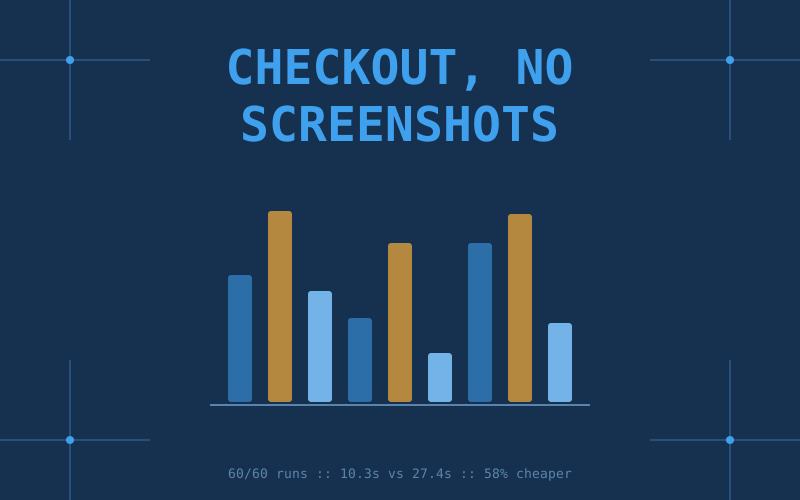
Shopify has extended WebMCP support to checkout, including Shop Pay, for all eligible merchants as of September 28. An AI agent running inside the buyer's browser can now call four structured tools to read the checkout, change the address, delivery option, discounts, or payment selection, and place the order once the buyer approves it. No merchant setup, no new API. In Shopify's own test, the tool route beat screenshot-and-click automation on reliability (60 of 60 attempts versus 56 of 60), speed (10.3 versus 27.4 seconds per attempt), and cost (58% lower). If you sell on Shopify, your checkout just became agent-readable whether or not you planned for it.
What shipped
WebMCP is an emerging web standard, developed in the open by the W3C Web Machine Learning community group, that lets a page register tools the browser's agent can call directly. Instead of guessing which button says "Continue to shipping," the agent asks the page what it can do and gets typed functions back.
Shopify already did this for storefronts. Its August 5 changelog turned on catalog search, product and variant lookup, cart edits, and policy search for every Liquid storefront and the Hydrogen developer preview. That got an agent as far as the cart. Checkout, the step where the money moves, was the missing piece. The checkout WebMCP docs now list four tools:
get_checkout: reads the current checkout state, messages, and the order receipt after completion, without changing anything.update_checkout: sets buyer contact, fulfillment, discounts, declared fields, and payment selection.complete_checkout: places the order, and only after buyer confirmation.navigate_to_storefront: sends the tab back to the shop when that route exists.
Checkout reports status values such as incomplete, ready_for_complete, requires_escalation, and completed, so the agent knows whether it can proceed or has to hand the wheel back.
The numbers Shopify published
Gil Greenberg, a staff product manager on Shopify's agentic commerce team, posted the company's comparison alongside the launch, as Search Engine Journal and How2Shout reported. Both arms ran GPT-6 Sol with the same prompts and starting conditions across ten checkout tasks in two test shops. The tasks were the boring, failure-prone ones: update an address, apply and remove a discount, change an email, enter an invalid code, pick a country the store does not ship to. Results were checked by reloading the checkout and reading its actual state.
The cost gap was 58% per attempt at OpenAI list prices, with page setup time excluded from the timings. That makes sense mechanically: a screen-driving agent pays for screenshots and page dumps on every step, while a tool call sends a small JSON payload and gets a small JSON answer.
The caveats: this is a vendor benchmark, on Shopify's own test shops, published on X rather than in a paper. Sixty attempts per arm is a smoke test, not a study. The direction is believable; the exact multipliers are Shopify's.
How the buyer stays in the loop
The agent does not get a skeleton key. It runs in the buyer's own browser tab, on the same checkout the buyer can see. The buyer still handles Shop Pay login, payment challenges such as 3D Secure, and anything a blocking checkout extension throws up. Payment is limited to saved Shop Pay cards, Shop Pay approvals, and billing addresses for guest checkouts: the tools do not accept new raw card numbers.
The docs are blunt about the last step: before calling complete_checkout, your agent must show the buyer the current order and total and get permission, again if the total changes. A ready_for_complete status means the form is valid, not that anyone agreed to pay.
Think of it as the difference between a valet and a car thief. Both drive your car; only one had you hand over the keys at the curb.
What it takes to build against it
- Signed requests. Calls must carry Web Bot Auth signatures: generate an Ed25519 key, host the public key in a key directory, register it with Shopify, and sign with short-lived timestamps. Unregistered agents get nothing.
- PUT semantics.
update_checkouttakes the full desired state. Leave a field out and it is usually cleared, with field-specific exceptions for payment, declared fields, and vaulted contact details. Diff-style thinking will eat your shipping address. - Timeouts and navigation. Updates running past 30 seconds return
update_failed, and a result comes backnullif the page navigates first. - Browser support. WebMCP is still an origin trial in Chromium-based browsers, per Shopify's storefront changelog.
- Two lanes. Agents in the buyer's browser use WebMCP; server-side agents use Shopify's Checkout MCP. Both map onto the Universal Commerce Protocol checkout spec, so the checkout model is the same either way.
Why merchants and builders should care
For a small store, this is distribution you did not have to pay for. Eligible checkouts got the tools with no configuration, which means an agent shopping on a customer's behalf now finds your checkout the easiest path to a completed order instead of the flakiest one. The platform did the integration work that no one-person shop would ever do on its own.
It also changes what "conversion rate optimization" means. If a growing share of checkouts are filled in by an agent, the clever upsell modal and the discount-code field hidden behind a toggle stop being nudges and start being obstacles. The buyer's agent does not get tempted; it gets confused, or it routes around you.
For agent builders, the lesson is broader than Shopify. Screen-driving works, but it pays a latency and token tax on every step and still drops a few runs out of every sixty. Wherever a site offers structured tools, calling them is the cheaper, faster, and more reliable path. Shopify just made that true for a very large slice of online checkouts.
Key Takeaways
- Shopify turned on WebMCP checkout tools, including Shop Pay, for all eligible merchants on September 28, with no merchant setup.
- Four tools (
get_checkout,update_checkout,complete_checkout,navigate_to_storefront) let an in-browser agent finish the funnel that the August storefront tools started. - Shopify's own GPT-6 Sol test: 60 of 60 successes versus 56 of 60, 10.3 versus 27.4 seconds, and 58% lower cost than browser automation. Treat it as a vendor smoke test.
- The buyer must approve the order and total before submission, handles logins and payment challenges, and new raw card numbers are not accepted.
- Builders need registered Web Bot Auth keys and careful handling of full-state updates; merchants should assume agents will read their checkout literally.
Sources: Shopify changelog: WebMCP support for checkout, Shopify docs: Checkout WebMCP, Shopify changelog: WebMCP for Liquid and Hydrogen storefronts, Gil Greenberg on X, Search Engine Journal, How2Shout, TechCrunch, UCP checkout specification