Supabase Buys Turso and Raises $150M as Agents Create 70% of Its New Databases
TL;DR
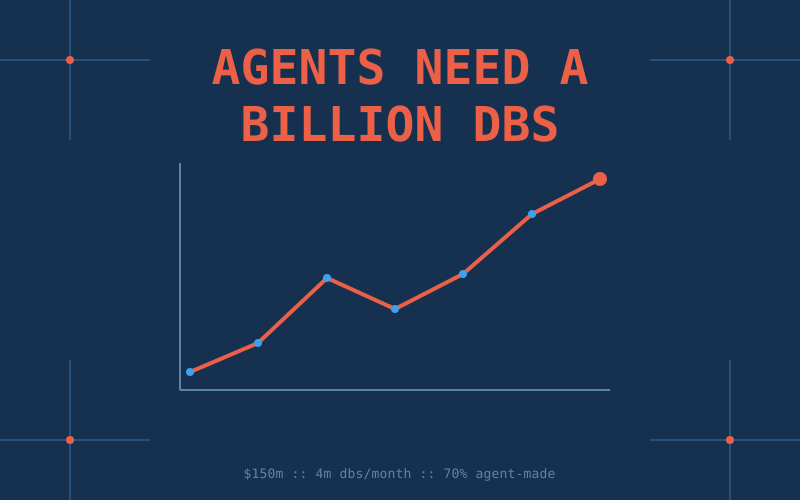
Supabase announced on October 2 that it raised $150 million in new funding led by GIC and agreed to acquire Turso, the company that rewrote SQLite in Rust and built a cloud where one server can manage millions of databases. The reason is spelled out in the press release: Supabase now adds about 4 million databases a month, and 70% of new ones are created by agents or AI-driven tools. Turso keeps operating, its founder Glauber Costa becomes Supabase's Head of Agentic Services, and the price was not disclosed.
What was announced
Two things landed in one press release. First, money: $150 million led by GIC, with Alphabet's CapitalG, IronArc, and SquarePeg participating. It comes four months after Supabase's $500 million Series F, which valued the company at $10.5 billion, also led by GIC. No new valuation was stated for this round.
Second, the acquisition. CEO Paul Copplestone's announcement post says Turso founder Glauber Costa and co-founder Pekka Enberg join Supabase "with the rest of the Turso team," and Costa will lead the new agentic infrastructure effort. Deal terms were not disclosed.
For anyone already on either platform, the official line is short: "For existing users, nothing changes." Supabase stays a Postgres company. Turso keeps working on SQLite.
The numbers behind the deal
The interesting part is not the round. It is the usage data Supabase published to justify it:
- Over one million databases launched per week, per the blog post. The press release puts it as 4 million databases and more than 1 million new users a month.
- 70% of new databases are created by agents or AI-driven tools.
- 600% year-over-year growth in databases, as of June, a figure Supabase also cited when it closed the Series F.
Put those together and roughly 2.8 million databases a month are being spun up by software that never logs into a dashboard. That is the customer Supabase is now building for.
In June, coverage of the Series F reported that Claude Code had been Supabase's largest contributor of new databases since the start of the year. The October figure makes the same point at a bigger scale: the prototyping wave that coding agents set off is showing up as database count.
Why Supabase wanted Turso
Postgres is great for a real application. It is overkill for an agent that wants a scratch database for a dashboard it will throw away in an hour. A Postgres instance means a process, memory, and usually a dedicated machine, which is fine at thousands of projects and painful at millions.
Copplestone's post says it directly: "Agents should be able to create a database as easily as creating a file, with just as little concern about cost." SQLite fits that because a SQLite database is a file. Turso built the cloud layer on top. Per Supabase, a single Turso server can manage millions of databases, loading each one when it is needed and suspending it when it is not.
The hotel analogy works here. A Postgres instance is a rented apartment with the lights on all month. A Turso database is a hotel room key: the room exists, but nobody pays to heat it until someone walks in.
Turso's database is already used this way. Supabase names Superhuman, Sauna.ai, CTO.new, and Mastra as customers that create a database for each agent on demand, either on Turso Cloud or in their own clouds.
What Turso brings in code
Turso has two well-known open-source projects. libSQL is its open-contribution fork of SQLite, at about 17,000 GitHub stars. The newer Turso database is a from-scratch SQLite-compatible engine in Rust, MIT-licensed, at about 24,500 stars, and its repository description now says it is "also speaking Postgres (experimental)". That last detail matters a lot more this week than it did last week.
We have seen this movie before
This is the second time an agent-driven database statistic has been the headline of a big database deal. In May 2025, Databricks agreed to acquire Neon and said that over 80 percent of the databases provisioned on Neon were created automatically by AI agents rather than by humans.
Seventeen months later, the same argument is being made at Supabase, now at roughly 4 million databases a month. The difference is the direction of the move. Databricks bought a serverless Postgres to get closer to developers. Supabase, already the developer's Postgres, bought something smaller and cheaper than Postgres, because even serverless Postgres is too heavy for the volume agents generate.
That is the useful signal for anyone pricing a developer product. When the buyer is an agent making thousands of throwaway projects, cost per idle unit matters more than features. A database that bills nothing while it sleeps beats a better one that bills by the hour.
What this means if you build on either
The business logic is clear. Supabase is betting that its growth now depends on a buyer that does not read pricing pages: the agent. Earlier this year, a study of which tools coding agents pick found Supabase's bundled auth, storage, and realtime pitch sometimes lost database sessions to leaner options. Owning a "just give me a database file" product closes that gap from below.
For builders, the practical takeaways:
- Per-agent and per-tenant databases are now mainstream architecture. If you run agents that need state, one small SQLite database each is a pattern with a well-funded owner, not a hack.
- Nothing changes today. Both companies say existing users are unaffected. No pricing changes or migration timeline has been announced, so do not migrate on vibes.
- Design for the idle case. If your product sells to agents, the Neon and Supabase numbers say most of what they create will sit unused. Pricing and architecture that cost nothing at rest are now table stakes.
- Watch the SQLite-to-Postgres handoff. "Same developer experience from prototyping to production" is the promise. Whether that becomes a real one-command upgrade path is the part to judge when it ships.
The quiet winner here is the SQLite file format, which has been sitting on every phone on Earth for two decades and has now become hot agent infrastructure without changing much at all.
What is still unknown
- The acquisition price and Supabase's valuation in this round.
- Closing conditions or timeline. The release says Supabase "is acquiring" Turso and gives no closing date.
- What happens to Turso Cloud pricing, libSQL, and the Rust rewrite's roadmap over time. The posts promise continuity but no specifics.
Key Takeaways
- Supabase raised $150 million led by GIC, four months after a $500 million Series F at a $10.5 billion valuation.
- It agreed to acquire Turso for an undisclosed price. Glauber Costa becomes Head of Agentic Services and Pekka Enberg also joins.
- Supabase adds about 4 million databases a month, 70% of them created by agents or AI tools, and database count grew 600% year over year as of June.
- Turso's SQLite-in-Rust cloud loads and suspends databases on demand, so one server can manage millions of them. That is the economics agents need.
- Existing Supabase and Turso users see no changes for now, and no pricing or migration plan has been published.
Sources: Supabase blog: Supabase is acquiring Turso, PR Newswire: Supabase Announces $150M in New Funding and Turso Acquisition, RuntimeWire, Orrick: Supabase Raises $500 Million at $10.5 Billion Valuation, tursodatabase/turso on GitHub, tursodatabase/libsql on GitHub, Databricks: agreement to acquire Neon