Naveen Rao's New Chip Cuts AI Power 1,000x, but Only in Simulation
TL;DR
Databricks' former AI chief Naveen Rao has a new company, Unconventional AI, and a genuinely strange first product: Un-0, an image generation model that does not run on transistors at all. Instead of pushing 1s and 0s through digital logic, it computes with the physics of a network of coupled ring oscillators, and Rao claims this path could eventually cut AI power consumption by 1,000x. Un-0 reportedly produces results on par with diffusion models like Stable Diffusion. The enormous asterisk: the chip does not exist yet. Un-0 runs entirely on a software simulation of hardware that has not been built, so the thousand-fold savings is, in the company's own words, aspirational. So far the only thing the chip has powered down is a GPU running the simulation of it.
How do you compute with oscillators?
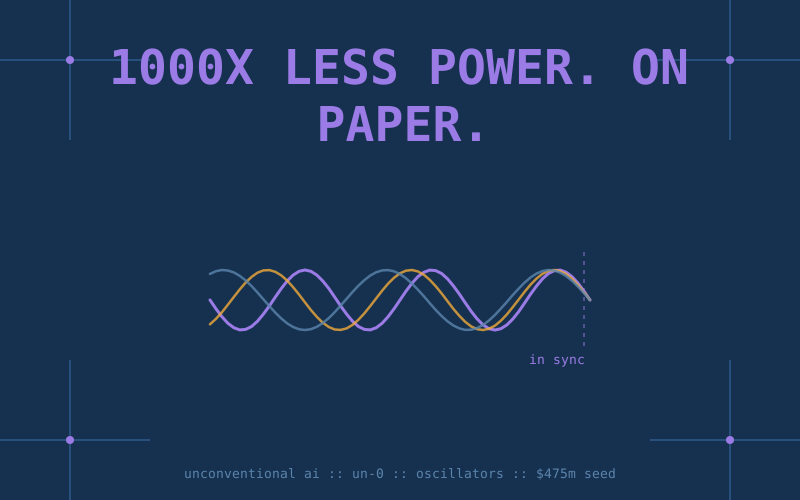
This is the part that breaks most people's mental model, so here is the analogy. Put a row of cheap wind-up metronomes on a wobbly shared shelf and start them all ticking out of step. Within a minute, the tiny vibrations they pass through the shelf nudge them into lockstep, and they all tick in unison. Nobody told them to; the physics of coupled oscillators just relaxes toward a synchronized state. Fireflies flashing together and pendulum clocks on the same wall do the same thing.
Unconventional AI's bet is that this settling is the computation. You encode a problem as the starting phases and couplings of a fabric of ring oscillators, let the network physically relax toward its low-energy synchronized configuration, and read the answer off the state it lands in. For a diffusion-style image model, that final settled pattern is the denoised image. No clock stepping through billions of binary operations, no shuttling data back and forth to memory, just a physical system falling into the shape of the answer. Rao calls Un-0 the "hello world of a new kind of computer."
Why this could matter: the energy math
The reason serious people are paying attention is power. A modern GPU spends most of its energy not on math but on moving bits around: fetching weights from memory, switching billions of transistors, fighting heat. An oscillator fabric does the work in the analog physics itself, which in principle sidesteps most of that overhead. Hence the 1,000x figure. AI's electricity appetite is the industry's least funny problem right now, so a credible 1,000x is the kind of number that makes a16z and Lightspeed reach for the checkbook.
The funding backs that up. Unconventional raised a $475 million seed in December 2025 at a $4.5 billion valuation, led by Lightspeed and Andreessen Horowitz, with Sequoia, Lux, DCVC, and Jeff Bezos along for the ride. Rao put in $10 million of his own money, and the whole company is fewer than 50 people. That is a seed round bigger than most companies' entire lifetime fundraising.
The catch you cannot skip
Un-0 works today only as a simulation of a chip nobody has fabricated. The 1,000x efficiency is a theoretical projection, not a measured result, and analog computing has a long graveyard of brilliant ideas that died on contact with real-world noise, manufacturing variation, and the sheer convenience of digital. Coupled oscillators are finicky: temperature, fabrication mismatch, and electrical noise all push them around, and "it relaxed into the right state in simulation" is a very different claim from "it does so reliably on silicon at scale." Unconventional says it will publish chip schematics soon and wants to build the entire inference stack itself and operate as a compute provider, which is a spectacularly ambitious to-do list for a sub-50-person startup.
Why builders should care anyway
Even if you never touch an oscillator chip, this is a signal worth reading. The smart money is now funding bets that the way out of AI's energy wall is not a better GPU but a different physics of computation entirely. Whether or not Un-0's specific approach ships, the category, analog and physics-based accelerators aimed squarely at inference, is heating up. Keep it on your radar, keep your weights portable, and do not rewrite your stack around a chip that currently exists only as a very expensive idea.
Key Takeaways
- Unconventional AI, founded by ex-Databricks AI chief Naveen Rao, released Un-0, an image model that computes with coupled ring oscillators instead of transistors.
- Oscillator computing encodes a problem and lets a physical network relax into a synchronized state that is the answer, skipping most of the data-movement energy a GPU burns.
- The claimed payoff is up to 1,000x lower power, but it is an aspirational projection: Un-0 runs only in software simulation of hardware that does not exist yet.
- It is backed by a $475M seed at a $4.5B valuation (Lightspeed, a16z, Sequoia, Lux, DCVC, Bezos) for a team under 50 people, on the strength of Rao's two prior exits.
- Treat it as a serious signal that analog and physics-based inference accelerators are coming, not as something to build on today.
Sources: The Next Web, TechCrunch, SiliconANGLE