A Reactor That Powered One Desktop PC Just Raised $1 Billion
TL;DR
On Monday, Valar Atomics closed a $1 billion Series B led by Sequoia Capital at a $6 billion valuation, plus a $200 million credit facility. Sequoia partner Shaun Maguire joins the board. The company's only operating reactor, Ward 250, is a 100 kilowatt thermal test unit that went critical in Utah on June 18 and, on July 1, produced the electricity that ran an Nvidia Blackwell desktop and served a website. The AI data center Valar and Nvidia have announced for the same site is 30 megawatts.
What actually exists today
Ward 250 is a Generation IV high-temperature gas reactor, helium-cooled and graphite-moderated, running TRISO fuel. Per POWER Magazine, it is rated at 100 kWt for initial testing, with the design intended to scale to about 5 MWe in a commercial unit.
TRISO is the part worth understanding. Each uranium kernel is wrapped in its own layers of carbon and silicon carbide, so the containment boundary is not the building, it is the fuel particle itself. Picture sealing every grain of rice in its own thermos before you put the pot on the stove: if the pot fails, the rice is still sealed. That is why these designs claim they cannot melt down in the way a light-water reactor can.
The reactor reached fueled criticality at roughly 4:30 p.m. MDT on June 18, 2026, at the Utah San Rafael Energy Lab outside Orangeville, in Emery County. It is the second advanced reactor to go critical under the Department of Energy's Reactor Pilot Program, after Antares Nuclear's Mark-0 on June 4, and the first DOE-authorized reactor built and operated outside the national laboratory system. That second distinction is the real one. A startup, not a national lab, put fuel in a core and turned it on.
Then came power ascension. The American Nuclear Society reported the unit at 10 kWt on June 22. Sources differ on where it sat by the July 1 demo, which is worth flagging: the Utah lab describes June 18 as full-power fueled criticality, POWER describes it as zero-power. The rated ceiling of the test unit, 100 kWt, is the number everyone agrees on, so that is the one to hold onto.
Thermal watts are not electric watts
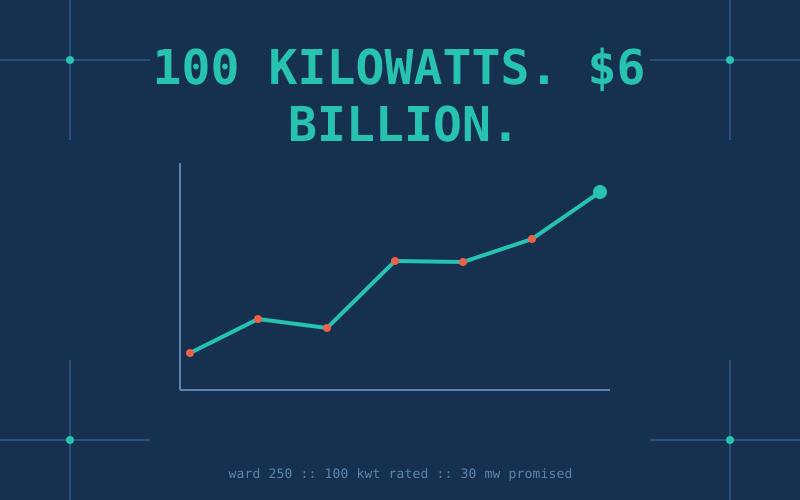
Reactors get rated in thermal output. Data centers get sized in electrical draw. A gas reactor converting heat to electricity does not do it for free, so 100 kWt is well under 100 kW of usable power at the rack. The 300x on the chart is therefore the friendly version of the number.
The Nvidia piece
On July 1, per the Deseret News, Valar connected Ward 250 to a Blackwell-architecture Nvidia desktop and used reactor-generated electricity to briefly host a website. It is the first website in history served on fission, and also, it must be said, the least impressive uptime story in hosting.
The same announcement laid out the actual plan: a 30 MW AI data center at the Utah site, built on Nvidia's DSX AI factory design with direct liquid cooling. Deseret reports the design holds coolant at about 113 degrees Fahrenheit, warm enough that you can reject heat without power-hungry chillers, which is where a conventional facility burns most of its water. Combined with helium cooling on the reactor side, the pitch is a data center that draws effectively no local water.
Why a compute person should care
The binding constraint on AI capacity right now is not chips or capital. It is interconnection. Getting a large load approved onto a transmission system is a multi-year queue in most of the United States, and utilities have started slowing walking it in the places where the queue is largest.
Behind-the-meter generation routes around that entirely. If your power plant sits inside the fence and never touches the transmission system, there is no queue to stand in. That is the whole reason a nuclear startup with a desktop-scale reactor can raise a billion dollars: investors are not buying today's 100 kilowatts, they are buying an option on a permitting shortcut.
Valar has been explicit that the endgame is not one reactor. CEO Isaiah Taylor, quoted by TNW, framed the whole thesis in one line: "One reactor can be built as a project. A fleet has to be manufactured." TechCrunch reports the company is targeting tens, then hundreds, then thousands of units a year. The company calls the clustered deployments gigasites.
The money
The $1 billion is equity. Alongside Sequoia, TechCrunch lists Apandion Capital, Atreides Management, Conviction, Dream Ventures, HOF Capital, Point72, Riot Ventures, Snowpoint Ventures and Valor Equity Partners. The $200 million credit line comes from Erebor and other banks. Valar's previous round, in March, was about $450 million at a $2 billion valuation, backed by Palmer Luckey and Palantir's Shyam Sankar. Before that, $130 million in 2025.
The caveats, stated plainly
None of this is licensed for commercial sale. DOE authorization under the Reactor Pilot Program is a research and demonstration pathway, not a Nuclear Regulatory Commission license. Deseret notes the NRC is trying to compress licensing reviews to under 18 months, which tells you what the current baseline looks like.
The 30 MW facility is announced, not built. Deseret's framing is that the two companies are exploring it. No small modular reactor operates commercially anywhere outside China and Russia, so there is no precedent for how fast a private fleet gets from a demonstration core to revenue.
And 5 MWe per commercial unit means a 30 MW site is roughly six units that do not exist yet, running a design whose largest built example so far tops out three orders of magnitude lower. Fission physics scales cleanly. Manufacturing, supply chains, fuel qualification and regulators do not.
What to watch
- Power ascension data on Ward 250. If the unit holds sustained output near its 100 kWt rating, the design works. If it stalls, the fleet math stops.
- Whether the Nvidia Utah facility converts from exploration to a signed build with a site plan and a date.
- The first NRC licensing application for a Valar commercial unit, and how long the review actually takes against that 18 month target.
- Whether any other hyperscaler follows Nvidia into behind-the-meter nuclear, which is the signal that the interconnection queue has become intolerable rather than merely annoying.
Key Takeaways
- Valar Atomics raised $1 billion led by Sequoia at a $6 billion valuation, tripling from $2 billion in five months, plus a $200 million credit facility.
- Ward 250 went critical June 18, 2026 in Emery County, Utah, the second reactor critical under the DOE Reactor Pilot Program and the first DOE-authorized reactor built and operated outside a national lab.
- The reactor is rated at 100 kilowatts thermal. The announced Nvidia AI data center at the same site is 30 megawatts.
- On July 1 the reactor's output ran an Nvidia Blackwell desktop and briefly served a website, the first commercial-adjacent use of the technology.
- The real product is not electricity, it is permitting: behind-the-meter generation skips the interconnection queue that is currently gating AI capacity.
- Nothing here is NRC-licensed for commercial power, and no SMR operates commercially outside China and Russia.
Sources: TechCrunch, TNW, POWER Magazine, American Nuclear Society, Deseret News, Utah San Rafael Energy Lab, Valar Atomics