They Give GPT and Claude Away Free. The Anime App Pays.
TL;DR
Korean consumer AI company Wrtn Technologies closed a Series C of roughly 100 billion won (about $72 million) at a valuation above 1 trillion won (about $722 million). The funding is the smaller half of the news. The bigger half is what Wrtn disclosed alongside it: OOC, an anime roleplay app it launched in North America in May, passed 10 billion won (about $7.2 million) in monthly revenue inside three months. Wrtn's flagship product, the thing the company is actually named after, hands out GPT, Claude, and Gemini access for free. The cartoons pay for the assistants.
The numbers Wrtn put on the table
Korean outlets covering the round list the same set of figures, and they line up across sources rather than coming from one press release repeated four times.
- Series C: about 100 billion won, roughly $72 million.
- Valuation: over 1 trillion won, roughly $722 million. The Korea Times calls Wrtn the first Korean AI service startup past that mark.
- Cumulative funding: about 230 billion won, roughly $166 million.
- Investors: Coreline Ventures and Eugene Asset Management are new. Goodwater Capital, Antler, Woori Venture Partners, and the Korea Development Bank returned.
- 2025 revenue: 47.1 billion won, about $34 million.
- 2026 guidance: over 200 billion won, about $145 million.
Hold those last two next to the OOC number and the shape of the business falls out. Ten billion won a month, annualized, is 120 billion won. One app, three months old, is running at roughly two and a half times what the entire company booked in all of 2025.
The free product is the funnel, not the business
Wrtn was founded in 2021 as a chatbot aggregator. Its flagship platform does the thing a thousand pitch decks promised: free access to frontier models from OpenAI, Anthropic, and Google in one Korean-language wrapper. It is a good product. It is not, by the company's own revenue breakdown, where the money comes from. Revenue comes from Crack, the character chat app Wrtn spun out as a standalone product in April 2025, and from OOC, its North American twin.
OOC is Crack with a different accent. Wrtn announced it on April 15 and branded it "The Playable Anime": you are the protagonist, the model runs the world like a dungeon master, and text, images, and audio get generated as the scene needs them. CEO Seyoung Lee's framing in the release is that "users aren't just chatting with a character, they are entering a narrative world where they are the protagonist."
Here is why that framing is a revenue strategy and not marketing. An assistant is a vending machine: you put a question in, you take an answer out, and you leave. A serialized story is a soap opera with a cliffhanger, and cliffhangers have never had trouble selling. Session length is the whole ballgame in consumer AI, because inference you pay for only becomes revenue if the user is still there an hour later.
Korea worked out consumer AI monetization first
Wrtn is not an outlier in its home market, which is the part worth paying attention to. In June, Scatter Lab raised about 50 billion won from Atinum Investment, SBVA, and Mirae Asset Venture Investment on the back of Zeta, its own character chat app. The Seoul Economic Daily reported Zeta at roughly 6 million registered users and 1.4 million monthly actives as of May 2026, with about 750,000 weekly users in Japan averaging around four hours a day. In April, Zeta briefly passed Netflix to top Japan's entertainment category by total usage time.
That same report contains the sentence every consumer AI founder should read twice: many services built on generative models are emerging, but apart from AI character chat, almost none are generating revenue.
Crack, for comparison, sat at 550,000 monthly actives in Korea in May 2026, more than double a year earlier. Wrtn's edge is not domestic scale against Zeta. It is that Wrtn shipped the same mechanic in English first and got paid for it.
What a builder should take from this
The uncomfortable read: the highest-margin consumer AI product category in 2026 is not a copilot, a search wrapper, or an agent. It is entertainment with a per-session cost you can meter. Wrtn had the assistant. It built the assistant first, in fact, and gave it away.
Three things travel out of this story regardless of whether you want to build a roleplay app:
- Free frontier-model access is a commodity, and priced accordingly. Wrtn gives away GPT, Claude, and Gemini and books revenue elsewhere. If your product's differentiator is routing to good models, you are running a loss leader whether you meant to or not.
- Geography is a real moat for a while. Crack won Korea, Kyarapu ran in Japan, and OOC took the same mechanic to English speakers who did not have a localized equivalent. Fortune reported in March that Wrtn was past 5 million monthly actives across Korea and Japan and on track to clear $100 million ARR, before OOC existed.
- Overseas revenue passed domestic. Wrtn now says international sales exceed Korean sales. For a five-year-old Korean consumer app, that is the number that makes a 2028 IPO plausible instead of aspirational.
The part that is not in the funding announcement
Roughly 10 percent of Crack's users are teenagers, and Wrtn is now weighing usage-time limits, stronger parental consent, and lower spending caps for younger accounts. In July it stood up a user committee including ethics and philosophy specialists and began working with the Korea Internet Self-Governance Organization on chatbot guidelines.
Read that as a business risk line, not a corporate values line. A monetization model built on emotionally engaging serialized fiction, sold by the credit, to an audience that skews young, is exactly the model regulators in several jurisdictions are currently drafting rules about. The 1 trillion won valuation is priced on that risk not landing.
Caveats worth keeping
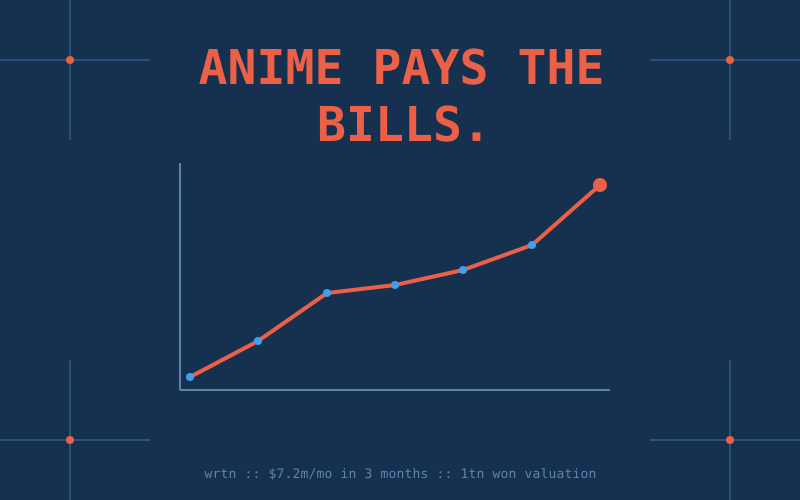
The 200 billion won 2026 figure is company guidance, not an audited result, and guidance issued in the same week as a funding round has a known direction of bias. The 10 billion won monthly number is disclosed revenue with no stated breakdown between gross app-store billings and net receipts, which is a meaningful gap in a business collecting through iOS and Android. And the 120 billion won annualized figure in the chart above is our arithmetic on Wrtn's monthly disclosure, not a company projection. Three-month-old apps do not always hold their run rate.
Key Takeaways
- Wrtn Technologies raised about 100 billion won ($72 million) at over 1 trillion won ($722 million), reportedly the first Korean AI service startup at that valuation.
- OOC, its North American anime roleplay app, cleared 10 billion won (about $7.2 million) in monthly revenue within three months of its May launch.
- Wrtn's revenue runs 47.1 billion won in 2025 to guided 200 billion won-plus in 2026, and overseas sales now exceed domestic.
- The flagship free portal bundling GPT, Claude, and Gemini is the acquisition channel; character chat is the business.
- Rival Scatter Lab raised about 50 billion won in June on Zeta, which reached 1.4 million monthly actives and briefly outranked Netflix by usage time in Japan.
- Teenagers are about 10 percent of Crack's users, and the spending limits Wrtn is now weighing sit directly on top of the revenue line.
Sources: The Korea Times, International Business Times, Seoul Economic Daily, Fortune, Wrtn OOC launch release, OOC, Crack