The $3 Trillion AI Bill Buried in Big Tech's Footnotes
TL;DR
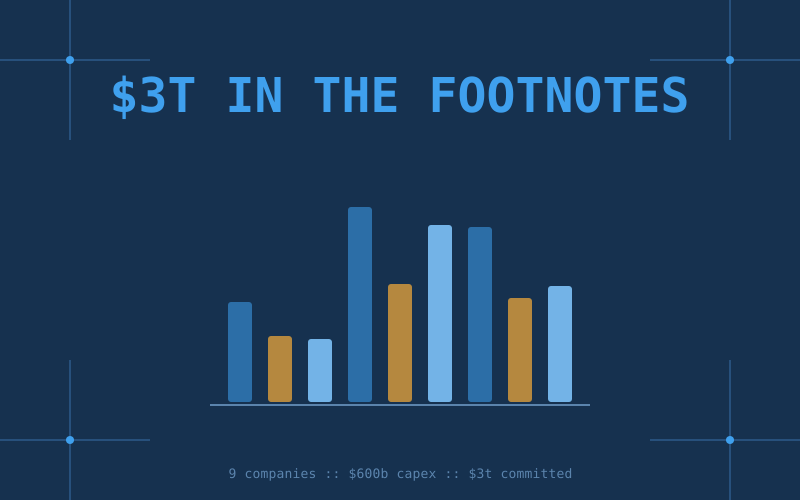
A new Wall Street Journal analysis of SEC filings finds that nine companies at the center of the AI buildout are carrying roughly $3 trillion in AI-related spending commitments that have not yet appeared on their balance sheets. That is about five times the roughly $600 billion in capital expenditures the same companies reported over the past year. The pile splits into about $1.2 trillion in leases on facilities that have not started operating and $1.9 trillion in purchase commitments for chips, equipment, energy, and services. All of it is disclosed. All of it is legal. Almost none of it shows up in the headline numbers everyone has been arguing about.
The number under the number
The Journal went through the filings of nine companies: Alphabet, Amazon, Meta, Microsoft, Oracle, Nvidia, Broadcom, AMD, and SpaceX. It tallied two categories of future obligations that live in filing footnotes rather than on the balance sheet: leases already signed for data centers that have not begun operating, and contractual commitments to buy chips, equipment, energy, and other services.
The first bucket comes to about $1.2 trillion. The second comes to about $1.9 trillion. Together, roughly $3 trillion in committed future spending, sitting next to about $600 billion of capex the same companies actually reported over the preceding year.
Reported capex is the number that has fueled a year of bubble discourse. The Journal's point is that it is the trailer, not the movie: the contractual pipeline behind it is several times larger, and it is growing quarter over quarter at a pace the income statement does not hint at.
How $3 trillion stays off the balance sheet
None of this is hidden in the Enron sense. Under current accounting rules, a lease does not land on the balance sheet as a liability until the leased asset is available for use. Sign a 15-year lease on a data center campus that is still being built, and the obligation waits in a footnote until the day the servers can move in. Purchase commitments, such as multi-year contracts for chips, power, and equipment, get the same treatment: disclosed as "purchase obligations" in the fine print, recognized only as the goods and services are delivered.
Think of it like signing a lease on an apartment in a building that is still a hole in the ground. The rent is real, the contract is binding, and your future is spoken for, but nothing shows up on your credit report until you get the keys. Big Tech has signed for a very large number of unfinished buildings.
Bloomberg Tax has already run the inevitable piece comparing the structures to the accounting devices that toppled Enron. The comparison is colorful but imprecise: Enron concealed its obligations from investors, while Big Tech publishes them in SEC filings, in a very patient font. The problem is not concealment. It is that almost nobody reads that far.
Alphabet added $479 billion of obligations in one quarter
The single starkest number in the analysis belongs to Alphabet: $811 billion in purchase and contractual obligations, up from $332 billion just three months earlier. Bloomberg flagged the jump when the filing landed in July. That is $479 billion in new committed future spending added in a single quarter, mostly long-term supply agreements and purchase orders for compute infrastructure.
Meta is the lease-side standout, with $347 billion in future lease commitments disclosed. And the trend line was already visible before the Journal widened the lens: a July tally based on Nikkei Asia reporting put five hyperscalers at $1.65 trillion in off-balance-sheet obligations, already more than the roughly $1.35 trillion of actual debt on their balance sheets. The Journal's $3 trillion figure adds the chip suppliers and SpaceX to the frame.
If you build on this compute
You are not going to trade Alphabet stock off this post, but the $3 trillion has direct consequences for anyone whose product sits on top of cloud GPUs and API tokens.
- Capacity is pre-funded. These commitments are locked-in future supply of chips, data centers, and power. Whatever quarterly sentiment does, the buildout through the late 2020s is contractually spoken for. Compute scarcity easing is a when, not an if.
- The bill comes due either way. If AI revenue keeps compounding, the commitments look prescient. If it disappoints, the obligations do not vanish; they show up as pressure to monetize harder, through enterprise pricing, ads, and consumption commitments, or as writedowns. Either way, the people paying for this are eventually the people buying tokens.
- Watch footnotes, not keynotes. The genuinely informative capex signal has moved from earnings-call soundbites to the purchase-obligation and lease footnotes. Alphabet's one-quarter delta was disclosed weeks before it became a headline. The filings are free, and apparently nearly private.
The caveats
Three things keep this from being a doom number. First, the comparison is multi-year against single-year: the $3 trillion spans many years of future payments, while the $600 billion of capex covers one. It is a statement about scale and trajectory, not about next year's cash flow. Second, the company sets differ across the circulating tallies: $1.65 trillion covers five hyperscalers, while $3 trillion covers nine companies including Nvidia, Broadcom, AMD, and SpaceX, so do not graft one trend line onto the other. Third, everything here is disclosed and compliant. "Off-balance-sheet" describes accounting geography, not wrongdoing.
Key Takeaways
- A Wall Street Journal analysis finds nine major tech companies hold roughly $3 trillion in AI-related commitments not yet on their balance sheets, versus about $600 billion in reported capex over the past year.
- The total splits into about $1.2 trillion in leases on facilities not yet operating and $1.9 trillion in purchase commitments for chips, equipment, energy, and services.
- Alphabet disclosed $811 billion in purchase and contractual obligations, up from $332 billion three months earlier; Meta disclosed $347 billion in future lease commitments.
- Accounting rules keep unstarted leases and purchase obligations in filing footnotes until assets are in use, so headline debt and capex figures understate the real committed spend.
- For builders, the commitments mean compute supply keeps arriving pre-funded, but the financing pressure behind it will eventually surface in token and cloud pricing, one way or the other.
Sources: The Wall Street Journal, Bloomberg, The Next Web, Bloomberg Tax